Now Reading: BridgePort CEO Nirup Ramalingam on Crypto’s Institutional Shift
-
01
BridgePort CEO Nirup Ramalingam on Crypto’s Institutional Shift


Consensus Hong Kong 2026 felt fundamentally different; the relentless shill talks were noticeably absent. There was a refreshing effort to bring the mic back to projects and individuals solving actual problems.
It was evident that the Web3 industry has matured tremendously over the last few years. Institutions are no longer just observing from the sidelines; they are actively driving the conversation and shaping the market’s future.
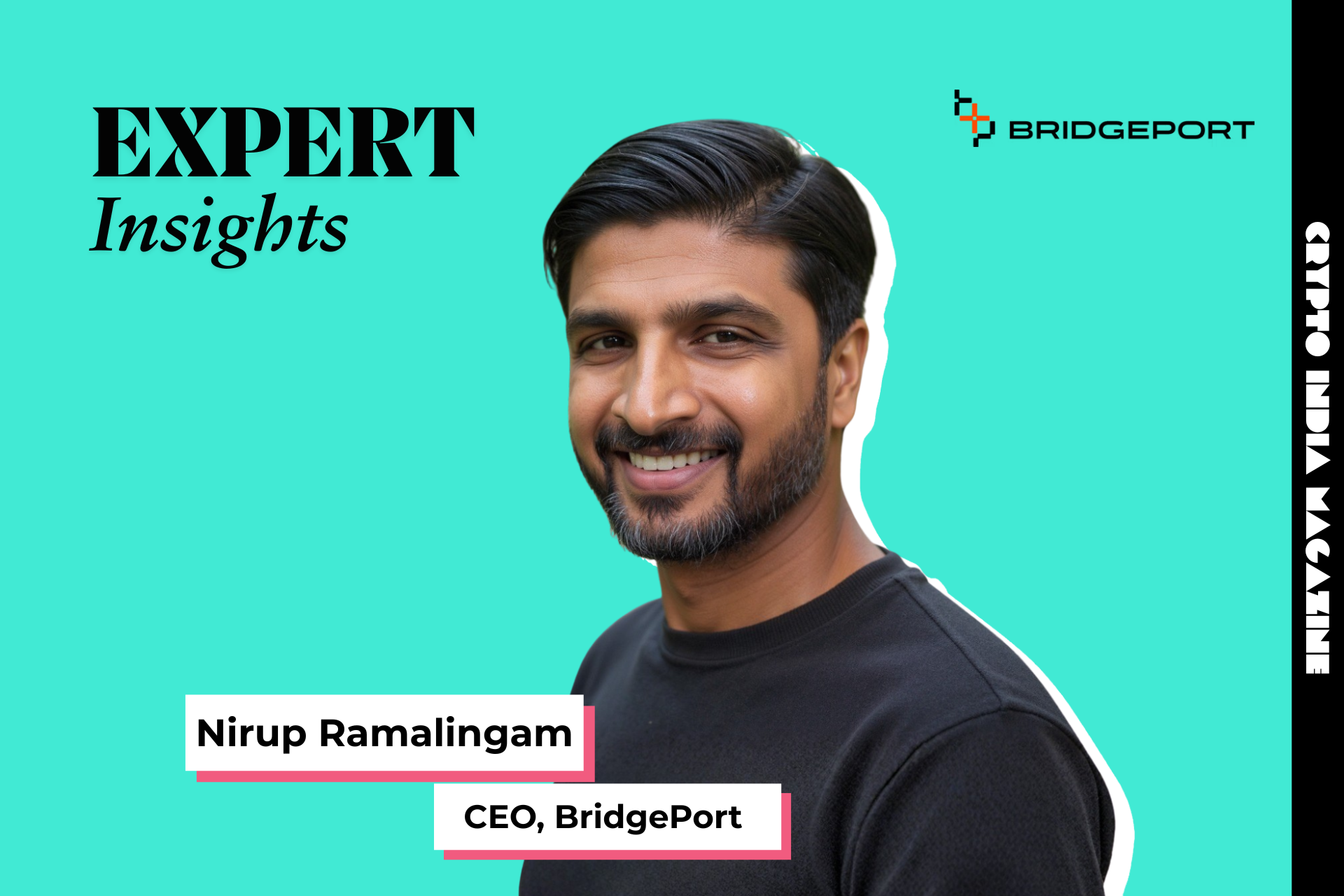
We wanted to understand more about what is truly happening and where the current focus lies. And to get a clearer picture, we sat down with Nirup Ramalingam, CEO of BridgePort.
In this exclusive interview, Ramalingam spoke about his transition from traditional finance (TradFi) to Web3. He also shed light on the crucial need for institutional-grade interoperability between exchanges and custodians, and why the next wave of capital relies on robust infrastructure rather than fleeting market hype.
Building the Missing Institutional Layer
Ramalingam built his career on the established trading desks of traditional finance before transitioning into cryptocurrency infrastructure. With a background in fixed income and foreign exchange (FX) derivatives, culminating in a position at Chicago Mercantile Exchange (CME), he had a clear view of how mature markets operate and scale.
The idea for BridgePort was shaped in 2018, when Bitcoin was nearing $20,000, and institutional interest was building rapidly. Ramalingam and his co-founders launched a spot crypto exchange designed for banks and hedge funds seeking to hedge client exposure. What they encountered instead was a structural bottleneck. Integrating with Fidelity as a custodian took nearly a year, and the framework forced every trading firm into a single custodial relationship regardless of preference.
This experience exposed a critical flaw that forced trading firms into a restrictive, single-custodian model. Realizing that a multi-custodial approach was essential, Ramalingam recognized the logistical nightmare it presented. “So each exchange connecting to each custodian, and doing that n times is not something that any one exchange or custodian wants to go through,” he explained.
To solve this, he launched BridgePort, a fintech infrastructure company focused on institutional crypto trading. BridgePort connects exchanges and custodians through a middleware layer. It allows trading firms to hold assets with their chosen custodians while allocating credit across multiple exchanges for execution.
Building BridgePort required a significant professional leap. When asked if he felt he had traded the stability of CME to build infrastructure in crypto, Ramalingam was candid about the shift and did not romanticize it.
“I do not have any regrets. Although I do question my motives when I am up at like three in the morning taking a call when I would rather be in bed. But it is exciting,” he said. “Building a startup is not for the faint of heart. It is a lot of effort. And we wear multiple hats.”
He also acknowledged that he left behind the safety net of established teams. However, he stated that the decision was driven by what he saw as a structural necessity for the industry. “I knew if crypto was to scale, that someone had to tackle this problem. The problem being interoperability between exchanges and custodians,” Ramalingam noted.
Middleware, Clearing, and the Architecture of Trust
Drawing a parallel between the current cryptocurrency landscape and the nascent FX market reveals a striking historical rhyme. Although the early days of FX predated Ramalingam’s career, the inherited war stories from veteran traders deeply inform his perspective on market evolution.
Foundational markets spent decades wrestling with existential threats like counterparty and settlement risks, often learning through systemic shocks such as the infamous 1974 Herstatt Bank collapse.
Cryptocurrency is currently navigating a remarkably similar crucible. It is forcing builders to prioritize deterministic execution and the absolute safety of user funds. To successfully attract traditional asset managers and banks, the ecosystem must establish robust operational processes that eliminate ambiguity.
“And this middleware we’re building in BridgePort is also a page out of what happened in FX, fixed income, equities, right?” Ramalingam explained.
This ongoing maturation directly addresses the primary concern of global regulators, which fundamentally revolves around robust investor protection and preventing market manipulation. Emerging regulatory frameworks, such as the MiCA regulation in the European Union and new guidelines in Hong Kong, are finally providing necessary clarity and structural tailwinds.
By establishing clear market rules where every trading participant understands their specific role, the industry is moving past its chaotic origins. “But if the intent is there to want to regulate these markets, as opposed to just regulate by enforcement, which is what happened in the US for a long time, then I think that gives faith in the market to want to invest in this asset class,” he noted.
Capital Follows Structure
In April 2025, the global FX market hit over over $9 trillion in daily trading volume. However, for digital assets, the underlying objective is not necessarily to overtake traditional systems. Instead, the focus is shifting toward integrating digital assets seamlessly into the existing financial fabric to solve actual operational problems.
“And now crypto is trying to, I wouldn’t say supplant FX, but rather park itself alongside it with stablecoin payments and park itself around next to equities with tokenization and fixed income as well with tokenization,” Ramalingam explained.
When predicting which TradFi entities might fully commit to digital assets next, Ramalingam shifts the focus away from the obvious names and toward structural readiness. Major clearinghouses like the London Stock Exchange (LSE) Group, the New York Stock Exchange (NYSE), and the CME have certainly made recent pushes into tokenization.
Yet, his primary interest lies in the eventual arrival of asset managers and hedge funds. He remains remarkably pragmatic about the timeline for this institutional migration. The real catalyst, he argues, will not be a sudden influx of capital from massive brands, but the establishment of banking and prime brokerage services to support those asset managers.
“I think we still need the infrastructure I’m talking about to be in place for them to, but they’re curious. They’re crypto curious,” he observed. Once that essential operational foundation is laid and one major player successfully makes headway, he anticipates the rest of the traditional financial world will inevitably follow.
Where Crypto Must Refocus
As backend infrastructure advances toward institutional readiness, the broader public still questions crypto’s relevance. Ramalingam argues the industry weakens its impact by competing for attention, right now with artificial intelligence (AI), and trying to be everything at once.
Instead of chasing fragmented narratives, he argues the industry must focus on its core strengths: trading, stablecoin utility, and tokenization. Ramalingam also emphasised the fact that foundational financial systems do not measure success by public hype. “For instance, in the big FX conference, they’re not sitting around going, do we have the attention of the masses?” he remarked.
By prioritizing robust infrastructure over speculative assets, digital currencies can achieve quiet ubiquity. The ultimate goal is for the technology to become a seamless, invisible utility rather than a daily headline.
“So I think at best, we shouldn’t aim, at least my opinion is, we shouldn’t aim for crypto to take center stage, rather be baked into existing products so the user doesn’t even know that they’re trading crypto or using crypto,” he concluded.
Editorial Note: This article is based on an interview with Nirup Ramalingam, CEO of BridgePort. Certain parts have been adapted into a narrative format for readability, but his perspectives and insights remain presented as originally expressed.
Interested in advertising with CIM? Talk to us!