Now Reading: Tanisha Katara is Redesigning the Way Web3 Governs Itself
-
01
Tanisha Katara is Redesigning the Way Web3 Governs Itself

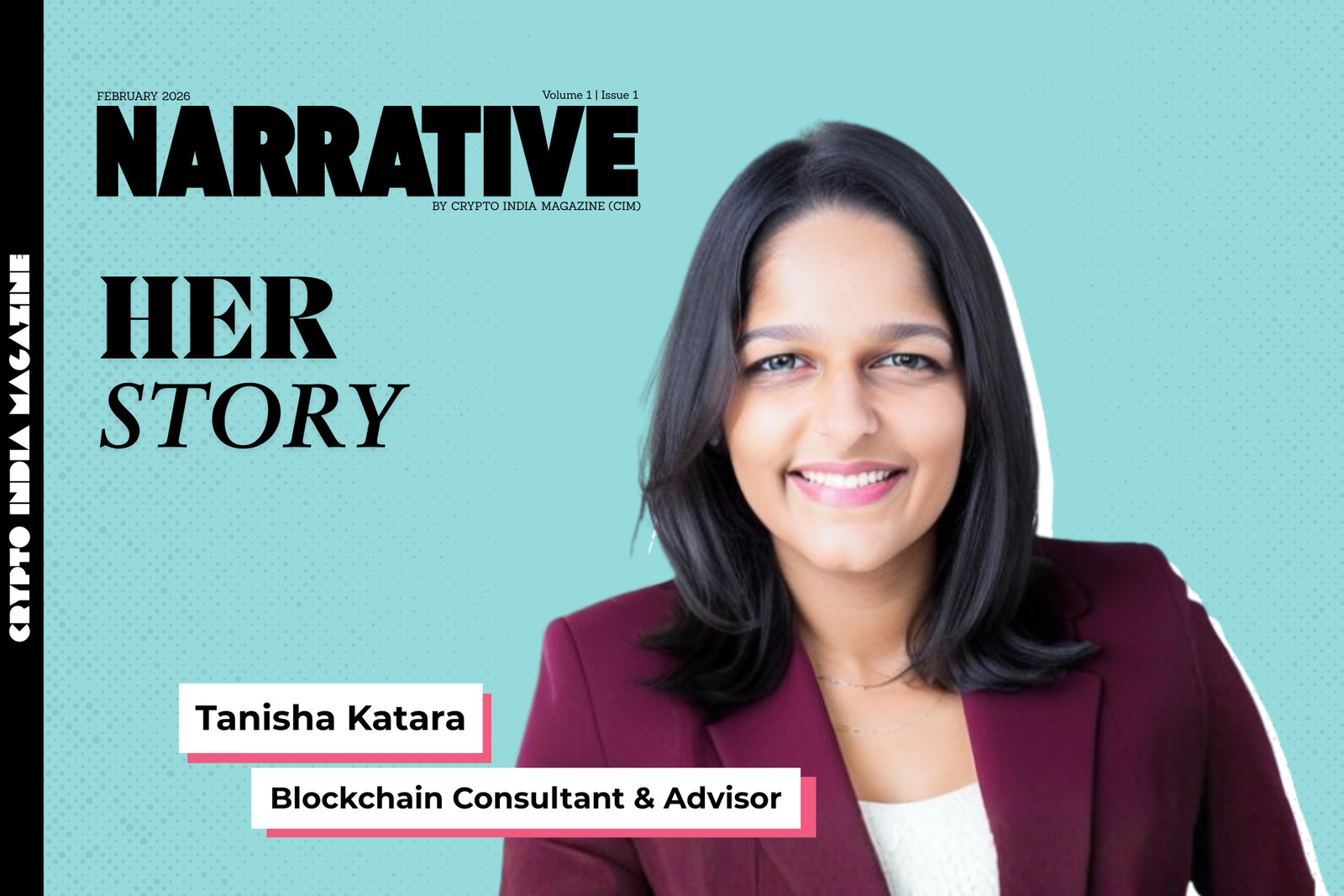

“My entry into blockchain governance wasn’t ideological. It was survival,” says Tanisha Katara, an independent blockchain consultant and governance researcher who has consulted some of the influential projects across the ecosystem, including Polygon, Filecoin, Avail, Mina (with Aragon), and more.
Tanisha did not arrive in Web3 through conviction or belief. She arrived burned out, depressed, and searching for work that didn’t leave her feeling hollow. After six months of struggling, a friend connected her to a strategy role at a neobank called Juno Finance, later OnJuno.
When the company pivoted into crypto, she was unconvinced. She spent her days in a WeWork in Bangalore, writing investor decks and regulatory memos for a system she distrusted. Blockchain, at the time, felt cultish and inefficient. “Why would anyone pay gas fees just to move data on-chain?” she remembers thinking.
The shift didn’t come through ideology; rather, through exposure. A colleague pulled the team into experimenting with NFTs, casually, without evangelism. That small act cracked open a deeper curiosity. Tanisha began paying attention not to tokens or price, but to the ideas underneath: decentralization, coordination, and alternative ways to organize decision-making.
“From there, things moved quickly. Investors began sending me portfolio companies, I started consulting on DAO tooling, onboarded more than a hundred DAOs, and eventually, Polygon brought me on as a consultant,” says Tanisha. “I thought I’d stay a generalist. Strategy, operations, a bit of everything. Instead, I kept being handed governance problems.”
What started as skepticism became inquiry. And inside that inquiry, she found governance as a practical set of tools for making systems work better.
“In my search for survival, I found skepticism,” she says. “In the skepticism, I found solutions.”
Speaking Up, Walking Away, and Building Anyway
Following is an excerpt from our conversation with Tanisha. Let’s learn about the decisions, tradeoffs, and thinking that shape her work, in her own words.
CIM: What does it take to build a consulting practice almost entirely through word-of-mouth in Web3?
TK: It takes courage. Often, ruthless courage.
Not long ago, I was in discussions with a large potential client who wanted to integrate an oracle, a bridge between on-chain and off-chain systems, that raised serious red flags for me. The dependencies hadn’t been properly audited, and in an industry already scarred by repeated exploits, the risk felt unacceptable. I flagged the issue immediately.
The client was under pressure to launch and asked me to come on board anyway, effectively sidelining the concern. It was a significant opportunity. Real money, real visibility. But I walked away. I can understand time pressure. I can’t justify exposing users’ funds to avoidable risk.
That moment wasn’t unique. I’ve encountered that crossroads more than once. Building a practice on referrals means doing more than delivering competent work. It means raising uncomfortable truths, questioning decisions others want to rush past, and knowing when to ask for guidance from people more experienced than you. Each time, it forces the same question: what do I stand for, and how much am I willing to trade away to keep growing?
CIM: As a woman building authority in a deeply technical and male-dominated field, what helped you stay confident early on?
TK: I’ve never experienced authority in this field as a matter of gendered voices, only as a matter of scarcity. There are far fewer women in the room, but the standards are the same.
My confidence didn’t come from certainty. It came from fear. The fear of being overlooked or unheard. I learned early that no one would advocate for my ideas unless I did so myself. That understanding forced me to speak clearly, stand behind my work, and claim space before it was offered. And it’s something I would encourage other young professionals to do early on.
CIM: How do you approach working across a wide range of clients without losing clarity or conviction?
TK: I lose clarity sometimes. That’s the truth. When you’re switching between a government compliance framework on Monday and a DAO treasury design on Friday, your brain gets noisy.
But I’ve stopped seeing that as a weakness. Last week, I was designing a fee model for a client. I was able to think holistically about it. I jumped to governance: who gets to alter this formula and how? Then, to interface: how do users actually see what they’re paying? Then to the treasury: where does this value accrue, and what unlocks it? Three steps ahead, all because I’d been thinking about adjacent problems for other clients that same week.
That’s what working at range does. A regulation I read for one project becomes a design constraint I flag for another. A governance failure I witnessed somewhere becomes a warning I raise somewhere else. Nothing I learn stays siloed.
CIM: What patterns do you keep seeing in governance systems that don’t work as intended?
TK: Governance, in its current form, feels dead. And I don’t say that lightly.
Many protocols copy existing, conventional voting models without real incentive design or system thinking. Participation drops, governance becomes a chore, teams get cut during market downturns, and power often shifts back to foundations when communities push back. And the cycle repeats.
This is why I focus on redesign rather than small fixes. If governance actually worked, tokenholders would stay engaged, contributors would gain real opportunities, and treasuries would support talent instead of insiders. That’s why I’ve been exploring governance through AI and human jury models, prediction markets, and yield-bearing governance.
Another issue is decentralization at the node level. Research I presented at EthCC Cannes last year showed that across many networks, 10% to 20% of nodes receive 80% to 90% of rewards. We talk about decentralization like it’s a fact, but the numbers say we’ve rebuilt the same concentration of wealth that we were trying to escape. That’s what pushed me toward validator reputation scoring and redesigning the incentive structures underneath the nodes themselves.
CIM: How do you think about value accrual and tokenomics in Web3, and why do you believe it’s still so poorly understood?
TK: Most projects today don’t even need a token. It’s important to find product-market fit before launching a token in haste. Too many teams treat the token as a fundraising mechanism to get the pump and worry about utility later. Maybe it works short-term, but it ruins long-term reputation. You’ve mortgaged your credibility for a liquidity event.
If you’re going to launch a token, do it right. Link it to a core utility that has commercial viability. Until you can do that, you don’t need one at all.
I learned this the hard way. Reading whitepapers obsessively, writing to protocols with clarification questions, going back to economics textbooks to see what I was missing, studying the exposure these tokens actually had. It took time to see past the price charts. But once you do, you can’t unsee how many tokens exist purely because someone needed to raise money and not because the product needed a token.
CIM: What excites you most about the research side of your work, especially when theory meets real-world systems?
TK: Honestly, what excites me is watching an idea survive contact with reality.
Paper is forgiving. Models behave. Simulations do exactly what you instruct them to do. The real test comes when those assumptions leave the spreadsheet and enter a live system.
Mina’s treasury was one of those moments. I ran simulations, shared recommendations, and watched the foundation implement them successfully. That shift from theory to execution was deeply rewarding.
Polygon was another example. The validator admission framework that I designed for them moved onboarding toward a more merit-based system. Once it went live, the data showed stronger performance from validators selected through the new process.
CIM: How has your role at Polygon influenced the way you think about governance at scale?
TK: Polygon definitely played a key role in exposing me to Governance. Polygon taught me that governance is not one-size-fits-all. Most tooling companies don’t understand this, and they sell templates when every protocol needs something stitched to its own shape.
I learned that foundations and communities must balance power proactively early, rather than later. And I stopped believing in “progressive decentralization” the way a16z frames it. It’s not progressive. It’s slow. It stays fixed for a long time until a crisis demands change. Nobody decentralizes gradually out of principle. They decentralize when they have to.
At Polygon, we launched the Governance Hub and designed a tokenholder governance system. During the process, we watched how decisions actually get made at scale. The lesson that stuck: governance at scale is more careful and more human than any framework wants to admit.
CIM: How did working independently shape the way you think about credibility, trust, and long-term impact in this industry?
TK: It taught me that credibility and trust are a two-way street. The dynamic with a client becomes more personal, more aligned, more visible. There’s clear attribution and shared goals. You succeed together, or you fail together.
In reality, my path has never been truly solo. I’ve been supported by generous leaders and friends who were willing to stand behind my work publicly. Investors trusted me with their early-stage portfolio companies; those founders spoke to others, and referrals followed. Most of my work has come through word of mouth.
Independence, though, is demanding. You have to read constantly, think rigorously, and be comfortable saying “I don’t know” when you don’t. It forces intellectual honesty. Over time, you also realise that for this industry to mature, it can’t be zero-sum. My clients now partner with each other, share lessons, and build together. Facilitating those connections is the part of the work I value most.
Staying With the Work
When Tanisha thinks about the future of decentralized systems or the broader Web3 domain, she does not frame it as a destination. “Reaching a genuinely decentralized world will be a long and difficult process,” she says. “I don’t hold romantic illusions about that.”
That realism comes from what she sees at stake when governance fails in practice. Governance systems that do not work do not remain neutral. They centralize power again, and this time behind technical language and new interfaces.
“The cost of failing is not abstract,” she says. “It is a future where financial agency and collective decision-making remain concentrated in the hands of a small group of corporations, individuals, or ideologies. We didn’t build decentralized systems to reproduce the same power structures under a different technical wrapper.”
Because of that risk, she does not argue for a single fix; rather, in her view, no single framework will hold across systems, cultures, or scale.
“I don’t pretend to know the single solution,” she says. “It may involve AI-assisted governance, prediction markets, reputation systems, or mechanisms we haven’t yet imagined. More likely, it will be a combination.”
What remains consistent, though, is her own response to that uncertainty. “I keep showing up,” she concludes. “I keep interrogating assumptions, publishing research, and testing ideas against reality, with the hope that some of them endure and meaningfully shift how these systems are designed and governed.”
Tanisha’s research and ongoing work on decentralized governance can be found at tanishakatara.com.