Now Reading: Power, Public Opinion, and Web3: How Laura Estefania Thinks About Communication and Leadership
-
01
Power, Public Opinion, and Web3: How Laura Estefania Thinks About Communication and Leadership

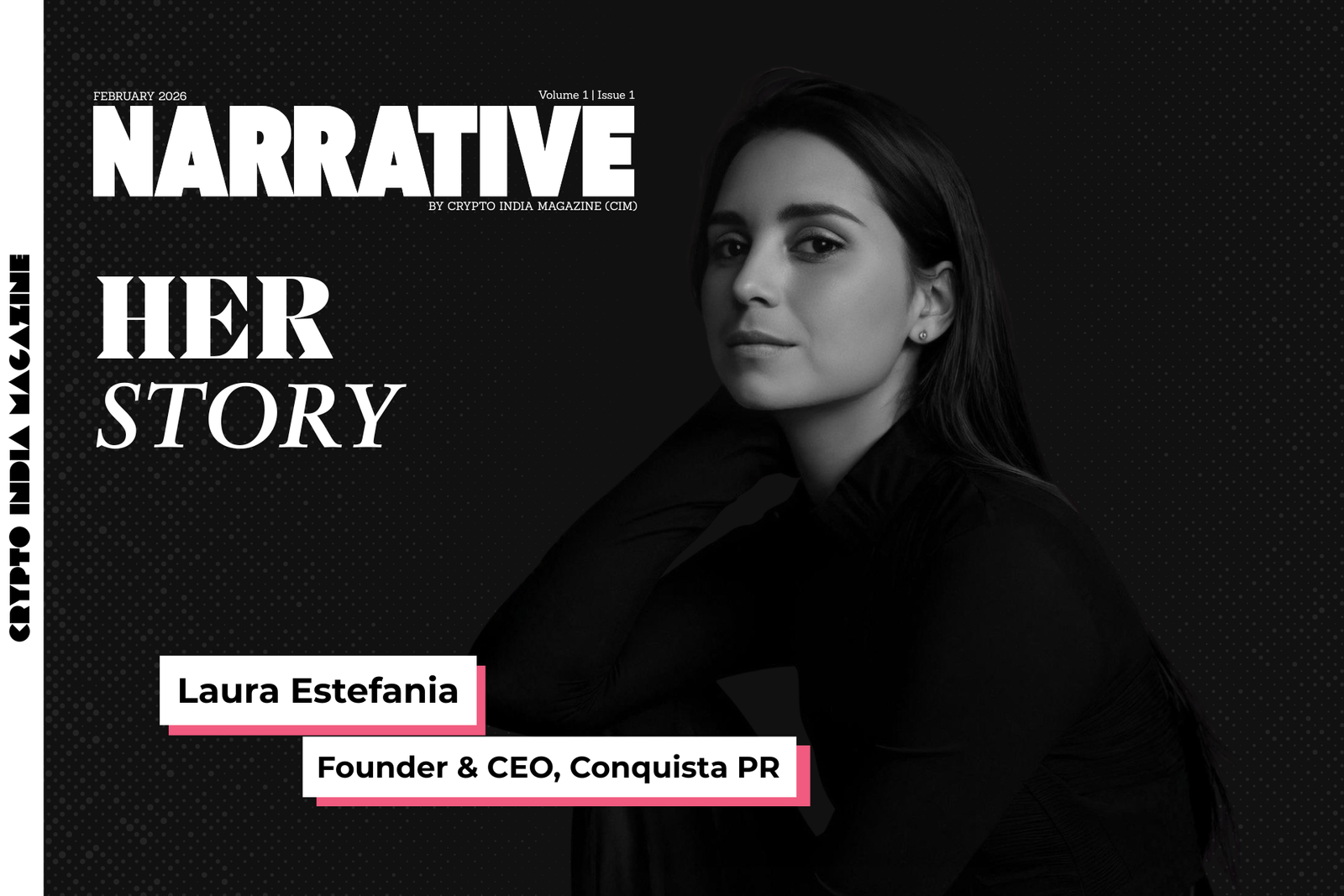

It’s not news that Web3 has matured significantly into an ecosystem where technology, capital, regulation, and public opinion intersect. Yet, much of the public conversation around the space continues to be driven by a narrow set of voices.
Laura Estefania, Founder and CEO of Conquista PR, wanted to change this and entered the industry with a different foundation. Rather than focusing the industry on technical or market-related perspectives, she focuses instead on the construction of narratives and public behavior.
One framework that continues to guide her thinking comes from Noelle Neumann’s theory of solid, liquid, and gaseous public opinion. As Laura explains, “solid opinions are deeply rooted and rarely questioned, liquid opinions are dominant but open to influence and debate, and gaseous opinions are volatile, fragmented, and highly reactive to events.”
In this HER Story, we spoke with Laura extensively. She shed light on her mindset, her journey, and the thinking that shapes her work, and explained how she is building Conquista PR with purpose, depth, and substance, far beyond the noise of hype.
Language, Culture and the Search for Alignment
While Laura is now a fixture in the fast-moving world of Web3, her origins were rooted in a different kind of global influence. From early on, she was driven by a desire to tackle socio-economic challenges. While the ambition has remained constant, the route has shifted from international relations and public institutions. She’s now focused on the private sector, where the impact is felt more directly.
Fluent in more than five languages and fascinated by how language shapes culture and thinking, she originally envisioned a career in diplomacy, dreaming of working with institutions like the IMF or the World Bank to tackle global socio-economic challenges.
“I will always say that I am an entrepreneur by default and not by design,” she notes. “The reality is that a policy career would have suited me perfectly. I am always keen on knowing how language shapes culture and thinking.”
As she moved through her education and early career, she recognized that legacy structures were shifting. She saw that media formats were evolving rapidly and consumption habits were changing at the speed of light. Rather than clinging to traditional policy paths, she sought a role that aligned with her specific strengths.
She found this alignment in the Japanese concept of Ikigai—a “reason for being” that marks the intersection of what you love, what you are good at, what the world needs, and what you can be paid for. For Laura, that intersection was not found in a government office, but in the combination of communications, languages, and people.
Building a Communications Firm with Purpose
With that clarity of purpose established, Conquista PR emerged less as a calculated business move and more as a natural progression. After starting in traditional finance communications and experimenting with entrepreneurship, including launching a sports clothing brand, she began to narrow her focus toward building something that genuinely reflected her strengths and long-term direction.
“It was less of a choice and more of a natural progression, to be honest,” she says. And over time, that clarity became more concrete. “In my case, it was communications, languages, and people.”
Additionally, Web3 and emerging technology offered exactly the kind of environment Laura was drawn to. It was fast-moving, intellectually demanding, and filled with people building across disciplines, from engineering and economics to infrastructure and policy. That density of talent and constant learning curve mattered to her.
“If you are the smartest person in the room, you are in the wrong room,” Laura explains.
Building Conquista PR, however, came with its own lessons. She was pushed through the less visible side of entrepreneurship, the kind that involves repetition, setbacks, and long stretches of work without applause. “You need a team. To be humble, to be consistent. To fall seven times and be ready to stand up eight,” she says. Over time, she also realized that strong work does not automatically translate into recognition. Trust and reputation, she learned, are built through delivery rather than promises.
Today, Conquista PR is one of the well-known and credible players in the industry. It operates with a deliberate, long-term lens. Laura carefully vets partners based on leadership and fundamentals, supporting both established entities and high-potential “hidden gems” that deserve greater visibility.
Excerpts from the Interview: What Leadership Really Looks Like
CIM: What kinds of mistakes do Web3 companies most often make when it comes to communication and public perception?
LE: They want to run before they can walk. I am a big believer in the bigger mission of a company and the gap they want to close, but founders’ tunnel vision often clouds their immediate surroundings. They must plan their partners and GTM strategies before they launch.
In terms of perception, as marketing professionals Al Ries and Jack Trout put it, “Marketing is a battle of perceptions, not products.” What users believe about a brand is often more influential than the product’s actual features, emphasizing the importance of creating a strong mental position to compete effectively. This holds true in today’s landscape, where many teams assume that a good product alone will drive immediate adoption and traction.
On top of that, there is significant noise in the Web3 marketing space, and advertisers face intense competition in the attention economy, especially across social platforms like X.
CIM: How do you balance advocating for innovation while also engaging seriously with regulation and public policy?
LE: I believe strongly in the role of favorable business environments, especially for small companies and young entrepreneurs, in driving long-term economic growth. Regulation and public policy are the frameworks we operate within, and in my view, they should be shaped by professionals with real business experience, not only by those who have worked exclusively in the public sector.
The UAE, for instance, is doing a very good job attracting human capital to the region. Firstly, I’ve moved here myself to be able to grow and scale my business, while staying aligned in the profession that I love. Additionally, I’ve met countless entrepreneurs from all around the world who are very satisfied with the overall opportunities and work-life balance they have been able to attain. Personally speaking, I wish that the European Union could take a page from these handbooks.
I’m a techno-optimist, and I think we should be able to talk about technology openly without defaulting to overregulation. There’s a real difference between putting sensible guardrails in place to keep things safe and reacting to new technology with fear. Too often, especially in Europe, the conversation jumps straight to worst-case scenarios, and that can end up slowing progress before we’ve even had the chance to understand what the technology can actually do.
CIM: How has being a woman leader in a still male-dominated industry shaped your perspective?
LE: I’ve never felt that my gender made my work any harder – your curiosity, drive, and ‘pain tolerance’ as a founder differ, though. It’s a journey where your experience makes you shine, and you are respected by building: a network, your knowledge, and your expertise. You do this through time and consistency.
I think men and women have complementary personalities, perspectives, and skillsets, and that it is very useful to work together when encountering different business challenges. And one character trait that I would highlight is humility. To me, great leaders aren’t loud and flashy; they listen carefully and are very context aware.
Now, do I think that we are still underrepresented? Yes. Do I think that many women should be in leadership roles? Also yes. Especially working with female founders and C-levels is great, because they often have very rich profiles that they undersell. So my job is often to help them stand out and highlight what they bring to the table, that is: rework their narrative, find their voice, and give them a platform to speak through.
CIM: What does leadership look like to you in Web3, especially when the industry is moving fast and often under scrutiny?
LE: Web3 demands a specific kind of leadership. It is a fast-moving environment where you need to keep pace with regulation, technical developments, and constant shifts in markets and teams. For me, leadership comes down to calmness. One must keep a cool head, steer in the right direction, and not panic when markets are down or signals turn bearish.
That pressure is amplified by social media and news cycles, where sentiment spreads quickly, and coverage is often driven by price and market action. In such a volatile industry, resilience, patience, and a long-term outlook are critical skills to have.
Responsibility, Policy, and the Road Ahead
What runs through Laura’s work, from day-to-day client communication to long-term strategy, is a clear sense of responsibility. At Conquista PR, this translates into staying closely aligned with founders, product roadmaps, and the broader state of the industry.
“When it comes to the technology being built, it is essential to communicate what can be delivered in a measured and concise way, and to support it with facts and clear metrics,” she says.
That same mindset is shaping the next phase of her work. Conquista PR is developing a Public Affairs vertical designed to bridge the gap between emerging technology companies and the public sector, broadly policymakers. By operating at the intersection of media, regulation, and innovation, Laura wants to contribute to conversations that are grounded in real-world experience rather than abstract debate.
Beyond business, she continues to invest time in education and mentorship. Through academic involvement and an upcoming project focused on deeper founder conversations, she is building spaces for learning, reflection, and honest dialogue.
“I care deeply about inspiring young professionals to trust themselves, stay curious, and build careers that genuinely allow them to thrive,” says Laura. “I’ve been fortunate to have mentors who challenged my thinking and helped me see the world differently, and I see self-improvement as a continuous process.”
Together, these efforts reflect a long-term vision centered on impact, not attention, and on building an ecosystem that values substance over spectacle. Ultimately, Laura’s view of leadership in Web3 extends far beyond policy rooms. Real change, she believes, begins with individuals who choose to think clearly, act responsibly, and build with intention. For those entering technology, finance, or entrepreneurship, she says, “power is not about hierarchy, but about agency, the ability to create systems that expand opportunity rather than concentrate it.” In that sense, Web3 is not an escape from the real world, but a tool to improve it, shaped decision by decision, narrative by narrative, builder by builder.