

The story of Algorand began in 2017, not in a corporate boardroom, but at a kitchen table in Cambridge, Massachusetts. It was there that Turing Award-winning cryptographer Silvio Micali gathered a small team of engineers to solve a fundamental challenge: how to build a blockchain that was secure, scalable, and decentralized.
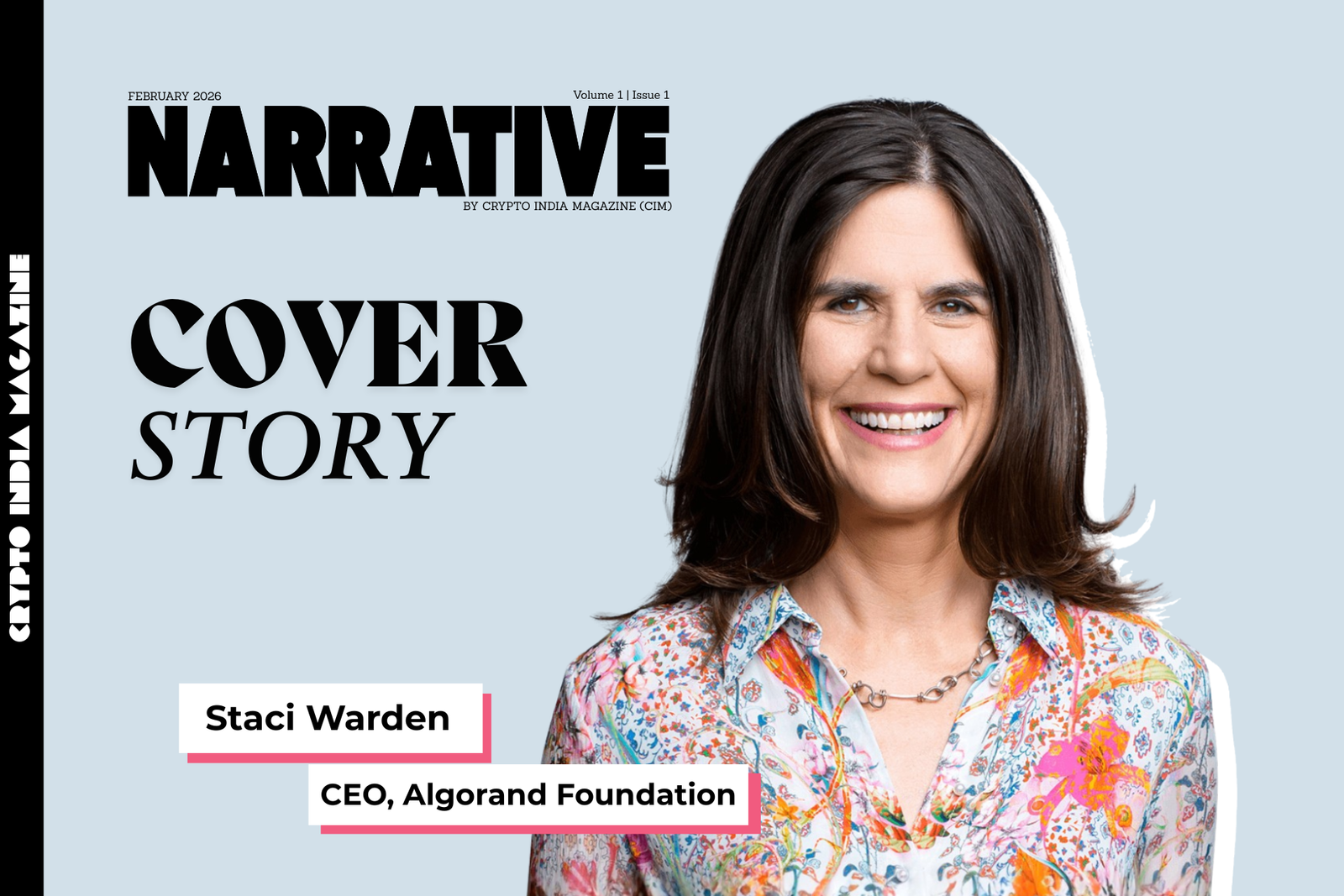
Years later, this philosophy is exactly what caught the attention of Staci Warden. A veteran of traditional finance (TradFi), Warden was not looking for a new executive role when she was first invited to join the Algorand Foundation’s board. However, as she examined the protocol’s architecture, she realized she was looking at something rare in an industry often driven by noise.
“I had the same reaction I had when I first learned about Bitcoin years earlier—a bit of a eureka moment,” Warden recalls. “What really stood out to me was that Algorand wasn’t designed to win a moment or a market cycle; it was built to solve some very hard problems correctly from the start.”
Today, under Warden’s stewardship, the network continues to grow into one of the industry’s leading Layer-1s, focusing on consequence: systems that work under load, settle with certainty, and hold up when the stakes are real.
In conversation with Crypto India Magazine, Warden expands on what it means to lead a Layer-1 built for consequence rather than spectacle.
Interview Excerpt: Finality, Reliability, and Decentralization in Practice
CIM: How do you define Algorand’s role in today’s blockchain landscape, and what aspects of its architecture matter most once networks are used at real scale?
SW: I think Algorand’s role is to be the infrastructure that actually works when things get real. There are a lot of Layer-1s that look impressive until people start actually using them. Then fees spike, finality gets fuzzy, or the chain slows down. Algorand was built with the assumption that it would need to operate at scale from day one, rather than treating growth as something to solve later.
The core differentiators are things like instant finality, no forks, predictable low fees, and the fact that the network has never gone down. Those are architectural outcomes, and they matter enormously once you move beyond experimentation into real financial activity.
CIM: What technical decisions made early in Algorand’s design have aged the best, and why?
SW: Instant finality is a big one. At the time Algorand launched, people didn’t fully appreciate how important it would be. But if you’re dealing with payments, tokenized assets, or anything regulated, you can’t have two versions of reality even briefly. Clearing has to equal settlement.
Another decision that has aged very well is keeping assets native at the base layer rather than pushing everything into smart contracts. That makes the system more efficient, more secure, and much easier to adapt to things like compliance requirements over time.
CIM: Algorand has often been described as technically strong but quieter than some peers. How do you think about storytelling and visibility without compromising substance?
SW: I’m not interested in telling stories that the technology can’t back up. That said, being quiet just to be quiet isn’t a virtue, and I don’t think anyone benefits from people not understanding what already exists on Algorand. A lot of the work we’ve been doing over the past couple of years is actually about visibility, but visibility that comes from clarity and usage, not hype.
For us, that means making it easier to build, easier to ship, and easier to explain what’s happening on the network. We’re also spending more time highlighting real-world usage, not announcements, but things that are live, processing transactions, and holding up under load.
CIM: Algorand emphasizes instant finality and zero downtime. Why do those design choices matter more now than they did when the network first launched?
SW: The stakes are higher now. Early on, crypto use cases could tolerate delays and uncertainty because the consequences were small. That’s no longer true. When you’re moving real value, settling trades, or supporting institutions, ambiguity isn’t acceptable. When a transaction happens on Algorand, it’s final. There’s no rollback, no fork, no question about what state the system is in. That’s not an add-on feature; it comes directly from the way the protocol was designed.
Zero downtime matters for the same reason. As blockchains move closer to payments, settlement, and real-world workflows, reliability stops being a technical preference and becomes a requirement. Infrastructure that underpins economic activity simply can’t pause.
CIM: What does decentralization mean in practice at Algorand today, and where do you believe the industry still gets it wrong?
SW: For us, decentralization is about how the network actually operates, not just how it’s described on paper. In practice, that means reducing reliance on any single set of actors and making sure the protocol’s guarantees are supported by the way the network runs day to day.
That’s why we’ve focused on peer-to-peer networking and expanding consensus participation. In 2025, total ALGO staked increased by nearly 57%, the community’s share of stake rose to over 80%, while the Foundation’s share declined to under 20%, and the number of active validators nearly doubled. Those are tangible signs of decentralization in practice.
Where the industry often gets this wrong is by treating decentralization as a static label rather than an ongoing process. It’s easy to make claims based on architecture or snapshots in time. It’s much harder to decentralize responsibly while maintaining performance, security, and reliability.
For Algorand, the goal isn’t decentralization at any cost. It’s decentralization that supports real-world use and long-term resilience.
Scaling Through Design and Real-World Use
As Algorand scales, Warden does not frame growth as a question of choosing markets or chasing categories. She sees it as an outcome of design. Teams working on payments, tokenization, identity, and DeFi arrive with similar needs: finality that settles immediately, fees that stay predictable, and infrastructure that can handle volume without surprises. Algorand’s role, in her view, is to meet those needs by staying reliable and straightforward as usage increases.
That focus becomes most visible in conversations around real-world asset (RWA) tokenization. For years, pilots have shown that assets can be represented on-chain, but few have moved into everyday use. Warden is clear about why.
“Tokenization itself is not the hard part anymore,” she says. “The technology works.”
The constraint has been settlement. If assets move on-chain while money moves later or elsewhere, the system keeps the same delays and risks it was meant to remove. What changes the equation is digital money. Once assets and payments move together, clearing becomes settlement, and tokenization stops being an experiment. It starts to look like an infrastructure that institutions can rely on.
Usage, not narrative, is also how Warden measures whether the ecosystem is healthy. She looks for transactions that repeat, users who return, and applications that keep working as volume grows. “If something works in the real world, it leaves evidence,” she says.
What Durable Infrastructure Looks Like
The kinds of projects that take root and last with Algorand are the ones that are built as if their systems will be used daily and judged by outcomes.
Projects like Lofty are good examples of that approach. Their work in fractionalized real estate is not tokenization for its own sake. It gives everyday investors access to income-generating assets that were previously limited to accredited investors, and it operates in a way that has to function reliably day to day.
World Chess is another example where the blockchain is not the headline. Match results, player records, and tournament outcomes carry weight beyond the platform itself. Algorand is used because finality and immutability are built into the system. When records matter, uncertainty is not an option.
Projects focused on financial access at scale follow the same logic. Initiatives like SEWA’s Digital Health Passport and the Mann Deshi Credit Scorecard in India use Algorand to support economic activity for large populations, often in cost-sensitive environments.
“In those cases, the technology succeeds precisely because it fades into the background,” Warden says. “These teams are building systems meant to run quietly and reliably over time, which is ultimately what durable infrastructure looks like.”
Securing the System for What Comes Next
Trust, at the infrastructure level, is built through decisions that hold up under scrutiny. For institutions and governments, sustainability shapes that trust through how a system operates at scale and under oversight. Environmental efficiency affects procurement decisions, regulatory review, and long-term viability.
Warden points to Algorand’s efficiency as a result of early design choices that emphasized lightweight computation and predictable performance. Those characteristics make it easier for public and private organizations to justify long-term reliance on the network.
That same long-horizon thinking guides how Algorand addresses risks that are not immediate but inevitable, such as quantum computing. In 2022, Algorand introduced State Proofs, compact certificates that attest to changes in the ledger and are signed using Falcon, a post-quantum signature scheme selected by NIST. This secured the chain’s historical record using quantum-resistant cryptography.
More recently, the protocol team demonstrated that this work extends beyond preparation. A live post-quantum transaction was executed on Algorand mainnet using Falcon, showing that quantum-resistant signatures can secure real digital assets today.
“For us, preparing for long-term risks like quantum computing starts with taking practical steps early, rather than treating it as a purely theoretical problem,” Warden emphasizes. “One of the first things we focused on was securing the chain’s history. With State Proofs signed using Falcon, the historical record of the chain is already protected. More recently, we showed that post-quantum security is no longer just a roadmap item. This was working code on mainnet, real infrastructure, and developer tooling that supports experimentation now.”
Where Algorand Stands
Warden has spent most of her career in TradFi, where infrastructure is not rebuilt every cycle; it improves through steady iteration and consistent performance. That experience influences how she thinks about the current state of the Web3 industry.
Furthermore, she sees this phase of Web3 as a period of sorting. There has been no shortage of experimentation, noise, and rapid shifts in focus. Beneath that, she believes, a quieter effort has been underway to turn early ideas into infrastructure that can support real economic activity at scale. That work is often slow and unremarkable from the outside, but it is what allows applications to move from demos to daily use.
When she considers how Algorand should be remembered, Warden points to that discipline.
“I hope Algorand is remembered as the blockchain that focused on doing the hard, unglamorous work early so that others could build with confidence later,” she says.
For her, the measure of success is simple. Public blockchains should be able to support payments, financial markets, and real-world applications without breaking down or losing performance as usage grows.
Algorand’s choices have consistently leaned in that direction. If the network is seen as part of the shift from experimentation to infrastructure, it reflects the way Warden believes systems should be built: deliberately, patiently, and with an expectation that they will still be running over time.