Now Reading: Kapil Dhiman on Building a Quantum-Secure Layer 1 for the Decades Ahead
-
01
Kapil Dhiman on Building a Quantum-Secure Layer 1 for the Decades Ahead


Web3 has always been a broad conversation, with multiple parallel tracks evolving at once. What tends to receive less attention are the questions that stretch beyond immediate product cycles, the ones concerned with how today’s infrastructure will hold up over decades rather than months.
Quantum security, somehow, sits within that quieter category; not because it lacks relevance, but because it operates on a longer horizon than most narratives are built to accommodate.
Quantum-secure Layer 1 blockchains are emerging as a response. They are designed to address a structural challenge that has been forming gradually as advances in quantum computing reshape the assumptions underlying modern cryptography.
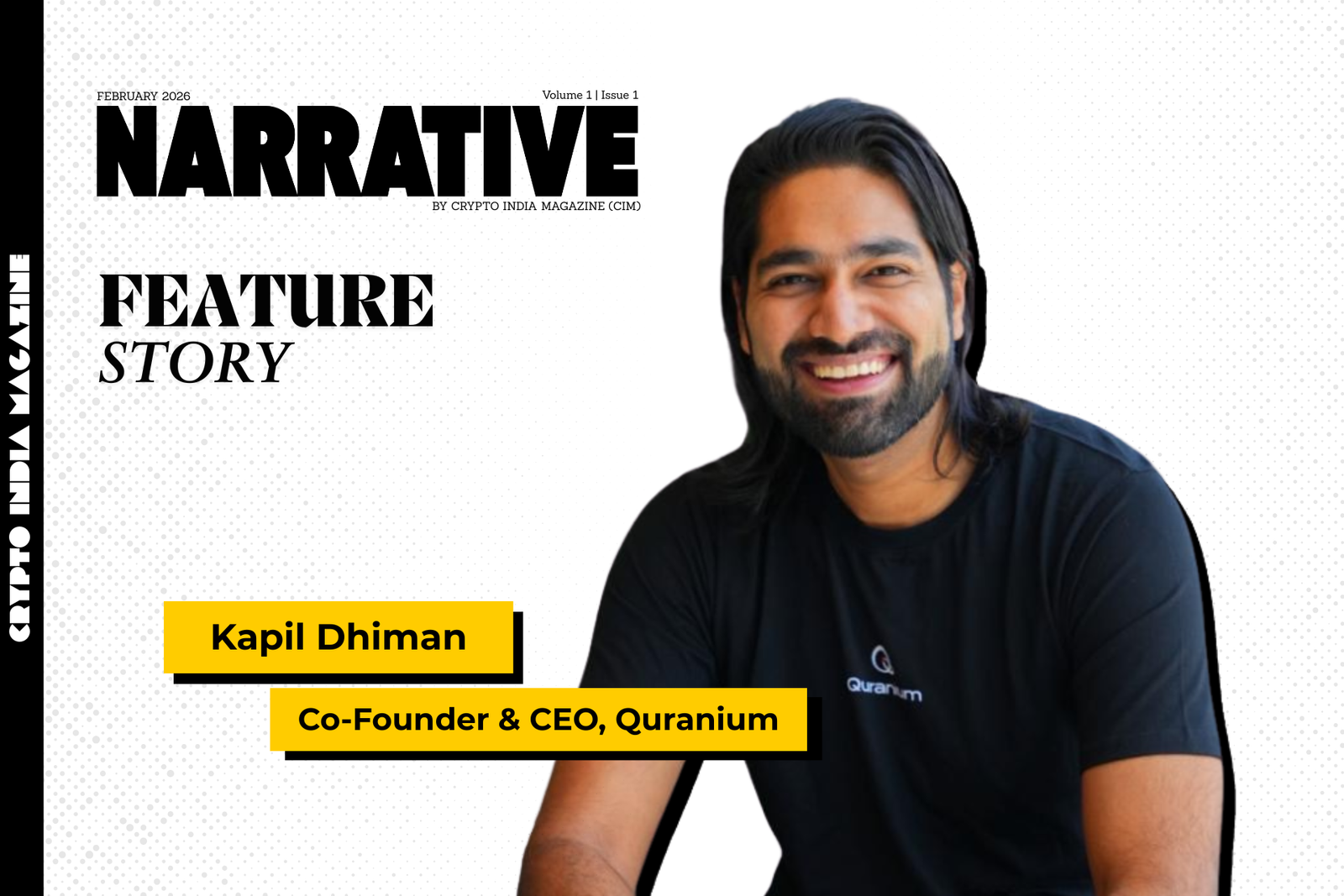
To explore what it means to build a quantum-secure Layer 1 blockchain, we spoke with Kapil Dhiman, Co-Founder and CEO of Quranium.
Quantum Security as Responsibility
CIM: What led to the creation of Quranium as a quantum-secure Layer 1?
KD: The turning point was realizing that digital systems were becoming more valuable and interconnected, while the security protecting them was aging faster than most people acknowledged.
Quantum computing changes the security timeline entirely. Encrypted data can already be collected today and stored for later decryption, which means many systems are quietly accumulating long-term risk without it being visible in day-to-day operations.
We asked a simple question: if you were building financial infrastructure meant to last 30–40 years, supporting money, assets, and identity, what would you trust it to run on?
The answer wasn’t incremental upgrades or patchwork solutions. It required rebuilding the foundation itself, with quantum-resistant cryptography embedded at the protocol level from day one.
CIM: What does building an “uncrackable digital future” mean in practical terms?
KD: For us, “uncrackable” is really about removing uncertainty.
People shouldn’t have to wonder whether the money they hold, the assets they tokenize, or the data they protect today will quietly become vulnerable tomorrow. Most systems are designed around known threats and short planning horizons. We’re designing for threats that are already forming, even if they aren’t headline news yet.
At a human level, uncrackable means trust that lasts, technology that doesn’t require constant rethinking of whether it will still hold up in five or ten years. Its infrastructure is designed for longevity, not short product cycles.
CIM: Why choose stateless, hash-based post-quantum signatures?
KD: Because infrastructure is a long-term commitment.
Hash-based post-quantum signatures are conservative and future-proof, but they aren’t convenient. Tooling is less mature, transactions are larger, and developer habits haven’t fully adapted yet.
The internal discussion wasn’t security versus adoption; it was about sequencing. We chose to be uncompromising at the foundation because when the base layer is genuinely secure, everything built on top of it can scale faster and with more confidence. Adoption should be driven by products, applications, and ecosystems, not by inheriting hidden security debt at the infrastructure level.
CIM: How do you explain the urgency of quantum security without fear or speculation?
KD: By framing it as a responsibility. The systems we rely on today were designed for threat models that are already being phased out. NIST has finalized post-quantum standards and made clear that widely used public-key encryption is entering active deprecation, with institutions expected to migrate well before 2030. Regulators are urging action now because data encrypted today may not remain secure over its intended lifetime.
Quantum security isn’t about sudden collapse. It’s about continuity, making sure that what you protect today remains protected tomorrow, without needing emergency fixes under pressure.
CIM: What did the transition from a quantum-secure PoW testnet to PoS teach the team?
KD: It clarified that quantum security isn’t just about transactions; it’s also about consensus.
In PoS systems, validators must cryptographically authenticate blocks to reach agreement. That makes quantum-secure signatures foundational not just for user transactions, but for how the network itself reaches consensus.
The transition helped us balance scalability and usability while preserving our security assumptions, which is essential if the network is meant to support real-world financial activity.
CIM: What convinced partners and institutions that Quranium’s approach had substance?
KD: Consistency.
From early conversations, we were transparent about trade-offs and clear about prioritizing security. Many partners operate in environments where mistakes carry real cost, and they recognize infrastructure built for longevity rather than headlines.
Trust grew because the technical choices, the threat models, and the long-term outlook all aligned, and stayed aligned over time.
CIM: With quantum security and AI often overhyped, how does Quranium stay grounded?
KD: By focusing on systems, not narratives. Our community tends to be interested in how infrastructure actually works, how security evolves, how tools integrate, and how long-term ownership should function in digital systems. Products like QRemix reflect that approach by embedding AI directly into a quantum-resistant development environment, reducing friction without compromising correctness.
We don’t try to explain the future through slogans. We build and let the systems speak.
Designing Infrastructure With Time in Mind
As Quranium’s ecosystem has grown, one pattern has remained consistent. “Intentionality,” Kapil says, defines a community of more than 200,000 members, many drawn less by short-term speculation than by a long-term interest in how digital infrastructure will evolve.
That same mindset shapes the people who thrive inside the company, where growth favors those who think beyond short timelines, value intellectual humility over speed, and understand that building foundational infrastructure is work measured in years, not quarters.
“Building systems meant to last isn’t about quick patchwork,” he notes. “It’s about patience, integrity, and being willing to take the harder path when it leads to more durable outcomes.”
When asked what the industry still underestimates as quantum computing advances, Kapil points to time. Quantum attacks begin when data is harvested, not at a sudden breaking point, and even decisive action takes years to unfold. Quranium, he says, was built with that reality in mind.
“The goal is not to race the future, but to assume it, and build accordingly.”
Looking ahead five years, Kapil hopes Quranium represents trust—quiet infrastructure that simply works, supporting money, identity, and critical systems across sectors. If it helps shift the industry toward building for longevity rather than short-term attention, he believes, that alone would make the effort worthwhile.