Now Reading: How This Domestic Derivatives Giant is Re-Engineering India’s Crypto Economy
-
01
How This Domestic Derivatives Giant is Re-Engineering India’s Crypto Economy


In the high-octane world of digital assets, India has often been a study in paradox. While the nation has consistently topped global charts for adoption, ranking first in the world for the third consecutive year in Chainalysis’s 2025 Global Crypto Adoption Index, the path for institutional-grade builders has been grueling.
Since 2022, a 30% tax on gains and a 1% TDS sent domestic volumes plummeting, leading many to view the Indian market as a regulatory dead end.
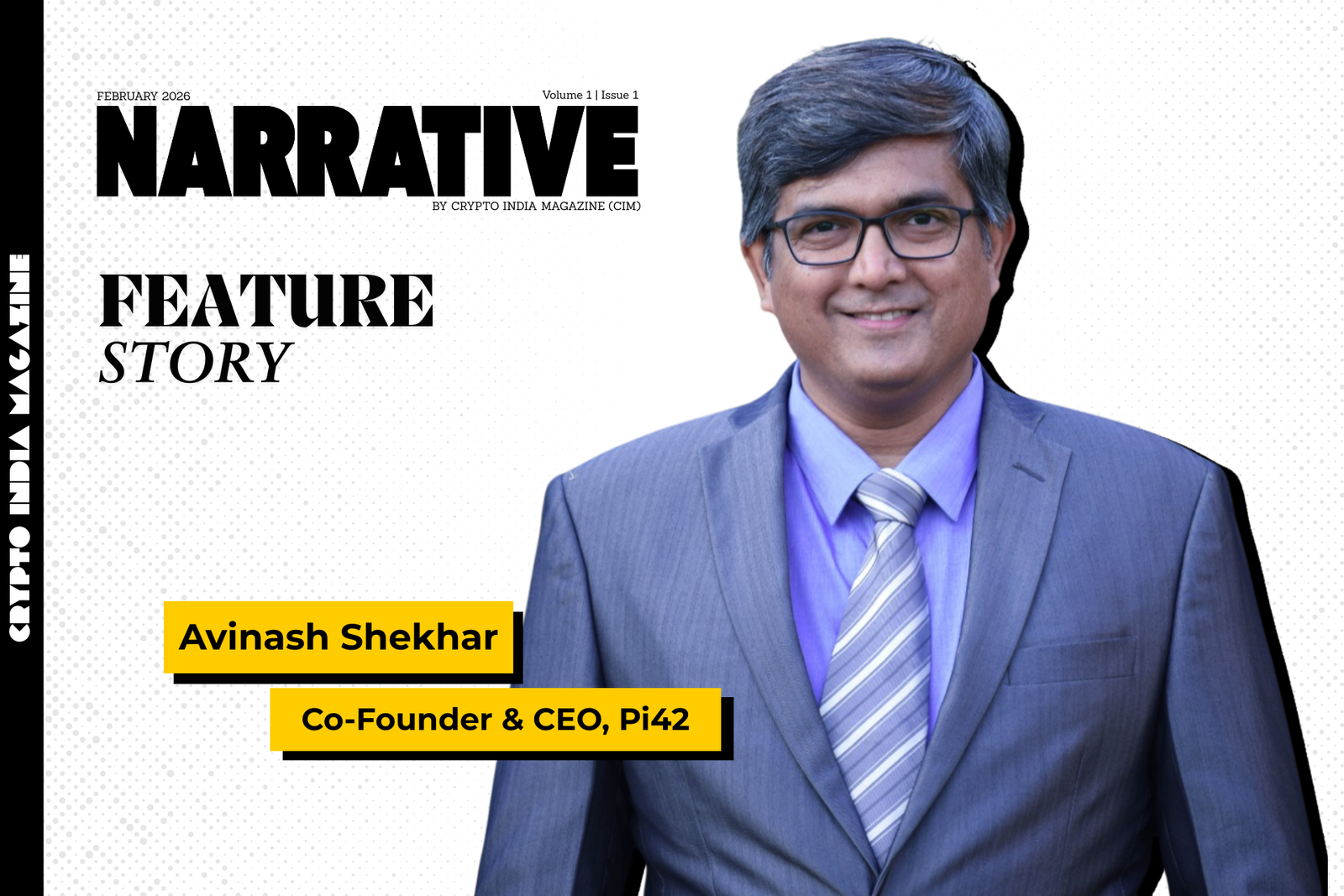
Yet, where most saw a wall, Avinash Shekhar, CEO and Co-Founder, Pi42, saw a blueprint. Shekhar didn’t just stay in the game; he pivoted to the sector most deemed “too difficult”: derivatives.
With Pi42, Shekhar is attempting a feat of regulatory engineering, introducing India’s first INR-margined futures exchange to capture a market that saw transaction volumes surge 41% to ₹51,000 crore in the 2024–25 fiscal year.
But building a clean exchange in a historically wild industry requires more than a slick UI; it requires a fundamental rethinking of what a crypto company should look like in a sovereign-first world.
In this exclusive interview, the Pi42 CEO pulls back the curtain on the internal doubts, the hard path of team building, and why he believes India is finally ready to stop participating in future markets and start shaping them.
Beyond the Lightbulb Moment
The genesis of Pi42 was less of a lightbulb moment and more of a response to a glaring market imbalance. While Indian investors were prolific in spot trading, the world of derivatives remained the domain of offshore platforms—unregulated, high-risk, and often detached from local realities.
To bridge this gap, the founding vision focused on a simple premise: Indian traders should not have to trade on the periphery of global finance.
“We believed Indian users deserved a product that was compliant, local and designed for their needs rather than being an afterthought,” says Shekhar.
It was a conviction that flew in the face of conventional wisdom, and skeptics argued that navigating India’s evolving regulatory landscape while competing with established global giants was a fool’s errand. The internal debate was just as rigorous: could a homegrown entity actually win back users who had spent years on international exchanges?
The leadership team viewed this friction as a necessary crucible.
“Every major innovation starts with someone choosing the harder path,” Shekhar notes, emphasizing that the “payoff would be transformational” if they could successfully merge compliance with a seamless user experience.
But scaling this ambition required a specific breed of talent, a fusion of traditional financial discipline and Web3 agility. And in an environment where the specialized talent pool remains shallow, the focus shifted toward finding a unique psychological profile.
“I looked for people who could operate with conviction in uncertain environments,” Shekhar explains. By blending institutional expertise with a “builder mindset,” the team at Pi42 was built not just to survive volatility, but to architect the foundation for India’s next financial frontier.
Why Pi42 Anchored the Ecosystem to INR
This internal culture of conviction was immediately put to the test when designing the platform’s core architecture. If the mission was to repatriate Indian capital from offshore giants, the product couldn’t simply be a local clone of a global exchange; it had to solve the specific frictions of the Indian market.
“For us, ‘India-first’ means building a platform that reflects how Indian traders actually think, transact, and progress,” says Shekhar.
This philosophy manifested in the industry’s first INR-margined futures pairs. By allowing users to trade directly in their native currency, the platform effectively neutralized the “USDT-dependency” that has long plagued domestic investors. It turned a complex, multi-step conversion process into a familiar banking flow, making advanced strategies accessible to both retail participants and high-volume professionals.
However, the most radical expression of this onshore commitment was the decision to prohibit crypto withdrawals, a move that initially drew industry pushback. In a landscape often defined by borderless movement, Pi42 chose to anchor the ecosystem firmly within the domestic framework to ensure maximum regulatory alignment.
“We always asked ourselves what would maximize user protection,” Shekhar explains, adding that while there was early pushback, the feedback proved that “traders actually prefer compliance and stability when significant capital is involved.”
This focus on structural integrity extends to the unseen discipline of compliance. Beyond simple KYC checks, the architecture is designed around a rigorous operational flow.
“Compliance is not a checkbox,” Shekhar insists. “It influences how funds move, how data is protected, and how every trade is monitored.”
By treating regulation as a continuous investment rather than a hurdle, the platform is betting that in the long run, trust will be the only currency that truly matters in the Indian market.
Building a Ladder from Speculation to Security
Building a ladder for the Indian trader requires more than just code; it requires a psychological shift. Users in the region have proven to be incredibly adaptive, moving rapidly from basic speculation toward a demand for transparency and institutional-grade safety.
“The lesson has been to build a platform that respects that ambition,” Shekhar observes.
However, the weight of providing this stability in a high-stakes environment is constant. While many founders treat safety as a marketing buzzword, the team at Pi42 views it as the primary operational driver.
“For us, security is not a feature. It is the foundation on which everything else is built,” Shekhar asserts. This translates to an obsession with robust risk controls and continuous monitoring to stay ahead of the evolving threats inherent in a derivatives-heavy landscape.
Maintaining this level of discipline amidst regulatory shifts and market drawdowns has often tested the team’s resolve. Yet, the motivation remains rooted in a singular, long-term mission. “What kept me going was a strong conviction that India needs a trustworthy, compliant crypto platform built for the long run,” Shekhar reflects.
Scaling for Sustainability in the Internet of Value
Sustainable scaling has taken precedence over the hollow pursuit of vanity metrics. While the volatile nature of digital assets often rewards short-term surges, the roadmap to profitability at Pi42 is defined by operational discipline and healthy unit economics.
“We are building a sustainable exchange for a decade, not a quarter,” Shekhar emphasizes. The strategy involves deep liquidity and a broadening product suite, including the upcoming rollout of options, to ensure the business scales responsibly as trading volumes mature.
Looking toward the next five years, the ambition transcends the platform itself. The goal is for Pi42 to serve as a bellwether for India’s rising influence in the global Web3 economy.
“In five years, I want Pi42 to represent the idea that India does not just participate in future markets. We shape them,” Shekhar asserts.
By establishing a trusted, globally competitive gateway, the firm aims to prove that Indian innovation is not just following the internet of value but actively architecting its future.