Now Reading: Flying Tulip Raises $200M, Plans $FT Public Sale With Onchain Redemption Right
-
01
Flying Tulip Raises $200M, Plans $FT Public Sale With Onchain Redemption Right



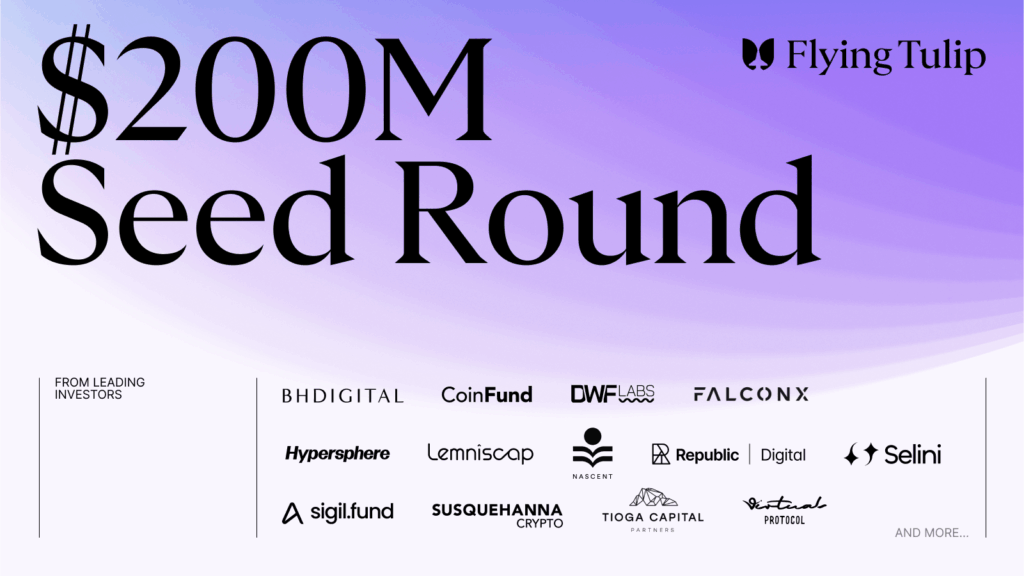
Onchain financial marketplace Flying Tulip has raised $200 million in a private funding round backed by a slate of major digital asset investors. The company also announced plans for a public sale of its $FT token at the same valuation, with an unusual feature: a programmable onchain redemption right designed to protect downside risk for investors.
The round drew participation from some of the industry’s best-known backers, including Brevan Howard Digital, CoinFund, DWF, FalconX, Hypersphere, Lemniscap, Nascent, Republic Digital, Selini, Sigil Fund, Susquehanna Crypto, Tioga Capital, and Virtuals Protocol, among others.
Flying Tulip describes itself as a “full-stack onchain exchange” that integrates multiple financial products, including a native stablecoin, money market, spot trading, derivatives, options, and onchain insurance—within a single volatility-aware, cross-margin system. The design is intended to maximize capital efficiency while unifying risk management under one platform.
Its most distinctive feature is its onchain redemption right, sometimes referred to as a “perpetual put.” This mechanism allows primary-sale participants, both private and public, to burn their $FT tokens at any time and redeem up to their original principal in the contributed asset (such as ETH).
Redemptions are programmatically settled from a segregated reserve seeded with capital from the raise, offering investors a safety mechanism rarely seen in token launches. The company says the design provides downside protection while preserving unlimited upside potential.
In a departure from typical token distribution models, the team will not receive an initial allocation of $FT. Instead, the team’s exposure will accrue over time through open-market buybacks funded by a share of protocol revenues, subject to a transparent schedule. Flying Tulip argues that this structure directly aligns incentives with actual protocol usage and long-term performance rather than short-term speculation.
The public sale of $FT will be hosted across multiple blockchains. Details on supported assets, circulating supply, and official smart contract addresses will be released ahead of launch via the project’s website. Flying Tulip aims to raise as much as $1 billion across combined private and public phases.
“Our goal is to provide institutional-grade market structure with onchain guarantees and clear alignment between users, investors, and the team,” said Andre Cronje, founder of Flying Tulip.
Flying Tulip’s announcement arrives at a moment when DeFi projects are under scrutiny for sustainability and investor protection. By offering an onchain redemption mechanism, the project is attempting to introduce a layer of trust and downside security in a sector often criticized for high risk and opaque tokenomics.
If the model proves successful, it could set a precedent for token raises where investors demand stronger guarantees against value erosion while maintaining exposure to upside. At the same time, the platform’s ambition to unify trading, lending, and risk transfer could make it a significant player in institutional-grade DeFi infrastructure.
Editorial Note: This news article has been written with assistance from AI. Edited & fact-checked by the Editorial Team.
Interested in advertising with CIM? Talk to us!