Now Reading: CULTD’s Bid to Make Web3 Growth Honest and Accountable
-
01
CULTD’s Bid to Make Web3 Growth Honest and Accountable


For years, the Web3 industry has been chasing a ghost. Founders celebrate six-figure Discord communities and viral promotion campaigns, only to realize later that much of this activity is driven by bots, short-term farmers, and incentive hunters. It’s a “growth at all costs” mentality that has left many promising protocols as digital ghost towns.
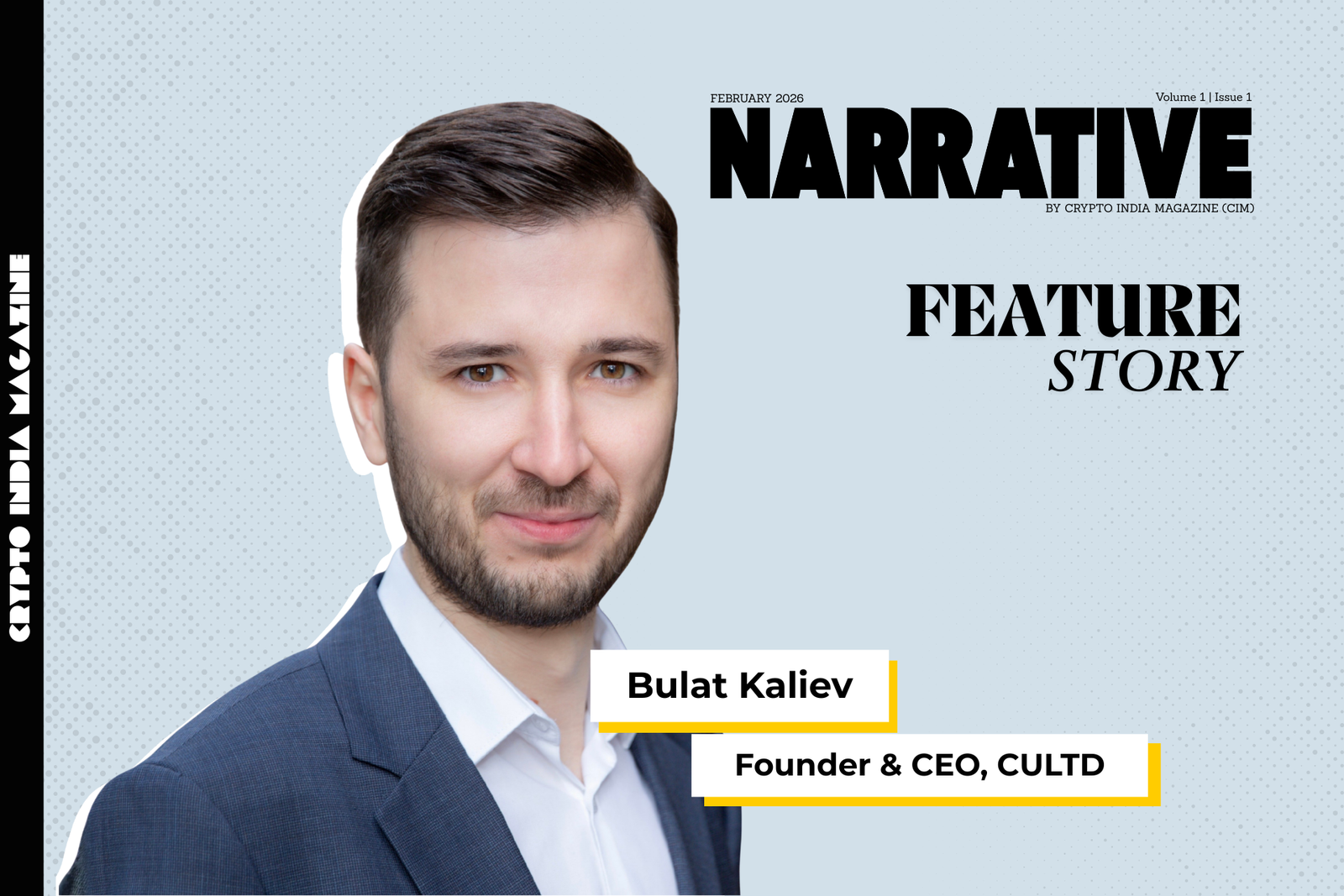
Bulat Kaliev, the founder of CULTD, has witnessed this cycle firsthand. As a product leader scaling platforms to hundreds of thousands, he could see that in Web3, users are often just entries in a database until they prove economic intent. While blockchain infrastructure continues to evolve rapidly, the industry still relies on surface-level metrics to measure attention and success.
“I watched brilliant engineers spend years building revolutionary tech, only to see their launches drowned out by InfoFi (Information Finance) noise and shill campaigns,” says Bulat. “We have incredible L1s and L2s, but the bridge between a human seeing a post and that human depositing liquidity was a black box.”
For Bulat, this disconnect exposed the core flaw. When 90% of the attention a project receives is incentivized noise that never touches a smart contract, then the tech isn’t the bottleneck; attribution is. With CULTD, Bulat is trying to close the attribution gap.
A Growth Engine That Prioritizes Liquidity Over Likes
CULTD is built as an attention-to-TVL attribution engine, designed to connect social influence directly to sticky liquidity, users, and measurable economic outcomes. Rather than treating marketing as a visibility exercise, the platform reframes growth as a performance system where every action can be tracked back to liquidity, usage, and long-term user behavior.
At the core of CULTD is a simple but strict definition of what growth should represent. For Bulat, engagement only matters when it produces measurable economic behavior, and this logic reframes marketing from visibility into performance.
“Real engagement is correlated with economic action. If a user likes a post, that’s a vanity signal. If a user likes a post, clicks a link, and deposits $500 into a vault, that’s engagement.”
When building CULTD, Bulat treated friction as a quality filter, keeping the creator experience seamless while enforcing strict data discipline on the backend. Guided by the principle that “you get what you measure,” the platform follows user activity inside smart contracts to identify sticky TVL and separate lasting liquidity from short-term spikes.
The platform has seen the strongest adoption among DeFi protocols, yield aggregators, and layer two networks, where liquidity is a core success metric. Fintech applications and gaming studios are also beginning to adopt CULTD’s pay-per-action approach. Not to mention, the product is intentionally not built for projects chasing memecoin-style virality. Without meaningful actions to measure, CULTD has nothing to optimize.
The New Rules of Sustainable Web3 Growth
In this excerpt from our conversation, Bulat outlines the principles shaping CULTD’s approach to performance-driven growth.
CIM: How do you get founders to rethink growth when inflated numbers still dominate investor and community conversations?
BK: I show them the liquidity vacuum and “retention cliff.” I show them data from past projects where 100k followers resulted in zero retention after their campaigns or engagement vanished 48 hours post-TGE. I tell founders: “You can either lie to your investors with vanity metrics today, or you can show them a real ROI and a sustainable treasury tomorrow.” Investors are maturing: in 2026, they are asking for CAC/LTV (Customer Acquisition Cost / Lifetime Value), not just “impressions.”
CIM: Where do traditional Web3 growth tools like airdrops, quests, or KOL campaigns fall apart in practice?
BK: They fall apart at the attribution gap. Airdrops attract sybils (farmers), quests attract clickers and bots, and KOL campaigns often result in pump and dumps or fake engagement metrics. These tools treat attention as a commodity to be bought, rather than a relationship to be tracked. They fail because they lack a feedback loop: the project pays for the effort (the tweet) instead of the outcome (the liquidity).
CIM: What role does product design play in filtering out bots and passive participants without alienating genuine users?
BK: Design is our first line of defense. By shifting the UI from engagement leaderboards (which bots love to climb) to performance dashboards, we remove the incentive for public-facing spam. We also integrate deep social and wallet analytics to ensure that the humans in our system have a “Proof of Reputation” before they access a campaign link.
CIM: How do you balance performance-driven growth with the risk of eroding community trust?
BK: Trust is eroded by transparency gaps. When a community sees a project paying shills and bots, they lose faith. But when a community sees a project rewarding value-add contributors who actually bring in capital or sticky users and community members, it creates a virtuous cycle. CULTD balances this by making the reward criteria objective: “If you bring value, you get paid.” It’s a professional marketplace, not a popularity contest.
Scaling Without the Noise
CULTD’s long-term ambition is not to win the attention race, but to change how growth is built in Web3. For Bulat, scaling the company means avoiding the same noisy mechanics the industry has relied on for years. Instead of chasing visibility, CULTD is positioning itself as core infrastructure within a project’s marketing stack, built around utility rather than hype.
“We scale through SaaS utility, not InfoFi hype,” Bulat says. “We do not need to be viral on Twitter. We need to be indispensable in the CFO’s budget.”
That mindset also defines how the company measures its own progress. Success is not tied to brand reach or social presence, but to the total value CULTD is able to attribute on-chain. By anchoring growth to TVL and measurable outcomes, the platform aligns its incentives with the same performance standards it expects from its users.
Looking ahead, Bulat sees a broader shift that extends beyond his own product. The ambition is to change how Web3 defines attention itself. “I want CULTD to have killed the shill economy,” he says. In that future, creators operate as professionals with verifiable return on investment, and marketing becomes a predictable business function rather than a speculative gamble.