

The crypto industry is not ignorant of its darker dimensions. Money laundering, terrorism financing, cybercrime, the limits of sovereign regulation, these conversations do surface. But they are often met with deflection, buried under the next bull run narrative, or dismissed as the price of building something new. When they do make headlines, they leave a dent. FTX left a dent. TerraUSD left a dent. And yet the cycle continues.
Governments are scrambling to build frameworks. Law enforcement agencies are playing catch-up with criminals who are, in many cases, a step ahead. And the gap between financial innovation and public safety continues to widen.
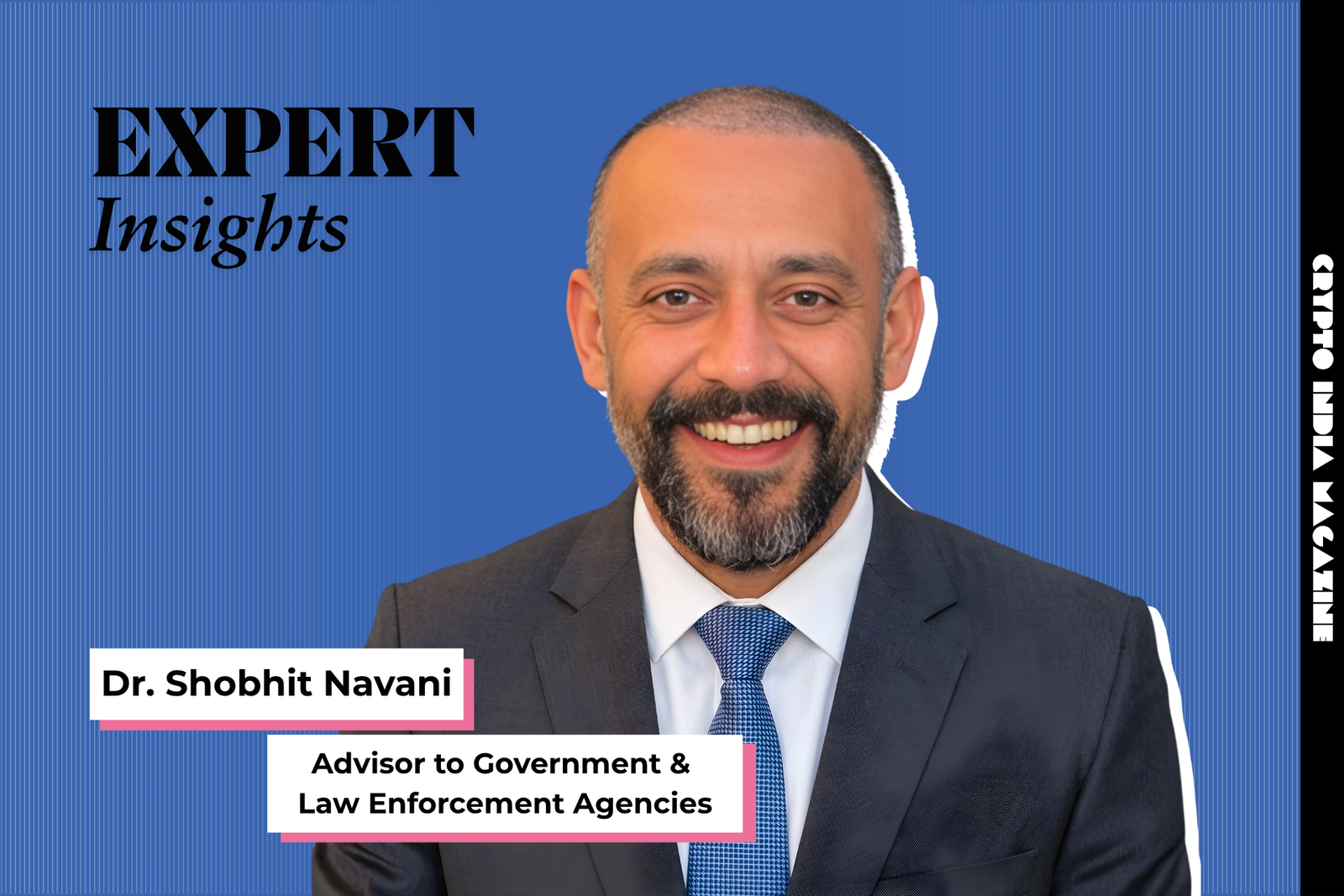
Dr. Shobhit Navani works inside that gap. An advisor to government and law enforcement agencies, his expertise spans anti-money laundering (AML), counter-terrorism financing, and the regulatory architecture of digital assets. We sat down with him to understand not just the risks, but the systems, incentives, and blind spots that keep creating them.
Entering Crypto Through Anomaly
Dr. Navani, based in Germany, did not arrive at cryptocurrency through a whitepaper or a wallet. He came from data centers, which he refers to as the unglamorous infrastructure backbone of the digital world. It is where he worked on the cooling systems and server administration, and even led the teams that kept enterprise hardware running.
His first real introduction to cryptocurrency wasn’t through an investment opportunity or a market run. It was rather through an anomaly buried inside routine infrastructure management.
While leading a team, he noticed certain servers drawing unusually high amounts of electricity. An internal investigation revealed that an infrastructure administrator had been quietly using company hardware to mine Bitcoin and run an Ethereum validator node. These were servers long overdue for decommissioning, kept alive through oversight gaps and inefficiencies, allowing an unauthorized crypto operation to go undetected far longer than it should have.
The second incident was more personal. He opened his laptop one day to find a message informing him that his files had been encrypted and that he needed to send Bitcoin to an alphanumeric address to recover them. He refused to pay, but the mechanics of the extortion fascinated him. Tracking that alphanumeric address across open-source forums, he realized he was part of a coordinated, global cyberattack.
“I found there were other victims around the world who had been hacked. There was a common consensus that they were remotely linked to a group of hackers allegedly based in Russia,” said Dr. Navani.
Those two incidents reshaped his entire perspective on the space. He was drawn further in by the work of economist George Akerlof and his concept of the market for lemons.
“If you read about George Akerlof, he says the ‘market of lemons’ is in normal finance; banks know who you are. But in crypto, no one knows,” he explains. “This creates this asymmetry of knowledge… remotely hacking the computer and asking for money, and without any trace.”
That asymmetry became his area of focused research, which eventually brought him into contact with government bodies and law enforcement agencies whose interest in his work opened the door to the advisory roles he holds today.
How Governments Are Approaching Crypto Differently
The knowledge gap, the facelessness that first drew Dr. Navani into studying crypto’s darker dimensions, is also what makes regulating it so difficult. And yet governments around the world are trying, each through a very different lens.
In his advisory work, Dr. Navani observes three broad regulatory approaches taking shape globally. The first is restrictive, best illustrated by India, where a 30% tax on crypto profits sits alongside a 1% tax deducted at source on every transaction. The latter, he explains, is less about revenue and more about surveillance, giving the government a paper trail of where money is moving and deliberately cooling speculative trading in the process.
China sits at the harder end of this spectrum, having outright banned cryptocurrency, though its simultaneous push to position Hong Kong as a crypto hub signals that the door has not been shut entirely.
The second approach is pro-growth, with the UAE leading the way through a clear licensing framework, tax advantages, and an explicit ambition to become a global crypto hub. Germany sits in an interesting position within this category. Currently, crypto held for more than one year is entirely tax-free.
Dr. Navani, who has been part of the think tank advising on this very question, notes that this will not last indefinitely. “Germany is now planning, in the coming years, to introduce taxation on crypto. There is no law up till now, but they are discussing how to tax it,” he said.
The third approach is structured regulation, most prominently through the EU’s MiCA framework, which requires crypto service providers to maintain KYC standards comparable to those of traditional banks. It is a meaningful step, but Dr. Navani is measured in his assessment of it.
“MiCA controls centralized exchanges and crypto service providers. But it does not control DeFi platforms, smart contracts, or DAOs. Crime does not vanish. It moves from a strong jurisdiction to a weak one,” he said, pointing to the fundamental enforcement gap that no regional framework, however well designed, can fully close on its own.
The Institutional Turn in Crypto
Regulatory ambiguity has long been the primary reason institutions kept their distance from crypto, and for years, that distance felt permanent. At recent industry events, however, the presence of institutional players has moved from peripheral to prominent. And this reflects a shift that Dr. Navani sees as both inevitable and overdue.
Institutions are in the business of making money, and crypto has matured enough to be taken seriously as an asset class. A decade ago, the conversation around crypto was dominated by scams, hacks, and an almost total absence of governance. Today, the same institutions that once dismissed it are building financial instruments around it.
“Crypto is a wild horse. It has a lot of potential, but the question was always whether you let it run wild or try to tame it. That is exactly what institutions are now beginning to do,” said Dr. Navani.
BlackRock’s Bitcoin ETF, which crossed $10 billion in assets faster than most anticipated, was a defining signal of that shift. A pro-crypto political environment in the United States has further reduced institutional hesitation. But Dr. Navani notes that what institutions are scrutinizing just as carefully is custody, specifically who controls the asset and how safely it is held. The collapse of FTX was a watershed moment in that regard, pushing institutions toward far more rigorous custody standards and forcing a broader reckoning with governance inside the industry.
The adoption, as he puts it, is real but cautious, driven as much by structural safeguards as by market opportunity.
Stability, Crime, and the Limits of Control
The conversation also steered towards a more unsettling dimension of crypto’s growth, one that touches on national security, financial stability, and the consumers who remain most vulnerable to it.
Stablecoins, despite their reputation as the more measured corner of the crypto market, carry risks that extend well beyond price volatility. Dr. Navani explains that when money moves from a bank account into a stablecoin, it does not simply change form; it reduces the pool of deposits that banks rely on for lending and monetary transmission.
As stablecoins scale, their issuers are required to hold equivalent reserves in short-term assets like US Treasury bills, raising a question that few are asking loudly enough: Who is actually verifying that the reserves match the supply? TerraUSD, which collapsed with roughly $40 billion in circulation, offered one answer to what happens when they do not.
On the question of cross-border crime, Dr. Navani is candid about the limitations of even the most sophisticated enforcement infrastructure. Tools like Chainalysis and Palantir’s crypto-focused infrastructure have strengthened tracing capabilities. Interpol’s real-time coordination has added another layer. But criminals have adapted, using AI to fragment transactions into amounts too small to flag, and exploiting blockchain bridges to move value across chains and further obscure its origins. “It is a cat-and-mouse game,” he said.
Applying AML rules to DeFi compounds the problem further. In a truly decentralized, leaderless system, there is no bank, no CEO, and no compliance officer to hold accountable. Dr. Navani does not argue that DeFi should become a lawless space, but he insists that the thinking has to change.
“DeFi is like a bird that needs two wings. One is regulation and compliance, the other is technology. Both have to be in sync,” he said.
The most realistic intervention point, in his view, is the fiat on and off ramps, the centralized exchanges, stablecoin issuers, and payment apps where identity checks can actually be enforced, because almost nobody enters DeFi from nowhere.
What Crypto Still Needs
For all the complexity of what precedes it, Dr. Navani’s view on crypto’s everyday utility remains grounded. Despite the arrival of crypto cards and spendable stablecoins, every transaction still bottoms out in fiat. The famous Bitcoin pizza, where Laszlo Hanyecz purchased two Papa John’s pizzas for 10,000 Bitcoins, is an exception rather than a blueprint.
Governments will not relinquish control over monetary supply, and until that changes, crypto will continue to need fiat as its final leg. How far the industry travels from here depends, as he puts it, on how governments and people choose to perceive it.
Which brings everything back to the question that underlies the entire conversation: what does crypto actually need to survive and grow responsibly? For Dr. Navani, the answer is trust, and he is specific about what building it requires.
“The most important guardrail the world needs right now is trust in the system. If that trust is not there, no one will invest in crypto or use it,” he said. That trust, he adds, can be strengthened when centralized exchanges demonstrate transparency by providing verifiable proof of reserves.
His research into FTX, which formed part of his PhD, sharpened that conviction. The exchange projected strength publicly while operating with no transparency, no governance, and no compliance behind the scenes. The solution, in his view, is mandatory proof of reserves, where exchanges publish their assets and liabilities openly on blockchain and submit to independent audits.
Alongside that, he points to zero-knowledge proofs as a mechanism that validates transactions without exposing user identity publicly, while still allowing law enforcement access when legitimately required.
The technology to build that trust already exists. The will to enforce it is what remains unfinished.
Editorial Note: This article is based on an interview with Dr. Shobhit Navani. Various parts have been adapted into a narrative format for readability, but his perspectives and insights remain presented as originally expressed.
Interested in advertising with CIM? Talk to us!


Can You Trust AI With Your Crypto? Francesco Andreoli Thinks You Can, With Limits
MetaMask opened Agent Wallet to all users on August 6, 2026, giving AI agents a scoped wallet across 22 EVM chains and Hyperliquid. Francesco Andreoli, Head of Developer Relations at Consensys, walks through the policy engine, the $10,000 Transaction Protection, and where users get it wrong.

Interview with Charlie Hu, Co-Founder of COCO AI: AI Agents, Enterprise Adoption, and Future of Work
COCO AI co-founder Charlie Hu runs a 15-person team alongside about 60 AI agents, serving 500-plus businesses in e-commerce, gaming, and digital marketing. He breaks down the shift from Copilot to Autopilot, why physical AI is the next frontier, and how to stay valuable.

Interview with Adam Budínský: Trezor’s Head of Hardware on the Safe 7, Open Security, and Self-Custody
The Trezor Safe 7 just won a 2026 Red Dot Award for Product Design. Head of Hardware Adam Budínský talks to CIM about the device's open, auditable, secure element, the push to end blind signing on Ethereum, the touchscreen threat model, and why self-custody adoption still lags in India.
[…] The bill creates a registration framework for digital commodity exchanges, brokers, and dealers, with provisional registration requiring disclosure, recordkeeping, and membership standards before full CFTC registration. These firms would also become subject to the Bank Secrecy Act for anti-money laundering purposes. […]