Key points
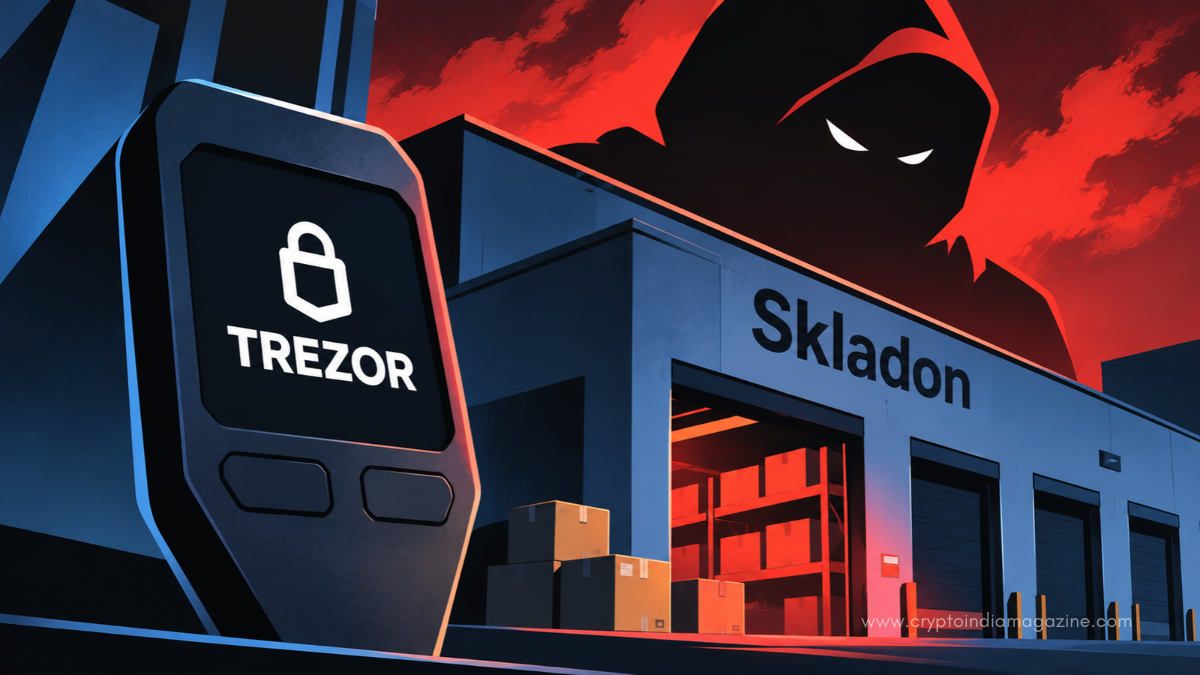
- Trezor said on November 16 that Skladon, one of its third-party shipping partners, suffered a data breach exposing data tied to roughly 27,000 orders.
- Exposed records include full names, phone numbers, email addresses, delivery addresses, and purchase details, though no wallet backups, PINs, or passphrases were involved.
- Trezor launched Anonymous Pickup across 18 European countries the same day, letting buyers collect devices from parcel lockers without sharing a name or home address.
Hardware wallet maker Trezor disclosed on November 16 that Skladon, one of its third-party shipping partners, suffered a data breach that exposed customer data from roughly 27,000 orders. The Trezor data breach traces to unauthorized access to Skladon’s systems on November 7, 2026, and the shipping provider notified Trezor on November 15, according to the company’s disclosure. Trezor said its own infrastructure was not compromised and that customer devices remain secure.
The exposed records cover orders placed between August 9 and November 7, 2026. The data included full names, phone numbers, email addresses, delivery addresses, and order details such as the products purchased and their prices. Wallet backups, PINs, and passphrases were not part of the exposure, and the company stressed that neither Trezor nor Skladon ever holds them.
The incident extends a difficult stretch for the Prague-based firm. In August and September 2026, Trezor told customers that order data held by another fulfillment partner, ShipMonk, had been exposed. The company acknowledged that this is not the first time a partner incident has leaked customer contact details, and it apologized to affected buyers.
Trezor paired the disclosure with a product change it had been building since early 2026. On the same day, the company launched Anonymous Pickup, a checkout option on trezor.io that lets European customers buy a device without giving Trezor their real name or home address.
“We decided the cleanest fix was to stop collecting them at all,” said Danny Sanders, Chief Commercial Officer at Trezor. “If you choose anonymous pickup, your real name and address never reach us in the first place.”
ALSO READ: Trezor and Tropic Square Disclose TROPIC01 Chip Vulnerability in Safe 7 Wallet
Anonymous Pickup Goes Live in 18 Countries
Customers who select the option enter a nickname instead of a legal name and choose an automated parcel locker or staffed pickup point instead of a home address. The device ships in a plain, unbranded box, and the buyer opens the locker using a PIN or QR code sent by email. Trezor said the option is available from November 16 across 18 European countries, including France, Germany, Italy, Poland, and the Netherlands. German customers use a “discreet pickup” variant that requires a name matching their ID at collection, in line with local rules.
Trezor also said it is cutting how long it retains order data from 90 days to 45 for every order, with the goal of reducing that window further. The company is working on a United States launch and plans to expand to more European markets.
Why the Trezor Data Breach Matters for Crypto Holders
A leaked shipping record carries outsized risk for crypto owners because it links a named person, a home address, and evidence that they hold digital assets. Trezor warned that scammers may cite real order details to make fraudulent calls, texts, and emails look genuine, and it said some customers have already reported scam calls. The firm urged buyers to treat unexpected contact as suspicious and to contact support only through its official website.
Third-party suppliers have become a recurring weak point across the industry. A Verizon report cited by Trezor found an outside party involved in 48% of the breaches it studied, up from 30% a year earlier. The data trail left by ordering a wallet is turning into its own attack surface, and Trezor said it is now reviewing the security requirements it places on partners.
Editorial Note: Reported and edited by the Crypto India Magazine editorial team. We use AI tools to assist with research and drafting; every article is reviewed and fact-checked by our editors.
Interested in advertising with CIM? Talk to us!


Web3 Gaming Shutdowns of 2026 Fuel Calls for a Fun-First Reset
A wave of Web3 gaming shutdowns in 2026 has closed studios including YGG Play, Proof of Play, and Ubisoft’s Champions Tactics. With funding down sharply, players and creators are now calling for a fun-first reset that puts gameplay ahead of token and NFT speculation.

ED Raids CoinDCX, Delta Exchange; Flags Costa Rica Shell Entity
India’s Enforcement Directorate searched three Bengaluru offices tied to CoinDCX and Delta Exchange over alleged FEMA violations worth thousands of crores. The ED says rupee deposits became USDT routed through a Costa Rica “paper entity” to Binance, KuCoin, Gate.io, and Bybit. Delta denies wrongdoing.

Ethereum Patches Glamsterdam Bug That Could Have Sent Staking Deposits to Builders
Ethereum developers merged a fix for a Glamsterdam bug that could have credited staking deposits meant for new validators to builders, letting an operator withdraw the ETH. The patch entered Ethereum’s consensus specs on October 26, 2026. No losses were reported ahead of mainnet.
Zcash Co-Founder Sean Bowe Proposes Ending ZCG Grants Funding
Zcash co-founder Sean Bowe has published a draft proposal to end the Zcash grants funding stream, arguing the Zcash Community Grants treasury of about $125 million can run for years without fresh inflows. The redirected 8% share would move to the Network Sustainability Mechanism.