

The conversation around AI has shifted from what the technology can do to how organizations can use it effectively in the real world. At SuperAI in Singapore, this transition was a recurring theme across discussions on the future of business and work.
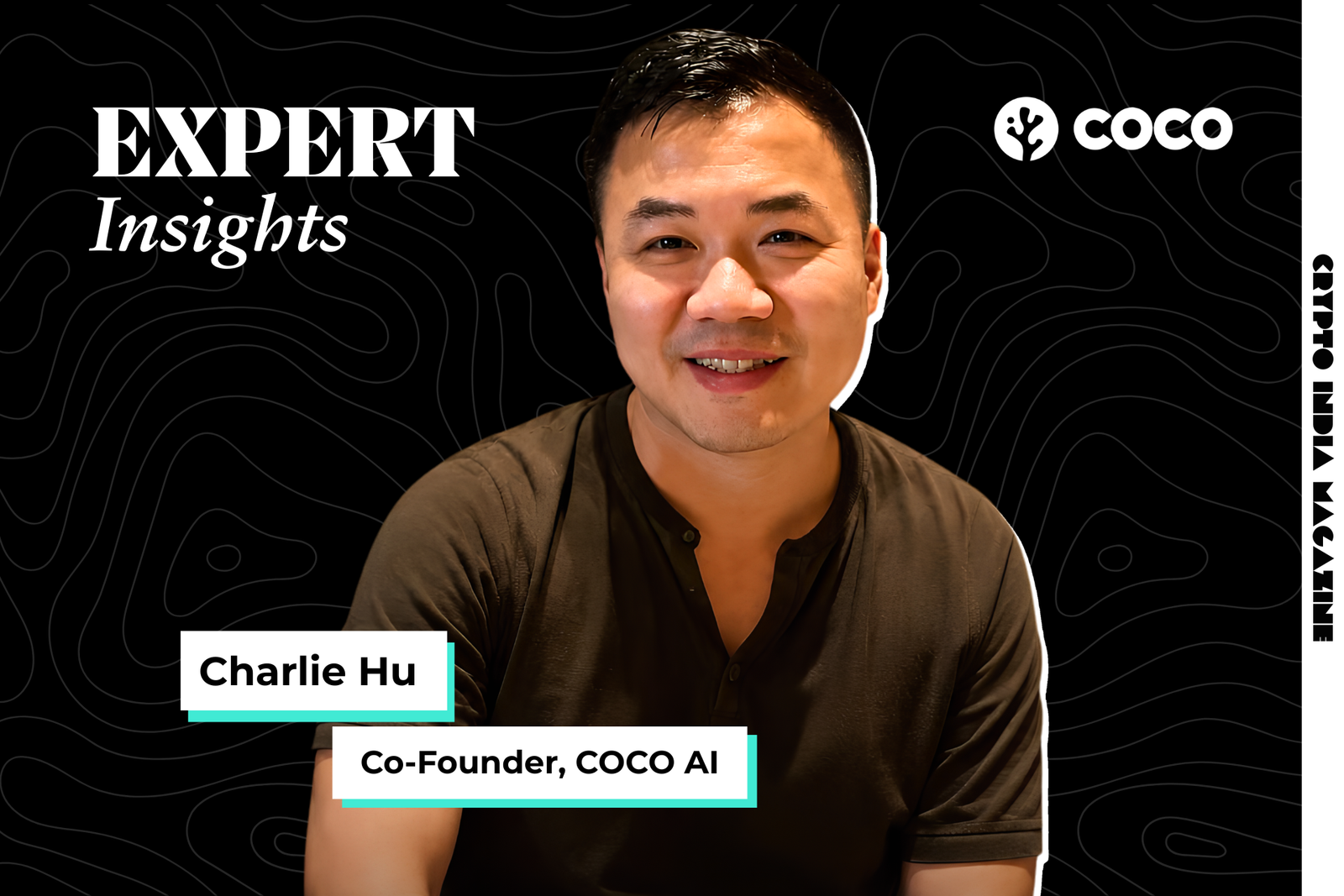
I spoke with Charlie Hu, Co-Founder of COCO AI, about how this shift is unfolding inside companies today. COCO AI, which builds multi-agent systems for enterprises, works with more than 500 businesses across sectors, including e-commerce, logistics, F&B, gaming, and digital marketing. That vantage point has given Charlie a front-row seat to the challenges and opportunities businesses face as they move from experimenting with AI tools to integrating AI into everyday operations.
From AI native teams and enterprise adoption to the risks of relying on foundation models, Charlie shared his perspective on where the industry is headed.
The following is an excerpt from our conversation.
In conversation with Charlie Hu
Polina: You’ve described the founder opportunity today as sitting in the orchestration layer, but you’ve also warned that the opportunity disappears once foundation model companies build those capabilities themselves. How is COCO protecting its position, and how much time do founders realistically have before that window narrows?
Charlie: A lot of frontier models are pushing quality forward at an incredible pace. That’s why we started focusing not only on helping enterprises hire better with AI, but also on bringing an AI workforce to small and medium-sized businesses through multi-agent teams. Currently, COCO AI has over 600 paying customers across industries, including e-commerce, gaming, and digital marketing, and we’re continuing to expand into new sectors as well.
In terms of the time window, I think it’s very important to find our niche because we’re in the B2B enterprise space, not B2C. Once customers start using our solution and our agents become deeply embedded in their workflows, while also delivering a great user experience, it becomes a work habit across the organization. That creates trust, increases retention, and raises switching costs.
By combining the capabilities of frontier models with our orchestration layer and agentic systems, we can deliver higher-quality outcomes overall. In the end, customers don’t even need to understand which large language model they’re using. We filter, curate, and deploy the best model for their specific needs. I wouldn’t say frontier model companies are going to eat our lunch. They may build and manage some specialized agents themselves, but I see it as collaboration rather than pure competition.
Polina: Your team went from 80 people to 15 humans plus 50+ agents. What broke first, and what still requires humans?
Charlie: As frontier models improved and coding agents like Cursor and Claude Code emerged, AI started augmenting a lot of our software development output. Over the last 12 months, we accelerated our restructuring efforts and went from around 80 employees down to just 8 people at our lowest point. We launched a new version of our COCO Enterprise solution, and after releasing V2, we started growing the team once more.
In the AI era, especially in today’s rapidly evolving AI landscape, we prioritize hiring AI natives. They understand their domain deeply and know what high-quality output looks like, whether in coding, design, content creation, or any other discipline. They’re comfortable coordinating with both people and AI agents and can work in teams where agents are actively participating in workflows and decision-making processes.
Currently, our team of 15 people manages around 60 AI agents. On average, that’s roughly four agents working alongside each employee 24/7. I think it’s a fantastic setup. Agents are now handling a huge amount of work, while our 15-person team is producing an incredible amount of output. I would estimate that the average person’s productivity is at least five times higher than it was last year when we had an 80-person organization. Back then, we had significant communication overhead and coordination costs.
Polina: You’ve said, “If it isn’t recorded, it didn’t happen.” How did the team react to that culture shift, and how do you prevent it from feeling like surveillance?
Charlie: Being a co-founder of an AI-native company comes with a few assumptions. One, the AI is generating very high-quality output. Our AI understands our business and how it operates. It’s constantly monitoring our competitors, industry leaders, and potential clients. This is why we go to offline events, record things, and observe what’s going on.
Humans have become the new frontier: we are the eyes and ears gathering information our AI cannot access, especially from exclusive, private events. We capture what our potential clients, partners, and competitors are saying and what’s happening with new product releases. We then transcribe those audio files, summarize the relevant content, and feed it back to the AI.
This is crucial for the AI to understand what’s happening in the real world. Because regardless of GPT-5 or other powerful new models today, they don’t inherently have access to real-world, physical data. The fully realized physical models from top AI research teams are still likely two or three years away. Obviously, I’m very bullish on foundation models, but right now, we are still operating in a purely digital intelligence world. Physical AI is the new frontier.
So, humans are the real team members on the frontier, feeding the AI real data. We act as the filter, the ears, and the eyes. In return, we get highly intelligent feedback based on the data we provide. AI becomes our second brain and a co-founder-level advisor. I don’t treat my AI like modern slave labor just to do grunt work. I treat it as a highly intelligent business leader and thought partner for me and my company.
In the end, surveillance and privacy come down to where your data is stored. Governments and large corporations often require local, on-premise, private deployments, recognizing that both surveillance and privacy come at a cost.
We work closely with providers like Google Cloud that are legitimate, mature, and well-established leaders in business and technology. We offer this cloud infrastructure as an enterprise plan for our Fortune 500 client companies using this structure. It handles information with ease, allowing for convenient access, upselling, upgrading, downgrading, or simply canceling. However, we do not recommend the cloud version for those who truly care about privacy and wish to maintain an ultra-private experience.
Polina: COCO’s runtime, Zylos, is fully open source. That’s a significant decision, especially when it sits so close to the core of what you’re building. What did you choose to open source and what did you keep proprietary? How does that support the business long term?
Charlie: There’s been a lot of talk about decentralized AI and privacy-focused AI. I think it’s becoming a pretty important topic. I see some solutions trying to position themselves as decentralized AI alternatives to OpenAI and Anthropic. They offer alternative AI model solutions for certain companies or individuals who really value that and are willing to pay for them.
For that, open-source models that you can host locally can add a privacy layer or a ZK layer, which I’m pretty familiar with as someone who’s been in Web3 for the last 10 years. I’ve seen a lot of ZK solutions. I think that’s a very interesting niche offering compared to the mainstream options like OpenAI’s GPT and Anthropic’s models.
On one side, you have all the big companies doing the centralized corporate version of large models. On the other side, you have open-source models and smaller vertical AI players offering alternatives. They differentiate themselves through cost, making inference cheaper for clients, or by being decentralized.
While the frontier AI labs are building the most powerful and expensive AI models, there are alternatives. COCO AI stands in the position of building agentic solutions for enterprises. We don’t build our own large model—we are model agnostic. We want better, cheaper, and ideally faster models that work with us.
And after spending many years in Web3, you can’t stop thinking about decentralization, privacy, and building protected systems.
One argument people often raise is that when you’re using a model like Anthropic’s, you’re feeding potentially valuable proprietary data into another company’s system. That’s not ideal because they’re capturing a lot of the value created from that interaction. It’s great for them, but the dynamic isn’t necessarily fair.
ALSO READ: Jordan Jefferson on Building the Financial Layer Dogecoin Has Been Missing
Polina: Many AI companies spend too much time talking to other builders in San Francisco and not enough time talking to actual customers, which led you to focus on places like Los Angeles and Miami. As a company based in Singapore, how does that geographic strategy connect back to Asia, and where are most of your 500-plus customers today?
Charlie: Many highly technical companies in San Francisco have already figured out how to build their own agentic solutions. We’re serving a different segment: mid-tech companies. By that, I mean companies that aren’t AI-native or deeply technical but are digitally savvy and want end-to-end AI solutions for their businesses.
Today, we have around 20 paying customers in the United States, mostly in places like Los Angeles and Miami. Among our 500+ paying customers globally, the majority are in the Asia-Pacific region: Singapore, Hong Kong, Thailand, Vietnam, and increasingly Korea and Japan. We’re also beginning to see traction in mainland China.
We’re getting some early customers in the Middle East as well, although that isn’t a major focus for us yet. From an industry perspective, we see strong traction and clear product-market fit in e-commerce, gaming, and digital marketing.
Polina: You often talk about a shift from the “Copilot era” to the “Autopilot era,” where humans become involved only occasionally rather than constantly. At the same time, you’ve previously written that you won’t fully automate things like outreach. Where do you see the line between assistance and autonomy, and which business functions will be the first to make that transition?
Charlie: People want to know how they can actually use AI in their day-to-day work and inside their companies. The answer varies because every company has different needs, but we do see some common patterns.
One major area is coordination across departments and functions, especially in organizations with multiple offices or franchise operations. Since COVID, remote work has become the norm, and AI agents can coordinate activities across teams much faster and more seamlessly. That’s a fairly universal problem that exists across industries, and it’s one that AI can solve effectively.
The next frontier, in my opinion, is client acquisition and user acquisition—the next generation of CRM systems, sales management, and outbound outreach. This is where AI delivers the highest ROI. There’s an ongoing debate around using AI primarily to reduce costs, which often means reducing headcount. That creates understandable resistance from employees and society.
I believe the most valuable AI use cases are the ones focused on revenue generation: finding new customers, identifying new opportunities, and exploring prospects that would otherwise take enormous amounts of time, or never be discovered at all.
That’s where AI creates value rather than simply cutting costs.
Polina: You’ve said Anthropic is the AI company you most admire because of its focus and culture. As someone building on top of foundation models, how do you think about the risk of depending on platforms you don’t control? And what steps do you take to reduce that dependency?
Charlie: It’s a bit of a love-hate relationship. We use Anthropic extensively, it’s probably one of the most advanced frontier AI companies today. At the same time, it’s still a centralized company. The concerns around governance and security that originally led people to leave OpenAI and start Anthropic are still legitimate.
My view is that competition is healthy. Every new AI model is competing against the others, and competition creates higher quality, innovation, and checks and balances.
We’re also seeing the emergence of decentralized AI projects, which could become useful for certain use cases. We don’t want to depend entirely on a single model provider because, ultimately, every provider requires a degree of trust. For some industries, particularly privacy-sensitive sectors and Web3, that “trust me, bro” dynamic doesn’t sit well.
Anthropic is a great company. Their valuation has increased dramatically, and their revenue has grown several times over recently. I believe they’ll continue to succeed. But for COCO AI, as a company building on top of large language models and agentic frameworks, we can’t rely on a single provider.
Polina: You’ve highlighted the Forward Deploy Engineer as a key role for the AI era. What’s one thing someone should do this month to stay valuable over the next three years?
Charlie: We’re entering an interesting era where people with business backgrounds can translate customer requirements directly into working prototypes using AI. That’s precisely what I’m doing. I’m speaking with enterprise customers, understanding their needs, and translating those needs into AI solutions in real time. I’m pushing myself to become a forward-deployed product engineer. I’m the business co-founder, and I lead growth, business development, and partnerships. I’m not a traditional engineer. What’s changed is that AI coding tools have become so powerful that I can now build many things myself at a prototype level without depending on engineers internally or externally.
The engineers nowadays need to understand customer pain points, articulate requirements clearly, and rapidly build prototypes with AI to validate ideas. That dramatically reduces the communication gap between business requirements and working products. Once that gap closes, sales cycles become much faster, and it’s easier to acquire customers.
A prime example of this occurred last Monday when I met with Hafary, a publicly listed ceramic manufacturing company in Singapore. The founder brought me in as a consultant and gathered about 20 representatives from various departments into a single room. During the session, I answered their questions, listened to their specific pain points, and provided live demonstrations of AI use cases tailored to different teams, such as finance.
Normally, it would take up to two months, but now we are able to achieve this in under two weeks. This accelerated timeline is an incredibly powerful asset for a forward-deployed engineer. It is a structural shift I am actively witnessing within my own company and across the broader industry.
Editorial Note: This article is based on an interaction between Polina and Charlie Hu, Co-Founder of COCO AI. The excerpt has been published as originally shared, without any modifications to the questions or answers. Only the introduction has been added to provide additional context and enhance readability.


Can You Trust AI With Your Crypto? Francesco Andreoli Thinks You Can, With Limits
MetaMask opened Agent Wallet to all users on August 6, 2026, giving AI agents a scoped wallet across 22 EVM chains and Hyperliquid. Francesco Andreoli, Head of Developer Relations at Consensys, walks through the policy engine, the $10,000 Transaction Protection, and where users get it wrong.
Interview with Adam Budínský: Trezor’s Head of Hardware on the Safe 7, Open Security, and Self-Custody
The Trezor Safe 7 just won a 2026 Red Dot Award for Product Design. Head of Hardware Adam Budínský talks to CIM about the device's open, auditable, secure element, the push to end blind signing on Ethereum, the touchscreen threat model, and why self-custody adoption still lags in India.

Dr. Shobhit Navani on Crypto’s Dark Side, Regulatory Gaps, and Institutional Shift
The crypto industry is not ignorant of its darker dimensions. Money laundering, terrorism financing, cybercrime, the limits of sovereign regulation,…

Jordan Jefferson on Building the Financial Layer Dogecoin Has Been Missing
Dogecoin was built as a joke. Jordan Jefferson is betting it becomes the most accessible financial platform in crypto. The CEO of DogeOS spoke to us at Consensus Hong Kong 2026 about building real utility on the world's favourite meme coin, and why the punchline was always the point.