Now Reading: Gata Presents Decentralized AI Infrastructure for the Trillion-Dollar AI Economy
-
01
Gata Presents Decentralized AI Infrastructure for the Trillion-Dollar AI Economy

Gata Presents Decentralized AI Infrastructure for the Trillion-Dollar AI Economy

Gata, a decentralized AI supercomputer in BNB Chain’s MVB 7 program, has raised $4 million in seed funding. Names that led the round include Gate Ventures, IDG Blockchain, Maelstrom Fund, and Manifold. Now, with over 800,000 users and 300,000 contributing nodes across 180 countries, Gata is unveiling its full decentralized AI infrastructure. It is built to challenge the dominance of cloud giants like OpenAI, Google, and Amazon.
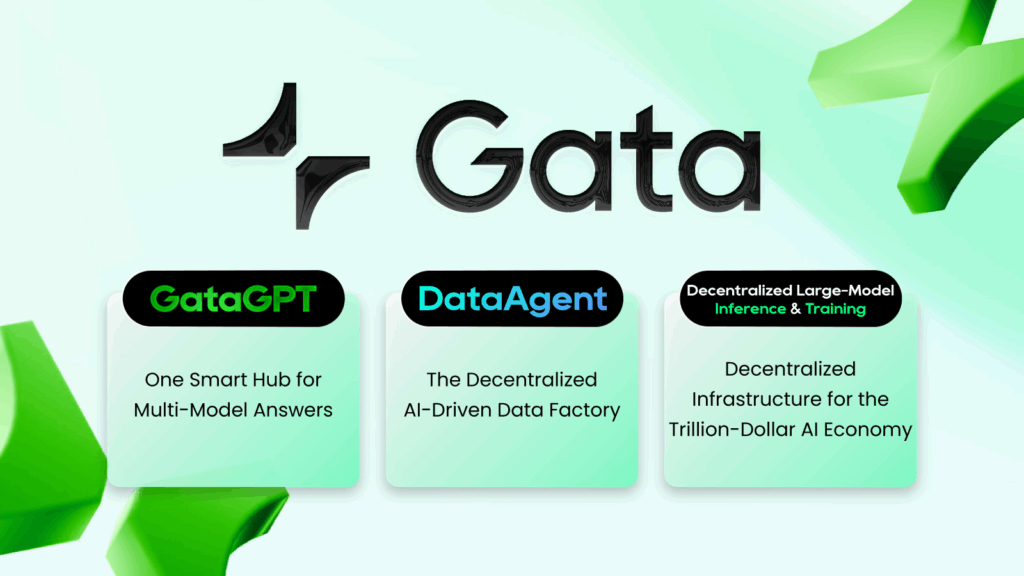
At the heart of Gata’s stack are three components: GataGPT, a multi-model intelligent interaction layer; DataAgent, an AI-powered data factory; and its decentralized model training and inference protocols. Together, these form what Gata calls an “AI supercomputer for everyone.”
Why does this matter? Over 60% of the world’s AI compute is concentrated in the hands of a few companies. This gives rise to concerns about censorship, innovation bottlenecks, and exclusionary access. Gata proposes a solution: an open infrastructure where compute, data, and value flow back to users, not monopolies.
DataAgent, now live, uses AI to automate large-scale, high-quality data labeling—accelerating dataset generation for models like Stable Diffusion and GPT-4o. It has already processed over 15 million multimodal images. Contributions are validated via decentralized consensus and recorded on-chain, enabling over 99.5% accuracy while scaling globally through browser-based nodes.
GataGPT goes beyond being a chatbot. It aggregates responses from top AIs like ChatGPT, Gemini, and DeepSeek to reduce single-model bias. Users contribute conversation data in return for “GPT-to-Earn” incentives, with over 3.5 million entries recorded. All data is encrypted and stored on BNB Greenfield, giving users full ownership.
Meanwhile, Gata’s decentralized inference and training engine distributes trillion-parameter models across geo-distributed GPUs. This drastically reduces compute costs by up to 95%, enabling model training without reliance on centralized servers. Validators monitor integrity, while results are stored on-chain for transparency and incentivization.
Gata envisions real-world applications ranging from localized language assistants in Hindi, Arabic, or Thai to AI infrastructure for DeFi, DAOs, and smart contract analytics. The roadmap includes model crowdfunding, allowing researchers to launch compute-intensive training with global support, and pay-per-use compute metered in FLOPs, bringing cloud economics to decentralized networks.
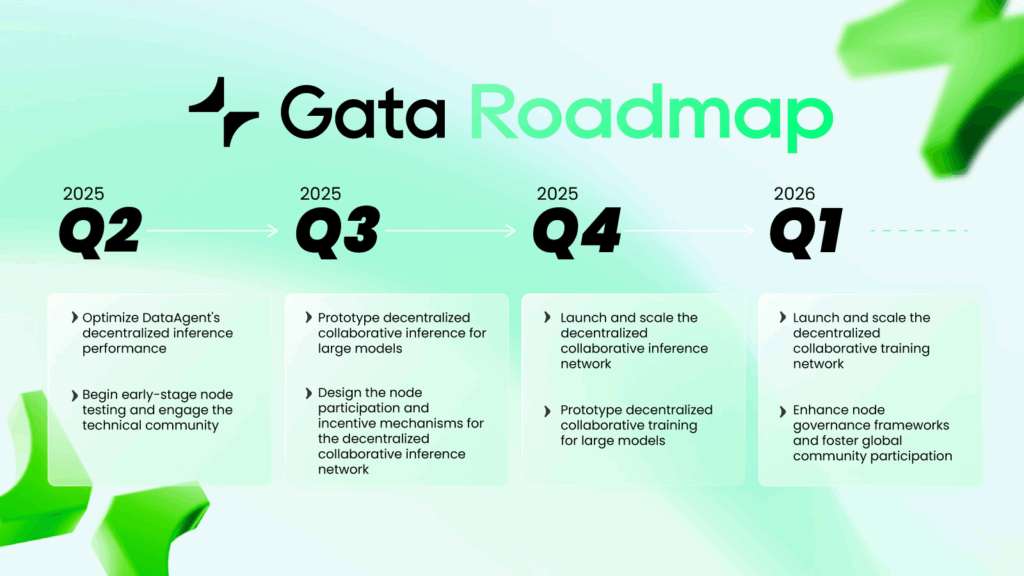
The project plans to launch its utility token, GATA, in Q4 2025.
The larger implication? Gata is attempting what many consider the holy grail of AI infrastructure. It is breaking the cloud monopoly, returning data sovereignty to users, and enabling AI to evolve. That too, not as a product of a few, but as an open system for many.
With mounting concern over AI censorship, data control, and economic exclusion, Gata’s timing may be spot-on. Whether it can match the speed and reliability of centralized incumbents remains to be seen—but it’s giving the trillion-dollar AI economy a serious decentralization thesis to reckon with.
Editorial Note: This news article has been written with assistance from AI. Edited & fact-checked by the Editorial Team.
Interested in advertising with CIM? Talk to us!