

Key points
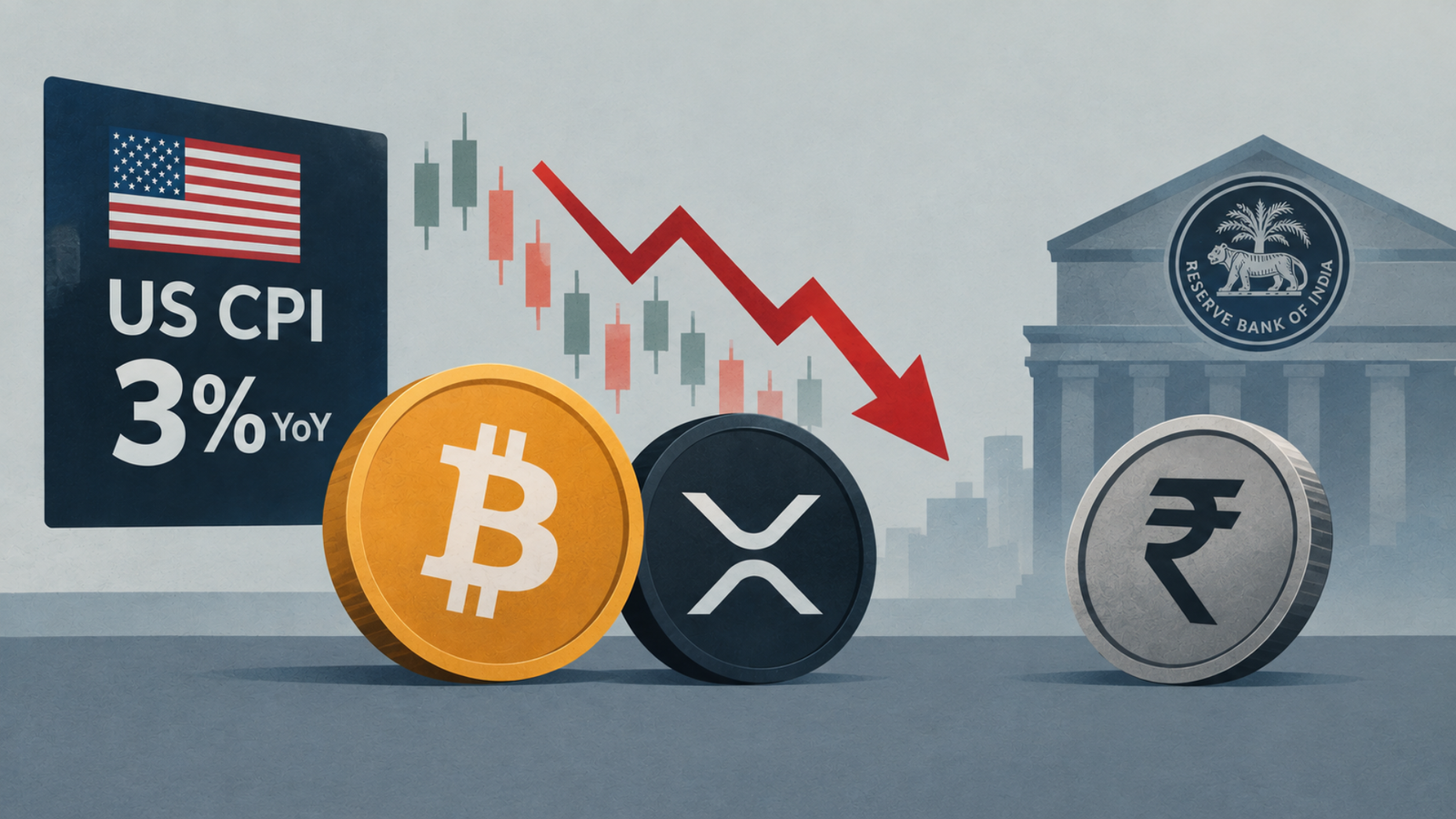
- The delayed US September Consumer Price Index landed this week at 3% year-on-year, and Bitcoin fell below $81,000 while XRP dropped more than 4% in 24 hours as roughly $1 billion in crypto positions were liquidated.
- The rupee is trading near its record low against the dollar, with the Reserve Bank of India deploying foreign-exchange intervention, dollar-inflow windows, and rate measures to slow the slide.
- A weak rupee cushions part of the dollar price fall for Indian holders, so the rupee-denominated prices of Bitcoin and XRP can move differently from their US dollar quotes.
The US September Consumer Price Index rose 3% year-on-year, data released this week showed, below the 3.1% economists expected and up from 2.9% in August. Crypto markets fell anyway. Bitcoin dropped back below $81,000 and XRP slid more than 4% over 24 hours, as the US CPI print collided with a Reserve Bank of India campaign to defend a rupee sitting near its record low. For Indian holders, the result is a market where Bitcoin and XRP prices in India could diverge from their US dollar quotes.
The inflation reading had been delayed by the US government shutdown and was published to let the Social Security Administration finish its annual cost-of-living calculation. Core CPI, which strips out food and energy, also came in at 3%, while the monthly headline gain slowed to 0.3% from 0.4% in August. Gasoline was the largest single driver, rising about 4.1% over the month, according to the US Bureau of Labor Statistics. Traders read the mix as sticky rather than soft, and risk assets sold off.
The move hit digital assets hard. Bitcoin traded near $80,884 on October 15, down about 3% on the day and 2.5% over the week, while XRP changed hands around $1.31, down 4.2% in 24 hours and 7.7% over seven days, CoinGecko data showed. The broader market shed close to $1 billion in liquidated positions, and CoinGecko’s Fear and Greed gauge sat at 35, in “fear” territory. Both assets retreated even though spot XRP exchange-traded funds recorded inflows the same week.
The India layer sits on top of that global move. The rupee has fallen more than 7% in 2026 and traded within a fraction of its record low near 96.97 per dollar, first reached in May. Foreign investors have pulled almost $30 billion out of Indian equities this year, and the country’s foreign-exchange reserves fell for a fourth straight week to $734 billion in the week ended October 2, down from a record $785 billion a month earlier, Reserve Bank of India figures showed. The central bank has leaned on direct dollar sales, higher rates, and measures to attract dollar inflows, and on October 10 it opened a special window to supply dollars to state-run oil companies.
ALSO READ: What India’s Crypto Investors Are Getting Right
HDFC Bank economist Sakshi Gupta said rate hikes offer only a weak short-term defence, because the rupee’s weakness is being driven by crude oil prices, equity valuations, foreign outflows, the global AI trade, and US dollar strength rather than by domestic rates alone. That assessment frames why the RBI’s tools can slow the depreciation without reversing it.
The currency channel is what separates the Indian picture from the dollar one. When a global investor measures Bitcoin, the only variable is the dollar price. An Indian holder faces two moving parts: the dollar price of the asset and the rupee’s value against the dollar. A falling rupee raises the rupee cost of every dollar of crypto, which can partly offset a dollar-price decline. On October 15, Bitcoin was quoted near ₹76.7 lakh and XRP near ₹124.35 in rupee terms, levels that reflect both the global sell-off and the rupee’s weakness.
That interaction is why Bitcoin and XRP prices in India can diverge from their headline dollar charts on days like this one. A 3% dollar drop in Bitcoin translates into a smaller rupee drop when the rupee is also weakening against the dollar, and the gap widens or narrows with each RBI intervention that moves the exchange rate. XRP adds a second India-specific thread through its cross-border payment use case, which keeps Indian trading desks watching Ripple’s settlement and institutional activity alongside the currency.
XRP’s ledger activity has continued to draw institutional attention even through the price decline. For Indian investors, the near-term question is whether the RBI’s defence holds the rupee steady enough to stabilize local crypto quotes, or whether continued outflows keep the currency and the two assets moving on separate tracks.
Editorial Note: Reported and edited by the Crypto India Magazine editorial team. We use AI tools to assist with research and drafting; every article is reviewed and fact-checked by our editors.
Interested in advertising with CIM? Talk to us!


Binance to Shut Down Binance Pool and Related Mining Services on November 10
Binance is closing Binance Pool and related mining services on November 10, 2026, at 07:00 UTC. The shutdown ends Cloud Mining, Pool Savings, the Transaction Accelerator, hashrate alerts, and the pool API. Miners must switch pools, redeem Pool Savings, and verify accounts before the cutoff.
“Your Computer Is Hacked”: CBI Busts India-Based Bitcoin ATM Scam Targeting US Seniors
India’s CBI has arrested four people over an alleged India-based Bitcoin ATM scam that impersonated Microsoft and pushed elderly US citizens into crypto payments. A Florida victim lost about $440,000 and a New Jersey victim about $130,000, as India tightens rules on crypto-enabled crime.

Vitalik Buterin Warns AI Could Weaken Crypto Security in Two Years
Ethereum co-founder Vitalik Buterin warns AI-accelerated math research has a "good chance" of seriously weakening lattice-based cryptography within two years. He also flagged added ECDSA risk and said Ethereum's Lean roadmap is shifting toward hash-based signatures.

Bitget Loses $351.6 Million in Hack, CEO Points to North Korea
Crypto exchange Bitget lost roughly $351.6 million after attackers spoofed transfers from its hot and warm wallets. CEO Gracy Chen ties the breach to a North Korea linked group, suspends withdrawals, and says the User Protection Fund covers the loss.