

For years, crypto investing in India was driven solely by price. Investors tracked every market move, reacted to every headline, and often made decisions based on short-term volatility rather than long-term conviction. Crypto was viewed as something to trade, not something to accumulate systematically.
But that behaviour is changing as the market matures. The biggest shift in India’s crypto market today isn’t Bitcoin’s price or institutional adoption. It’s that more and more Indians are approaching crypto the same way they approach other long-term investments, with discipline, consistency, and clear portfolio allocation.
SIPs are becoming the preferred way to invest
One of the strongest indicators of this shift is the rapid adoption of crypto SIPs. Across major Indian exchanges, systematic investment plans (SIPs) in crypto grew more than 60% year-on-year in 2025. Investors are increasingly choosing to invest fixed amounts every month instead of trying to time market cycles.
That behaviour is fundamentally different from speculation. Speculators increase exposure when markets are rising and disappear during corrections. Long-term investors continue investing regardless of market conditions because they’re focused on building wealth over years, not predicting next week’s price movement.
This shift has been particularly evident in 2026. Bitcoin started the year above $93,000, corrected towards $60,000 during the first half, and is now trading around $66,000, which is well below its October 2025 peak of nearly $126,000. Despite this volatility, monthly SIP participation has remained resilient, and that suggests investors are becoming less concerned about finding the perfect entry point and more focused on consistent accumulation over time.
Why this approach feels familiar to Indian investors
This transition hasn’t required investors to learn an entirely new investing philosophy. Indian households have spent decades building wealth through systematic investing. Mutual fund SIPs have become one of the most successful investment habits in the country because they remove the need to constantly predict market movements.
Crypto SIPs follow the same principle. By investing a fixed amount at regular intervals, investors automatically buy more when prices are lower and fewer units when prices are higher. Over time, this helps average the purchase cost while removing emotions from investment decisions.
More importantly, it creates consistency. Instead of asking whether today is the right time to invest, investors commit to a long-term plan and allow market cycles to play out.
Crypto becoming part of diversified portfolios
Perhaps the most meaningful change is where crypto now fits within an investor’s overall financial plan.
A few years ago, many investors viewed crypto as a high-risk bet capable of generating outsized returns. Today, more investors see it as one component of a diversified portfolio.
We’re increasingly seeing investors combine traditional instruments like EPF, PPF, mutual funds, fixed deposits, and gold with a measured allocation to digital assets. Rather than concentrating risk in a single asset class, they’re building portfolios that balance stability with long-term growth potential.
This approach also changes how investors respond to volatility. When crypto represents a carefully defined allocation within a broader portfolio, short-term corrections become easier to navigate. Investors are less likely to make emotional decisions because their overall financial goals are not dependent on daily price movements.
Regulation and taxation are encouraging longer-term investing
India’s crypto tax framework continues to attract debate, particularly the 30% tax on gains and the 1% TDS on transfers, both of which remain in place following the 2026-27 Budget.
For active traders, these provisions increase transaction costs and reduce capital efficiency. Frequent buying and selling becomes less attractive when each trade carries a tax implication.
Interestingly, this has also encouraged many investors to adopt longer investment horizons.
Rather than chasing short-term price movements, more investors are choosing to build positions gradually through SIPs and hold quality assets across market cycles. While the current crypto tax framework was not necessarily designed with this outcome in mind, it has reinforced the case for discipline, reducing speculation.
A more mature market
None of this suggests crypto has become a low-risk asset. Volatility remains an inherent characteristic of the market, and investors should continue to size their allocations appropriately.
What has changed is the mindset. With more than 119 million Indians estimated to own crypto, many of them under the age of 35 and increasingly coming from Tier-2 and Tier-3 cities, the market is beginning to resemble other mature investment categories. Investors are spending less time reacting to short-term price fluctuations and more time building long-term portfolios.
That evolution may ultimately prove more significant than any single bull market.
Markets will always move in cycles. Prices will rise and fall.
But when investors develop the discipline to stay invested through those cycles, the market itself becomes stronger. And that is perhaps the clearest sign that India’s crypto ecosystem is entering its next phase of maturity.
Editorial Note: This article has been written by a contributor to Crypto India Magazine (CIM). The views, opinions, and claims expressed in this article are solely those of the author and do not necessarily reflect the views of Crypto India Magazine. CIM does not assume responsibility for the accuracy, completeness, or reliability of the information, opinions, or statements presented in this article.


JPMorgan Brings JPM Coin Dollar Deposit Token to Ethereum
JPMorgan Chase is bringing JPM Coin (JPMD), its US dollar deposit token, to Ethereum for institutional clients, moving beyond Base where it launched in November 2025. Kinexys cited Ethereum’s onchain liquidity. The token stays restricted to approved, vetted counterparties.

Indian Finance Minister Flags 2027 Risk as Stocks Slide and Jio Hits Crypto Rails
Indian Finance Minister Nirmala Sitharaman named capital outflows as a top 2027 risk, speaking in Bangkok as Indian stocks fell over 12% and foreign investors pulled $33 billion. The warning lands as Jio’s record IPO is already priced through Bitget’s JIOUSDT pre-IPO crypto futures.
Capital B Posts €69.5M H1 2026 Loss Despite Buying More Bitcoin
Capital B reported a €69.5 million ($78M) net loss for the first half of 2026, with about 97% of it a non-cash Bitcoin impairment tied to the June 30 price. Revenue rose 3.5%, and the French treasury company kept buying, holding 3,538 BTC by September 30, up 25.3% since January.
Rupee Near Record Low Splits Bitcoin and XRP Prices in India From the Dollar
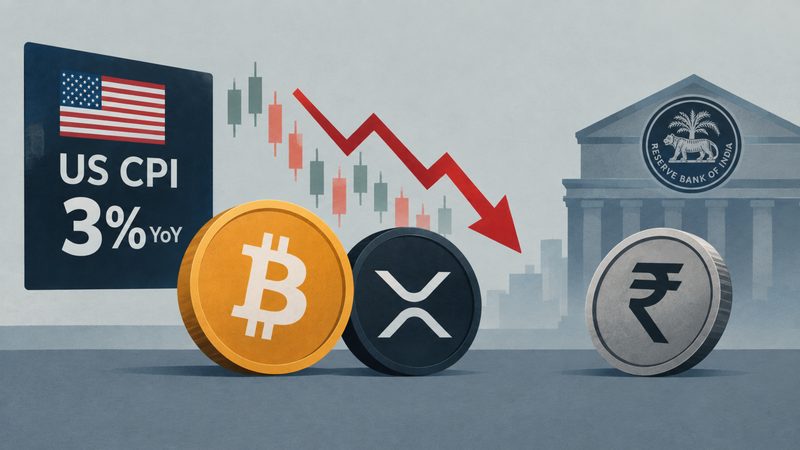
The delayed US September CPI came in at 3% and crypto sold off, with Bitcoin below $81,000 and XRP down over 4%. With the rupee near a record low and the RBI intervening, Bitcoin and XRP prices in India can move differently from their US dollar charts. Here is why that happens.
[…] ALSO READ: What India’s Crypto Investors Are Getting Right […]