

Key points
- Researchers at Clarkson University built a mathematical framework called Rex that improves the accuracy and control of diffusion and flow-matching models, the engines behind many generative AI systems.
- Rex lets AI systems reverse their own generation process with far less error, which matters for round-trip image editing, molecular design, and scientific simulation.
- The paper was accepted as an Oral at the International Conference on Machine Learning (ICML) 2026, placing it in the top 0.7% of submissions.
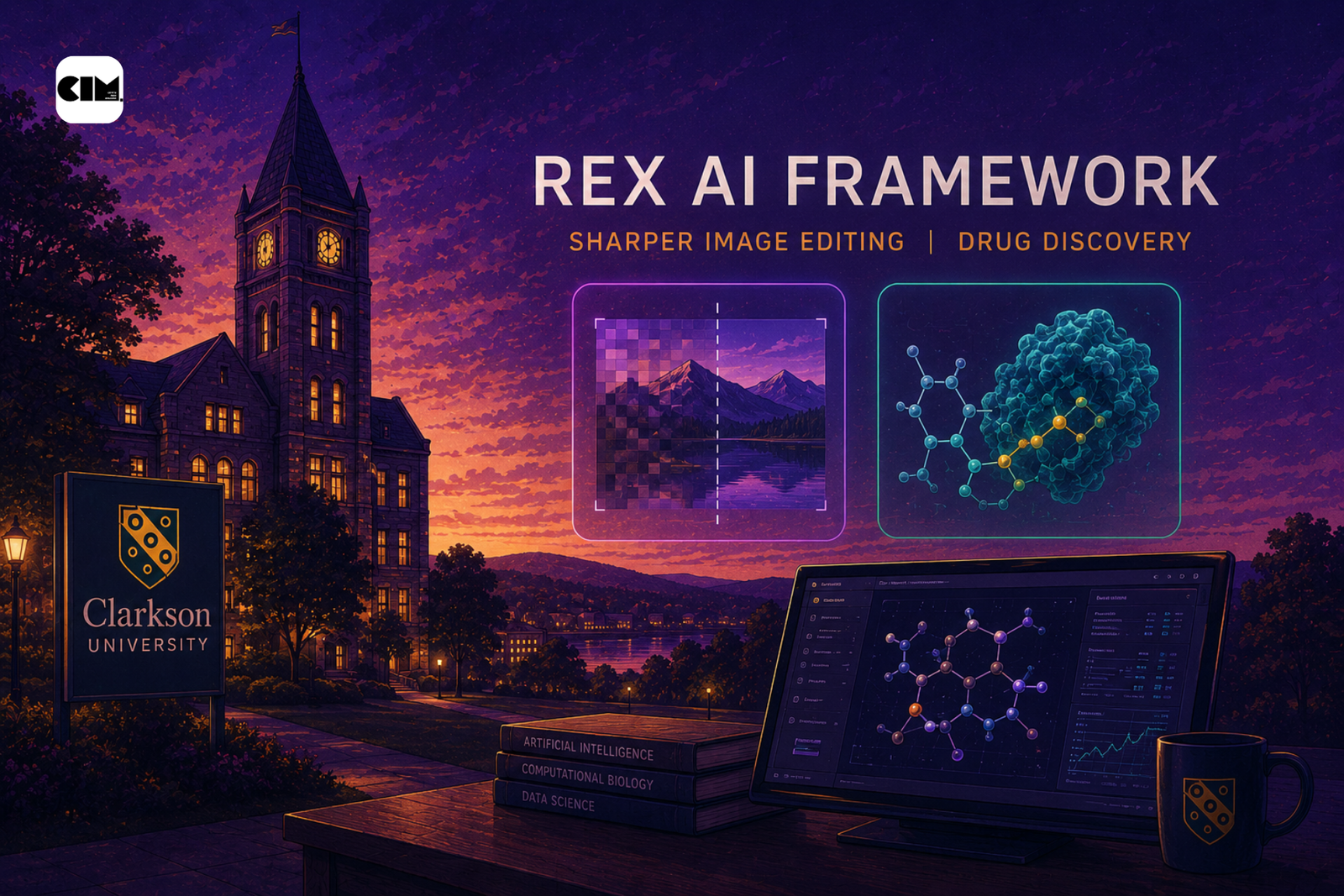
Researchers at Clarkson University in the United States have developed a mathematical framework called Rex that aims to make generative AI systems more accurate and controllable across image editing, drug discovery, and scientific simulation. The framework was built by Zander Blasingame, a postdoctoral researcher, and Chen Liu, professor of electrical and computer engineering at Clarkson.
Their paper, titled “Rex: A Family of Reversible Exponential (Stochastic) Runge-Kutta Solvers,” was accepted as an Oral at the International Conference on Machine Learning (ICML) 2026, one of the field’s leading venues. Blasingame announced the Oral selection on May 24, 2026. ICML reserves Oral slots for a small fraction of accepted work, and the paper sits in the top 0.7% of submissions.
“One important application of exact inversion solvers is round-trip image editing. While all reversible methods accumulate some numerical error, Rex achieves orders-of-magnitude lower inversion error than competing approaches,” Blasingame said in a statement.
Rex targets diffusion and flow-matching models, which underpin modern image generators, molecular design tools, and scientific simulators. These models work by transforming random noise into structured outputs such as images or molecular conformations. Many downstream tasks require running that process in reverse to recover the original input, a step called inversion. Existing methods often accumulate errors during inversion, which limits precision and control.
According to the project documentation, Rex aligns the forward and reverse processes so that running a model forward and then backward returns the original state, up to floating-point error. The construction applies Lawson’s exponential transformation to an explicit Runge-Kutta scheme, then wraps it in a reversible coupling introduced by McCallum and Foster in 2024. The result works in both the probability-flow ODE and reverse-time SDE settings, where earlier reversible solvers were limited to the ODE case and first-order accuracy.
The researchers validated Rex on several tasks, including unconditional image generation on CelebA-HQ-256, conditional generation with Stable Diffusion v1.5, image editing on the pix2pix dataset, and Boltzmann sampling of molecular conformations. They reported that Rex outperformed prior reversible baselines such as EDICT, BDIA, and O-BELM across the tested metrics.
For image editing, Rex could allow users to modify AI-generated images while preserving fine detail. For chemistry and drug discovery, the same precision applies to molecular simulations, where small inversion errors can distort results. A practical advantage is that Rex functions as a drop-in replacement for standard solvers, so teams can adopt it without redesigning existing pipelines.
Blasingame and Liu will present the work at ICML 2026, alongside other research on solvers for generative diffusion systems.
Editorial Note: Reported and edited by the Crypto India Magazine editorial team. We use AI tools to assist with research and drafting; every article is reviewed and fact-checked by our editors.
Interested in advertising with CIM? Talk to us!

Vitalik Buterin Warns AI Could Weaken Crypto Security in Two Years
Ethereum co-founder Vitalik Buterin warns AI-accelerated math research has a "good chance" of seriously weakening lattice-based cryptography within two years. He also flagged added ECDSA risk and said Ethereum's Lean roadmap is shifting toward hash-based signatures.

Crypto.com’s AI Agent Is Still in Stealth Mode, Eight Months After Its Super Bowl Debut
Eight months after a Super Bowl ad and a record $70 million domain, Crypto.com's ai.com personal AI agent is still in stealth mode. We look at why it is taking so long, and test the theory that the AI industry's new safety slowdown is behind the delay. It is not.

BlackRock Says AI Agents Will Drive the Next Stablecoin Boom
BlackRock's new paper, The Machine-Native Economy, argues autonomous AI agents will become a major source of stablecoin demand, settling machine to machine payments for data, APIs, and compute. It also floats tokenized compute as a new asset class, while conceding the market is early.

The $4.5 Billion Crypto VCs Raised in A Bear Market Came with A Different Pitch, and the New One Is Spelled “AI”
Crypto startup funding hit a 12-month low in April 2026, yet a16z crypto, Haun Ventures, Dragonfly, and Framework Ventures closed billions in new funds. Polina examines why LPs kept writing checks and how stablecoins, tokenization, and AI agents became the pitch that worked.