


May is always a fruitful month in Bangkok, one of the major Web3 hubs in APAC. After a year’s break, Southeast Asia Blockchain Week returned to the Thai capital and took place from the 20th to the 21st of May, where the broader crypto and fintech communities in Thailand engaged in meaningful conversations and built partnerships to scale industry development.
The core narratives at Southeast Asia Blockchain Week included stablecoins as a fuel for the digital economy in SEA, tokenized products, and cross-border payments, highlighted by opening remarks from ShardLab and sessions on cross-border “payment passports” and stablecoin-powered money movement.

Agent Commerce: rebuilding payments with stablecoins and wallets
Blockchain moves beyond speculation into real-world infrastructure where AI agents transact autonomously, purchase services, settle invoices, and manage budgets without human interaction at each step. The payment and settlement infrastructure already supports agent-native commerce, where stablecoins emerge as the default settlement layer. Speakers with backgrounds in payments, stablecoin infrastructure, and custody discussed wallet architecture, programmable payment rails, and the design challenges of building financial systems where the end user is software rather than a person. They also addressed the issues that still need to be solved before agent commerce can operate reliably at scale.
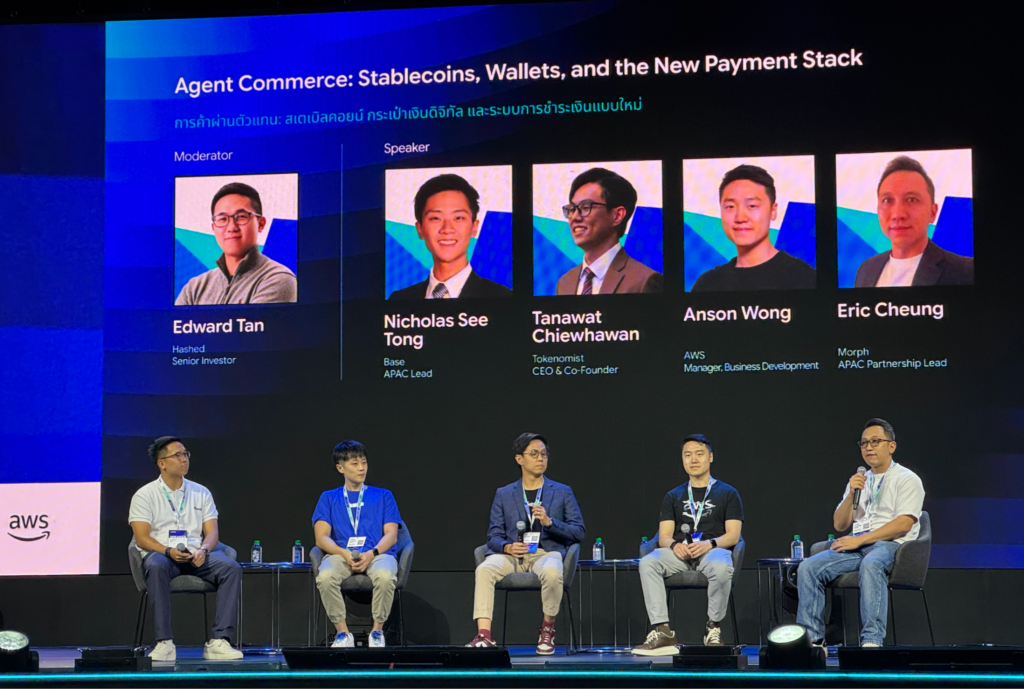
“When an AI agent can initiate, settle, and reconcile a cross-border B2B payment for a multi-million dollar transaction with no human intervention, that’s a game-changer. This moment is when the payment acts as a way of life with compliance checks built in and full auditability on-chain, and nobody thinks that’s unusual. It just becomes normal treasury infrastructure.” – Eric Cheung, APAC Partnerships Lead at Morph.
The importance of regulation, compliance, and enterprise-ready infrastructure for Web3 growth. The institutions are increasingly exploring blockchain for settlements, financial products, and programmable transactions rather than purely speculative use cases.
“I think we’re still a couple of years away from that becoming routine at an institutional scale, but the foundational pieces are being built right now. That’s why these conversations matter today, not five years from now. One thing that’s important in this space is not overselling where we are. People can tell the difference between real infrastructure progress and hype.” – Eric added.
Institutions should also start thinking seriously about governance and engage with regulatory sandboxes where possible. Places like Singapore and Hong Kong create environments for experimentation today. Institutions waiting for complete global regulatory clarity will probably fall behind the ones already testing these systems in controlled settings. Blockchain offers capabilities that traditional financial infrastructure never really supported, and the organizations that adopt those tools early will help shape the standards everyone else follows.
Stablecoins are powering Southeast Asia’s digital economy
Southeast Asia Blockchain Week clearly proved that stablecoins are no longer a buzzword. Banks are moving from pilots to implementation, and stablecoins transition into the infrastructure layer of APAC’s real economy, starting from cross-border remittances to institutional settlement and B2B commerce.
Stablecoin regulation in Asia, especially in Hong Kong, Singapore, Indonesia, Japan, and Thailand, genuinely gains traction in the region. There is a better regulatory alignment coming to every market in Asia.
Although USDT and USDC still remain predominant in trading and DeFi, there is a huge opportunity for local Asian stablecoins that is yet to be unlocked, and local stablecoins present a real opportunity for cross-border settlements and cross-border remittances. It no longer is a “why,” but rather a “how.”
Viable opportunities of real-world asset tokenization in APAC
Regulatory fragmentation remains one of the biggest challenges when it comes to tokenization across the whole APAC. RWA tokenization and the digital asset sector are increasingly developing into a market with its own drivers that are becoming less tied to short-term crypto price cycles. That shift is creating demand for infrastructure that institutions can trust at scale.
Solutions for broader adoption needed to be flexible enough to work within different regulatory landscapes in the region and still give market participants access to global liquidity and infrastructure.
Institutional interest in digital assets across APAC is changing significantly. Security and operational resilience are now a higher priority than they were a few years ago. The countries actively adjust their regulations and billions of dollars in assets and activity toward more secure infrastructure. As adoption grows, platforms that can consistently meet institutional standards are likely to benefit the most.
Editorial Note: This article has been written by a contributor to Crypto India Magazine (CIM). The CIM editorial team has not made any changes to the content. The views and insights expressed remain entirely those of the author.


What Is the CLARITY Act? Inside the Crypto Bill the US Senate Refused to Advance
The US Senate blocked the CLARITY Act in a 49-50 procedural vote on September 15, 2026. This explainer covers what the crypto market structure bill would do, who introduced it, how it passed the House, and why ethics, banks, and Democrats stalled it in the Senate.

The $4.5 Billion Crypto VCs Raised in A Bear Market Came with A Different Pitch, and the New One Is Spelled “AI”
Crypto startup funding hit a 12-month low in April 2026, yet a16z crypto, Haun Ventures, Dragonfly, and Framework Ventures closed billions in new funds. Polina examines why LPs kept writing checks and how stablecoins, tokenization, and AI agents became the pitch that worked.

How Invoice Financing Can Help Investors Become Partners in India’s Growth Story
India's invoice financing debate has centered on MSME working capital. Vinod Varma, Co-Founder and CEO of UpTik, argues the investor side deserves equal attention. Every financed invoice puts private capital behind a business that has already delivered, and awareness is now the binding constraint.

What India’s Crypto Investors Are Getting Right
Crypto SIPs across major Indian exchanges grew more than 60% year-on-year in 2025, and monthly participation has held through a steep 2026 drawdown. Prateek Gupta, Head of Business at Mudrex, argues that India's retail investors are now treating crypto as a portfolio allocation rather than a trade.