


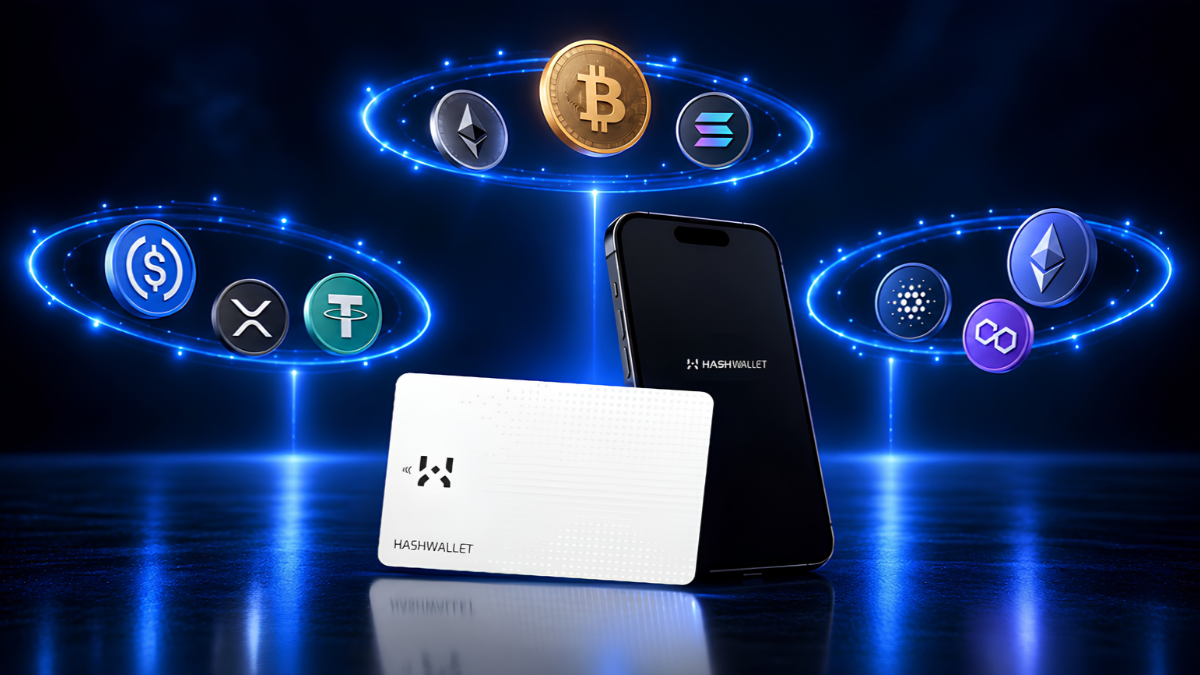
Self-custody gives users control over their crypto assets, but it does not necessarily mean privacy.
Public blockchains are transparent, so anyone can inspect balances, transactions, and activity associated with a public address. The level of exposure depends heavily on how those addresses are used and how a user organizes different parts of their activity.
Modern wallets already provide several ways to create separation. Hashwallet adds another through multiseed, letting several independent cryptographic roots coexist on the same card.
Understanding what that changes starts with something much simpler: how addresses actually work.
One Seed Can Create Many Wallets and Addresses
A seed can generate multiple wallets and addresses, and knowing one public address does not automatically reveal all the others derived from the same seed.
That already gives users a meaningful degree of separation.
For example, someone could create:
- ETH 1 for everyday activity
- ETH 2 for long-term holdings
- ETH 3 for interacting with dApps
Each wallet has a different public address, even if all three were generated from the same seed.
If someone sees the address of ETH 1, they do not automatically know that ETH 2 and ETH 3 belong to the same person.
This is one of the basic privacy advantages of HD wallet structures.
The Way Addresses Work Depends on The Blockchain
Different networks organize activity differently.
On account-based networks such as Ethereum, a wallet normally keeps the same public address over time.
That address may hold ETH as well as tokens such as USDC, USDT, or PEPE. Anyone who knows the address can inspect its balances and activity.
If that same address is used for payments, dApps, and long-term holdings, all of that activity sits under one visible public identity.
Creating another Ethereum wallet gives the user another public address and therefore another environment.
Bitcoin and other UTXO-based networks work differently.
A single wallet can create many public addresses. HD wallets generate new addresses as part of normal operation, helping avoid reusing the same address across multiple transactions.
This adds an extra layer of separation within the same wallet structure.
Privacy Already Starts with Good Wallet Organization
A user does not need several seeds to start separating activity.
Different wallets and addresses under one seed can already be used for different purposes.
Someone might keep one wallet for everyday use, another for savings, and another for interacting with decentralized applications.
This can make it harder for an observer who sees one address to immediately understand the user’s wider financial activity.
Good wallet organization therefore plays an important role in on-chain privacy.
The next question is what happens when a user wants stronger separation between those environments.
The Next Layer: Independent Seeds
Several wallets generated from one seed remain part of the same cryptographic structure.
Several seeds begin from completely independent cryptographic roots.
For example:
Seed 1: Savings
- BTC 1
- ETH 1
- ETH 2
Seed 2: Daily use
- BTC 1
- ETH 1
Seed 3: Work
- BTC 1
- ETH 1
Nothing in Seed 2 is derived from Seed 1, and Seed 3 starts from another independent root.
This creates deeper compartmentalization.
Nothing links one seed to another at the cryptographic level. Each starts from its own independent root, so the different parts of a user’s activity no longer share a common origin.
From Self-Custody to Compartmentalized Self-Custody
Self-custody is usually discussed in terms of control: who owns the keys and who can move the funds.
But control is only one part of user security.
How activity is divided, what information can be connected, and how easily different financial contexts can be kept separate also matter.
This is where multiseed becomes relevant.
Hashwallet allows multiple independent seeds to coexist inside the same card.
A user can dedicate one seed to long-term savings, another to everyday activity, and another to professional or higher-risk interactions.
Each seed can then generate its own wallets and addresses.
The result is a layered structure:
One card → Several independent seeds → Multiple wallets → Multiple public addresses
This structure does more than organize activity.
Concentrating everything under a single root means one problem can reveal the whole picture. Spreading activity across independent seeds keeps any single event contained.
If a seed is exposed, only the activity under that seed is affected. The other seeds, and everything held under them, stay separate.
Making Stronger Separation Practical
The traditional problem with having several seed phrases is managing them.
For example, three recovery phrases mean three sets of words and, therefore, three different secrets that must be kept secure over time.
Some users solve this with several hardware wallets, which adds cost and complexity.
Hashwallet brings those independent seeds into the same hardware environment.
In addition, thanks to the Hashwallet recovery process, users do not need a recovery phrase to recover access.
The cryptographic separation remains, but the user needs only one card and one application.
This makes stronger compartmentalization easier to use in practice.
Privacy as Part of The Self-Custody Architecture
Public blockchains remain transparent.
The user’s privacy depends partly on how much information becomes connected around that transparency.
HD wallets already help through organization. Different wallets and addresses under one seed can help keep everyday activity from sitting under a single public identity.
Independent seeds add a second kind of privacy. By keeping parts of a user’s activity on separate roots, they mean that if one seed is exposed, it does not reveal the rest.
One layer organizes. The other compartmentalizes. Together they give the user more control over how much of their financial activity has to belong to the same environment.
This moves self-custody beyond the question of who controls the keys, and turns it into a question of how the activity is divided and how little of it needs to be connected.
The Technology Behind Hashwallet
eSignus is a Spanish cybersecurity company specialized in self-custody and hardware-based protection for digital assets. It has received several cybersecurity awards for its innovation in the field. Through its Hardware Wallet as a Service (HWaaS) solution, it also enables other organizations to create custom self-custody solutions based on its technology and under their own brand.
Key Self-Custody and Privacy Features
- Self-custody and on-chain privacy: Self-custody determines who controls the private keys, while on-chain privacy relates to how easily activity on a public blockchain can be linked. Controlling private keys does not automatically make transactions private, as this also depends on how seeds, wallets and transactions are managed.
- Multiple addresses under one seed: A single seed can generate multiple wallets and public addresses. Knowing one public address does not automatically reveal every other address derived from the same seed.
- Separation of financial activity: Using different wallets provides different public addresses, helping users separate their financial activity. Hashwallet extends this approach by allowing separate wallets to be managed across multiple independent seeds on the same physical card.
- Independent cryptographic roots: Multiple seeds create independent cryptographic roots, allowing different groups of wallets to remain compartmentalized. If one seed is exposed, this does not by itself reveal the activity associated with the other independent seeds.
- On-chain activity can still be linked: Using independent seeds does not guarantee complete transaction privacy. Transfers between wallets, address reuse or identifiable transaction patterns may allow blockchain analysis to establish links between otherwise separate activity.
- Multi-seed management from a single card: Hashwallet allows multiple independent seeds to coexist on the same physical card, enabling users to separate different areas of their crypto activity without having to manage multiple hardware devices.
This press release has been provided by the client. Crypto India Magazine does not endorse and is not responsible for or liable for any content, accuracy, quality, advertising, products, or other materials on this page. Readers should do their own research before taking any actions related to the company. Crypto India Magazine is not responsible, directly or indirectly, for any damage or loss caused or alleged to be caused by or in connection with the use of or reliance on any content, goods, or services mentioned in the press release.


Devcon 8 Brings Ethereum’s Global Developer Community to Mumbai
The Ethereum Foundation brings Devcon 8 to Mumbai from November 3 to 6, 2026 at the Jio World Centre. The conference lands in India for the first time, with nine tracks, more than 300 speakers and contributors including Vitalik Buterin, and supporters led by Base and Fluid.

CoinSwitch Ventures Rebrands as BlackLane Capital, Expands Early-Stage Investment Mandate Globally
CoinSwitch Ventures has rebranded as BlackLane Capital, an independent global early-stage fund. The firm is expanding beyond Web3 into fintech, infrastructure, consumer and digital assets, writing cheques up to $5 million and targeting over $100 million in startup funding across five years.

Vaia Expands into the US Market, Bringing Its AI Intelligence Platform to American Financial Institutions
Bengaluru-born AI company is building a deeper US presence as financial institutions accelerate adoption of agentic AI across investment, wealth and enterprise workflows

Europe’s Premier FX, Crypto & Fintech Event – Wiki Finance Expo Cyprus 2026 is Coming to Limassol This November
Mark your calendars for WIKIEXPO CYPRUS 2026, taking place on November 6, 2026 at the prestigious Parklane, a Luxury Collection Resort & Spa. As one of Europe’s most influential gatherings for the foreign exchange and fintech services industry, the event is set to welcome over 5,000 professionals, 50+ distinguished speakers, and 50+ exhibitors from more than 30 countries.