

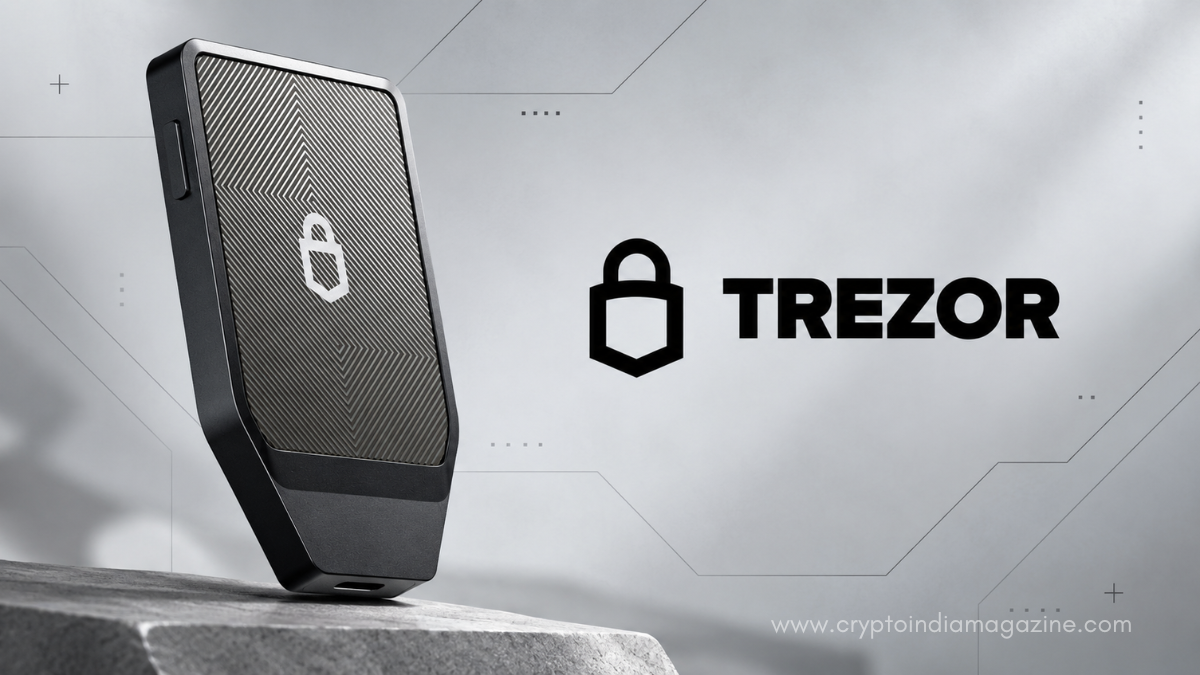
PRAGUE, 8 Sept 2026 — Trezor, the original hardware wallet, has switched on Clear Signing across its devices. Users interacting with major Ethereum protocols can now see what a transaction actually does, in plain language, on the Trezor screen before they approve it: the action, the tokens, the amounts, and the destination. For years, hardware wallets could only show these transactions as a hash or the words ‘Data Present,’ because no shared standard existed to make them readable. That gap is what attackers exploited. Clear Signing closes it.
Clear Signing is live for all contracts in the ERC-7730 registry, covering major protocols including: 1inch, Aave, Lido, Tether, LiFi, Hyperliquid, and others. Coverage grows as more protocols publish descriptors to the open registry.
Blind signing was a gap in the ecosystem, not a flaw in any one wallet
When someone interacts with a decentralised app, the app’s website shows a readable summary of the transaction on the computer screen. The wallet itself sends calldata: a string of hexadecimal that encodes the function being called and its parameters. The hardware wallet screen, until now, could only show that as a hash. The problem is that the readable version lived on the computer screen, which is the part an attacker can compromise, while the hardware wallet screen, the part they cannot compromise, showed nothing a user could act on. Users were left confirming on the device based on what the untrusted screen told them.
No single wallet could fix this alone. Making a transaction readable requires a shared way to describe what each smart contract does, published by the protocols themselves and held in a neutral registry. That standard did not exist until ERC-7730. The Ethereum Foundation launched it in May 2026 with a coalition of wallets and security firms, framing blind signing as a structural failure behind hundreds of millions in losses.
The February 2025 Bybit hack, around 1.5 billion US dollars and the largest in crypto history, worked this way. Attackers compromised the web interface of the wallet software Bybit used, altering what the signers saw so they approved a transaction that handed control of the funds to the attackers. The signers could not see the real transaction they were authorising. That is the class of attack Clear Signing is built to defeat: a device that decodes the transaction itself showing the real action, whatever a compromised interface displays.
What Clear Signing shows
The Trezor device decodes the raw calldata itself, using the ERC-7730 descriptor, and displays the transaction on its trusted screen: the action such as “Swap” or “Approve,” the tokens with correct tickers and decimals such as “1,000 USDC” instead of “1000000,” and the destination. The user reads it, checks it matches what they intended, and signs. If a compromised website had swapped in a different transaction, the device shows the real one, and the user simply does not sign.
The decoding happens against the raw data on the device, not against what the website claims. This is the core of the security improvement. A malicious frontend can change what appears in a browser, but it cannot change what the Trezor screen decodes and displays. Nothing changes in the user’s workflow. Clear Signing works through Trezor Suite, WalletConnect and Trezor Connect, with no new software to install and no setting to enable.
“A hardware wallet has always protected your keys. What it did not protect was the decision to sign. You were confirming a hash you couldn’t read. You were trusting a browser window. Now the device shows you the real transaction on the one screen malware cannot touch. If it does not match what you meant to do, you do not sign.”
— Anderson Guimarães, Firmware Product Manager, Trezor
Why an open standard, and why now
Clear Signing only works if the data that translates a transaction is open, neutral and verifiable. A wallet writing its own private transaction descriptions would be a closed system that does not extend to new protocols and asks users to trust the wallet maker rather than verify for themselves. That runs against the point of self-custody. Trezor implemented the open standard because it is the version that holds up: the entire Clear Signing stack, from the ERC-7730 parsing to the display logic, is open-source and auditable, consistent with how Trezor has built its firmware for over a decade.
Because the entire stack is open-source and the descriptors that power it are public, anyone can inspect and verify what the device shows, rather than trusting a company’s word for it. Contracts in the registry are audited and attested to by wallets and security providers, the registry itself is open for anyone to review. This is security you can check, not a claim you have to take on faith.
A standard that is spreading
Adoption of ERC-7730 has grown from one wallet at launch to five, with Trezor the latest to implement it, alongside Ledger, Ambire, Gemini and WalletChan. The registry behind the standard is filling in as protocols publish descriptors: on-chain transaction descriptors grew by around 28 per cent between the May launch and the end of July.
“Clear signing is a good example of the ecosystem coordinating to raise the security baseline. As adoption expands to more hardware wallets, such as Trezor, it protects individual users from approving transactions they can’t read, and reduces the ecosystem’s exposure to the kind of large-scale incidents that damage trust well beyond the parties directly involved.”
— Hester Bruikman, Cluster Coordinator Access Layer, Ethereum Foundation
What comes next
Clear Signing covers the contracts in the registry today, and falls back to the standard blind-signing warning for those not yet listed. The work from here is coverage: more protocols publishing descriptors, more of everyday DeFi becoming readable by default. Readable transactions are one layer of signing security, not the whole of it, and Trezor has said it will keep contributing to the standard as adoption widens.
“The principle is simple: what you see is what you sign. The text on the device screen matches what executes on-chain. Getting the whole ecosystem to that point is bigger than any one company, which is why the open standard is the right way to build it.”
— Tomáš Sušánka, CTO, Trezor
About Trezor
Trezor gives users a safe and easy way to control and protect their digital assets and privacy. As the inventor of the world’s first hardware wallet, Trezor created an entirely new industry and remains its most experienced producer. Both its hardware and software have been fully open-source from the very beginning, reflecting a core belief that collaboration improves security. Trezor is fully self-funded and answers only to its users, staying focused on the usability, security, and privacy of its products. Trezor’s mission is to empower individuals to achieve financial independence through self-custody, and to build a secure ecosystem for all.
This press release has been provided by the client. Crypto India Magazine does not endorse and is not responsible for or liable for any content, accuracy, quality, advertising, products, or other materials on this page. Readers should do their own research before taking any actions related to the company. Crypto India Magazine is not responsible, directly or indirectly, for any damage or loss caused or alleged to be caused by or in connection with the use of or reliance on any content, goods, or services mentioned in the press release.


CoinSwitch Ventures Rebrands as BlackLane Capital, Expands Early-Stage Investment Mandate Globally
CoinSwitch Ventures has rebranded as BlackLane Capital, an independent global early-stage fund. The firm is expanding beyond Web3 into fintech, infrastructure, consumer and digital assets, writing cheques up to $5 million and targeting over $100 million in startup funding across five years.

Vaia Expands into the US Market, Bringing Its AI Intelligence Platform to American Financial Institutions
Bengaluru-born AI company is building a deeper US presence as financial institutions accelerate adoption of agentic AI across investment, wealth and enterprise workflows

Europe’s Premier FX, Crypto & Fintech Event – Wiki Finance Expo Cyprus 2026 is Coming to Limassol This November
Mark your calendars for WIKIEXPO CYPRUS 2026, taking place on November 6, 2026 at the prestigious Parklane, a Luxury Collection Resort & Spa. As one of Europe’s most influential gatherings for the foreign exchange and fintech services industry, the event is set to welcome over 5,000 professionals, 50+ distinguished speakers, and 50+ exhibitors from more than 30 countries.

WebX 2026 Draws Over 13,500 Attendees in Its Latest Edition, Spotlights Japan’s Growing Global Influence In Web3
WebX 2026 Tokyo concluded its fourth edition with 13,641 participants from more than 90 countries and over 70 side events. Discussions across three stages covered yen stablecoins, megabank tokenization and rising institutional confidence. WebX returns on 25 to 26 August 2027 at Tokyo Big Sight.