


- A new research paper argues that Bitcoin-backed lending could tap into the massive $130 trillion global fixed-income market.
- Institutional-grade Bitcoin lending reached $24 billion in 2025, within a total lending volume of $74 billion.
- Current Basel III and IV rules assign a prohibitive 1,250% risk weighting to Bitcoin exposures for traditional banks.
- The paper proposes a “gold standard” featuring 30% LTV caps, multi-signature custody, and real-time proof-of-reserves to prevent past crises.
Bitcoin is quietly positioning itself to enter one of the most conservative corners of global finance: fixed income. A new research paper released in January 2026 argues that Bitcoin-backed lending has matured into a viable form of institutional-grade collateral. This shift could potentially unlock a $130 trillion market that largely remains closed to digital assets.
The $130 Trillion Opportunity
The paper titled The Bitcoin Lending Standards of 2026 posits that Bitcoin can now function effectively as collateral. The real question is whether financial institutions are ready to update risk frameworks built for an analog system.
The authors estimate that Bitcoin-backed lending volume reached $74 billion in 2025. This volume is split between centralized finance platforms and decentralized protocols. Regulated and institutional-facing lenders contributed $24 billion to this total.
While this figure is small compared to traditional credit markets, the paper highlights the massive scale of the opportunity. A mere 1% allocation from global fixed income would represent more than 50 times the current institutional Bitcoin lending market. The authors argue this gap is structural rather than speculative.
Regulatory Hurdles for Banks
Regulation remains a significant obstacle. Under current Basel III and IV rules, Bitcoin exposures carry a punitive 1,250% risk weighting. This makes holding Bitcoin economically unworkable for traditional banks.
For example, a €1 million Bitcoin-collateralized loan requires the bank to set aside the full €1 million in capital. In contrast, a residential mortgage of equal size requires just €22,400. Consequently, family offices, private debt funds, and non-bank lenders have become the primary participants in this market.
Learning from the 2022 Crisis
The research also revisits the failures of the 2022 crypto lending crisis. Platforms collapsed after operating with high loan-to-value (LTV) ratios, opaque rehypothecation practices, and platform-controlled custody.
The authors stress that these failures did not stem from Bitcoin itself. Instead, they resulted from leverage structures that mirrored historical credit bubbles like the 2008 mortgage crisis.
A New “Gold Standard” for Lending
In response to these risks, the paper outlines a “gold standard” for Bitcoin-backed lending. This framework centers on:
- Conservative LTV ratios capped at 30%.
- Multi-signature custody structures to prevent unilateral control of collateral.
- Real-time proof-of-reserves.
- Strict limits on rehypothecation.
According to the analysis, a 30% starting LTV can withstand a 65% price decline before reaching liquidation thresholds. This buffer covers nearly all historical Bitcoin drawdowns.
Bitcoin as Superior Collateral
Beyond lending mechanics, the paper examines the unique properties of Bitcoin as collateral. Unlike traditional assets, Bitcoin has no issuer and trades continuously. It settles instantly and carries no counterparty risk when held in self-custody.
Additionally, the Bitcoin supply remains capped at 21 million coins. Inflation dropped below 1% following the 2024 halving. The authors argue that traditional credit risk models fail to capture these characteristics because they prioritize long track records and stable cash flows.
The Path Forward
The conclusion is cautious but forward-looking. Volatility and regulatory uncertainty remain challenges. However, the paper suggests Bitcoin-backed lending has entered a phase of institutional professionalization.
Recent developments signal that frameworks are already evolving. These include regulatory clarity in parts of Europe and the acceptance of Bitcoin ETFs as collateral.
The authors note that the opportunity is not without risk. Yet for institutions willing to adopt conservative standards, Bitcoin-backed lending may represent a structural shift in how modern credit markets define collateral. Whether traditional banks follow non-bank lenders into this space will depend on how quickly regulatory models adapt to this digitally native asset class.
Editorial Note: Reported and edited by the Crypto India Magazine editorial team. We use AI tools to assist with research and drafting; every article is reviewed and fact-checked by our editors.
Interested in advertising with CIM? Talk to us!


Clarity Act Defeat Hands SEC and CFTC the Lead on U.S. Crypto Rules
The Senate's 49-50 vote on September 15 stalled the Clarity Act. Within 48 hours, the SEC issued an Innovation Exemption for tokenized stocks, and the CFTC sent a crypto markets rulemaking to the White House and broadened no-action relief for passive software providers.
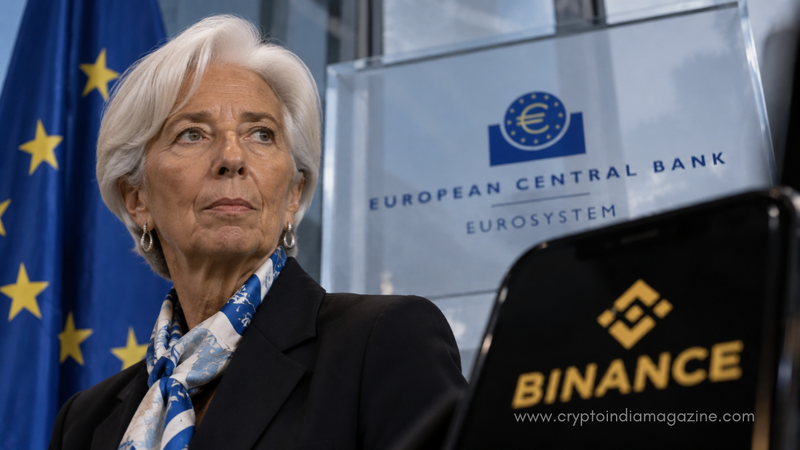
ECB’s Lagarde Intervened to Block Binance’s EU MiCA License: WSJ
ECB President Christine Lagarde asked Greek PM Kyriakos Mitsotakis not to approve the Binance MiCA license, the WSJ reports. Greece had signaled approval to ESMA in early June before Binance withdrew on June 24. Greek officials deny interfering, and Binance declined to comment on speculation.

The $4.5 Billion Crypto VCs Raised in A Bear Market Came with A Different Pitch, and the New One Is Spelled “AI”
Crypto startup funding hit a 12-month low in April 2026, yet a16z crypto, Haun Ventures, Dragonfly, and Framework Ventures closed billions in new funds. Polina examines why LPs kept writing checks and how stablecoins, tokenization, and AI agents became the pitch that worked.

MENA Crypto Volume Hits $350 Billion as Gulf Adoption Accelerates
MENA crypto volume climbed to an estimated $350 billion by 2025-2026 from about $100 billion in 2022, according to the Bitcoin Policy Institute. Turkey leads by transaction value, the UAE by institutional flows, and Saudi Arabia by growth, as conflict and regulation reshape demand.