
Key points
- Moonshot AI’s Kimi K2 Thinking outperformed GPT-5 and Claude 4.5 across key reasoning and coding benchmarks.
- The one-trillion-parameter MoE model activates 32B per inference and supports 256k-token context windows.
- Fully open-source under a Modified MIT License, K2 Thinking costs up to 10x less than GPT-5 while matching or exceeding its performance.
Moonshot AI, the Chinese startup backed by Alibaba, has unleashed a shockwave across the global AI industry with the release of its Kimi K2 Thinking model, a trillion-parameter behemoth that has outperformed OpenAI’s GPT-5 and Anthropic’s Claude 4.5 Sonnet across key reasoning and coding benchmarks.
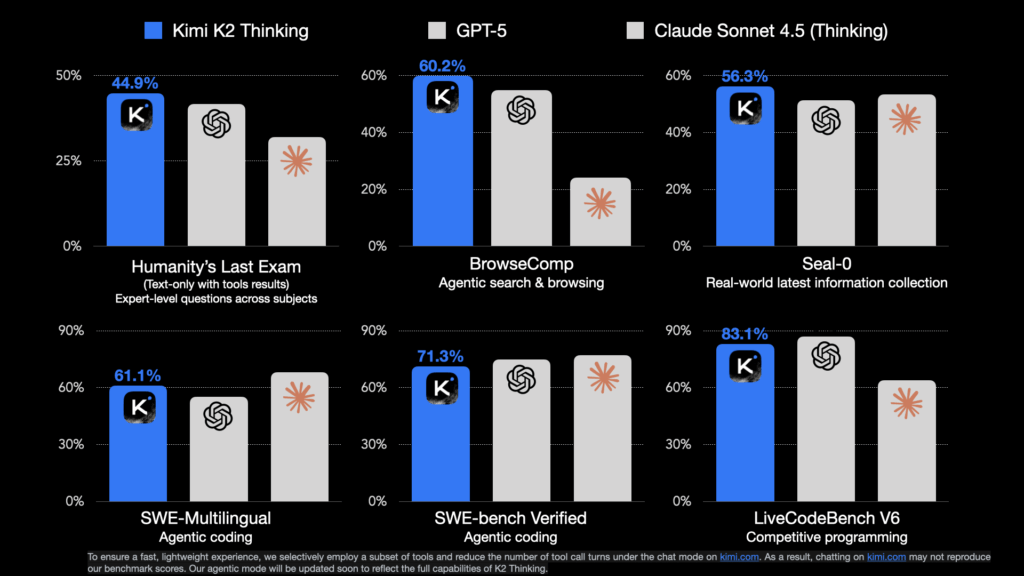
Launched on November 6, Kimi K2 Thinking achieved state-of-the-art results, scoring 44.9% on Humanity’s Last Exam, 60.2% on the BrowseComp web reasoning benchmark, and 71.3% on SWE-Bench Verified, cementing its lead over both U.S. and Chinese peers. Built as a Mixture-of-Experts (MoE) model, it activates 32 billion parameters per inference from a trillion-parameter total and supports a 256,000-token context window, enabling deep reasoning over extended conversations.
Unlike proprietary systems, K2 Thinking is fully open-source under a Modified MIT License, allowing unrestricted commercial use with a light attribution clause for massive-scale deployments. Its transparent reasoning design exposes each logical step in outputs, helping users verify multi-stage problem-solving in real time, a rarity among closed models.
Despite its massive scale, the model’s runtime efficiency is exceptional: it costs just $0.15 per million tokens (cache hits) and $2.50 for output, nearly ten times cheaper than GPT-5’s reported pricing. Moonshot AI claims it can perform 200–300 sequential tool calls autonomously, marking a new high for “agentic” reasoning systems that can plan, execute, and self-correct tasks without human guidance.
Benchmarks reveal K2 Thinking not only outpaces GPT-5 (54.9%) and Claude 4.5 (24.1%) in BrowseComp, but also matches or exceeds GPT-5 in technical reasoning and coding domains. This milestone effectively collapses the performance gap between open-weight models and frontier proprietary systems.
K2 Thinking’s rise comes as major U.S. AI firms face growing scrutiny over $1.4 trillion in cumulative AI infrastructure spending. With open-weight systems like Moonshot’s K2 and MiniMax-M2 achieving near or superior results at a fraction of the cost, the economics of “bigger is better” AI are now being fundamentally questioned.
For enterprises, this marks a paradigm shift. High-end reasoning and coding performance no longer requires billion-dollar data centers; it’s now available, freely and openly, from China’s rapidly evolving AI ecosystem.
Editorial Note: This news article has been written with assistance from AI. Edited & fact-checked by the Editorial Team.
Interested in advertising with CIM? Talk to us!

Vitalik Buterin Warns AI Could Weaken Crypto Security in Two Years
Ethereum co-founder Vitalik Buterin warns AI-accelerated math research has a "good chance" of seriously weakening lattice-based cryptography within two years. He also flagged added ECDSA risk and said Ethereum's Lean roadmap is shifting toward hash-based signatures.
Crypto.com’s AI Agent Is Still in Stealth Mode, Eight Months After Its Super Bowl Debut
Eight months after a Super Bowl ad and a record $70 million domain, Crypto.com's ai.com personal AI agent is still in stealth mode. We look at why it is taking so long, and test the theory that the AI industry's new safety slowdown is behind the delay. It is not.

BlackRock Says AI Agents Will Drive the Next Stablecoin Boom
BlackRock's new paper, The Machine-Native Economy, argues autonomous AI agents will become a major source of stablecoin demand, settling machine to machine payments for data, APIs, and compute. It also floats tokenized compute as a new asset class, while conceding the market is early.

The $4.5 Billion Crypto VCs Raised in A Bear Market Came with A Different Pitch, and the New One Is Spelled “AI”
Crypto startup funding hit a 12-month low in April 2026, yet a16z crypto, Haun Ventures, Dragonfly, and Framework Ventures closed billions in new funds. Polina examines why LPs kept writing checks and how stablecoins, tokenization, and AI agents became the pitch that worked.