

Estimated reading time: 5 minutes
Blink once, and AI seems to grow a little smarter. Blink again, and it’s suddenly helping out in your kitchen. That’s how swiftly this technology is threading itself into our daily lives, almost imperceptibly, yet profoundly.
But beneath the buzzwords and breakthroughs, there lie quieter, more intimate questions: can machines truly listen, empathize, and understand?
Furthermore, we have all heard the word decentralization tossed around in the Web3 and blockchain worlds. But look closer, and you’ll see it’s starting to seep into AI too. And as this shift unfolds, the conversation is moving from power to presence, from precision to empathy. Can AI grasp tone, context, and emotion without losing authenticity? Can it be both intelligent and humane?
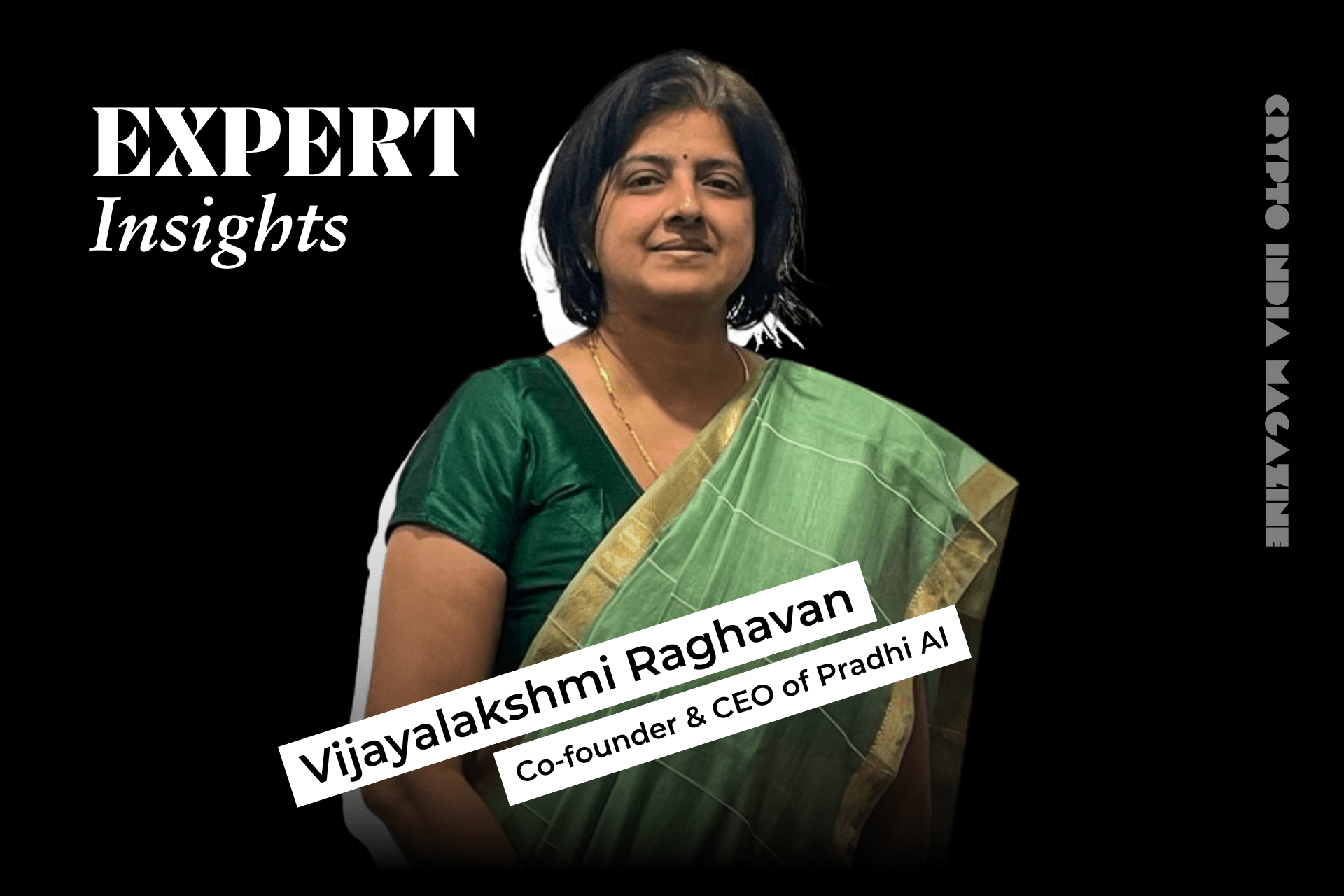
To dive into the depths of this particular technology in this edition of Expert Insights, we sit down with Vijayalakshmi Raghavan, CEO and Co-Founder of Pradhi AI.
Can Machines Truly Listen?
As the discourse around empathy in AI gains momentum, a few innovators are steering the conversation toward something more elemental — humanity. And among them is Hyderabad-based Pradhi AI, a company founded on the quiet conviction that intelligence without understanding is incomplete. Its work asks a deceptively simple question: can machines truly listen?
“We believe that the mathematical neuron has a long way to go before it can be on par with the biological neuron,” says Vijayalakshmi.
That belief became the foundation for Pradhi’s exploration into voice intelligence, an area often overshadowed by text-based AI. Inspired by the seminal paper “Attention Is All You Need“, her co-founder Ramakrishna Prasad’s background in signal processing made the leap to voice a natural progression.
“Among all human signals, voice most clearly projects the intent of the human,” she adds, pointing to how tone and inflection often convey far more than words alone.
This philosophy led to SEARS, Pradhi’s Speech Emotion Analysis and Recognition System, built not in sterile lab conditions but from real-world conversations. Emotion, especially in Indic languages, is an underexplored frontier. “There are not enough Indic expressions of emotion,” she notes, emphasizing how diverse linguistic data helped SEARS capture emotion as it truly exists, in lived, human dialogue.
Their innovation doesn’t stop at understanding emotion.
Pradhi’s concept of “Voice EQ” turns emotional data into what Vijayalakshmi calls decision signal intelligence, insights that help businesses assess intent, urgency, and opportunity. From predicting sales outcomes to identifying where deals need rescue, Voice EQ isn’t about efficiency alone; it’s about restoring empathy and meaning in the human-machine conversation.
As AI Learns to Listen, Can It Still Be Trusted?
The more our machines learn to listen, the more we must question what they choose to remember. Somewhere between empathy and overreach lies the frontier of emotional AI, a terrain where trust must be earned, not engineered.
And as our discussion with Vijayalakshmi unfolded, it touched upon some of the pressing aspects.
Following is an excerpt from the interview.
CIM: With voice and emotion sensors entering every interface, how can AI companies reconcile personalization with privacy, especially as emotional data becomes business-critical?
Vijayalakshmi: Consent for voice to be recorded is critical. The enterprise using the tool needs to put in place processes to explicitly gather consent. We advocate that. I think, though, that people understand that anything vocalised can be scrutinised. Devices that can be attached to phones that record everything, and there are a few of those in the market, those are a bit more intrusive.
CIM: OpenAI’s Sora 2 seems to have shattered boundaries between what’s real and what’s generated, especially in video and affective media. How do emotion-aware systems like yours preserve authenticity in a world where realism itself can be faked?
Vijayalakshmi: We don’t operate in the area of creating voices. We don’t want to create voices, etc. The space we want to operate in is in understanding and insights. More to support human intelligence than replacing it. We would like to answer the question(s): What was the person really trying to say? What was the best way to respond to what the customer said? It is not so much about faking it, as it is about responding in a meaningful way to get the most effective outcome.
CIM: Voice and visuals are merging faster than regulation can catch up. Do you see a new kind of “emotional misinformation” risk emerging, where AI not only imitates speech but also manipulates empathy?
Vijayalakshmi: Imitating speech is definitely an issue – deep fakes, etc. However, voice is a unique signal, and manipulation can be detected with some accuracy already. The risk for manipulating technology for nefarious purposes exists, but it falls into the realm of criminal activity.
Manipulating empathy is a bit more complicated. When I know you are upset, if I speak to you reassuringly, is it manipulative? Or human? If a tool can nudge a call center executive regarding the distress levels of a customer and ask him to respond appropriately, is the enterprise concerned with manipulating empathy? When we place some items near the cash counter to tempt the customer to pick them up, is the marketer being manipulative? We learn empathy from our surroundings – that is the concept of epigenetics. Are we being taught to be manipulative?
Decentralizing the Machine
As we wrapped the conversation, it felt fitting to turn to the larger architecture shaping AI’s future — decentralization, a term often reserved for Web3 evangelists. But as Vijayalakshmi points out, that vision remains more aspirational than imminent.
“Managing information and keeping multiple devices in sync is hard,” she says candidly. “Computing power in a local device to get insights is still a bit of a challenge.”
The dream of decentralized AI, she believes, must first confront practical realities—hardware limitations, governance friction, and the perennial tension between security and accessibility.
“In the enterprise space, security and privacy are huge concerns, even to the extent of resulting in slower adoption of AI,” she adds, suggesting that industries like healthcare and finance might lead the way toward pragmatic decentralization.
When asked what that pragmatism might look like, Vijayalakshmi describes a layered approach: decentralization at the application or governance level, supported by a secure central core.
“Adding federation, obfuscation, and anonymization will allow the centralized model to be to some extent blind,” she explains.
Yet she remains grounded in realism.
“Where platforms like IG, TikTok know so much about people’s personal lives, governance feels a bit like closing the stable door after the horse is long gone.”
As the dialogue around AI stretches from empathy to ethics and now autonomy, one thing becomes clear: trust isn’t built through power or precision, but through presence. And perhaps, in teaching machines to listen, we are really learning to listen better ourselves.
Editorial Note: This article is based on an interview with Vijayalakshmi Raghavan, CEO and Co-Founder of Pradhi AI. Certain parts have been adapted into a narrative format for readability, but her perspectives and insights remain presented as originally expressed.
Interested in advertising with CIM? Talk to us!


Can You Trust AI With Your Crypto? Francesco Andreoli Thinks You Can, With Limits
MetaMask opened Agent Wallet to all users on August 6, 2026, giving AI agents a scoped wallet across 22 EVM chains and Hyperliquid. Francesco Andreoli, Head of Developer Relations at Consensys, walks through the policy engine, the $10,000 Transaction Protection, and where users get it wrong.
Interview with Charlie Hu, Co-Founder of COCO AI: AI Agents, Enterprise Adoption, and Future of Work
COCO AI co-founder Charlie Hu runs a 15-person team alongside about 60 AI agents, serving 500-plus businesses in e-commerce, gaming, and digital marketing. He breaks down the shift from Copilot to Autopilot, why physical AI is the next frontier, and how to stay valuable.
Interview with Adam Budínský: Trezor’s Head of Hardware on the Safe 7, Open Security, and Self-Custody
The Trezor Safe 7 just won a 2026 Red Dot Award for Product Design. Head of Hardware Adam Budínský talks to CIM about the device's open, auditable, secure element, the push to end blind signing on Ethereum, the touchscreen threat model, and why self-custody adoption still lags in India.

Dr. Shobhit Navani on Crypto’s Dark Side, Regulatory Gaps, and Institutional Shift
The crypto industry is not ignorant of its darker dimensions. Money laundering, terrorism financing, cybercrime, the limits of sovereign regulation,…