Key takeaways
- Web3 is a vision of an internet built on blockchains where users directly own their data, money, and digital assets, rather than renting access from platforms that own everything.
- The web went from read-only (Web1) to read-write (Web2) to read-write-own (Web3); the new part is ownership.
- Ownership is real because the record of what you own sits on a public blockchain no single company controls, so no platform can delete it or lock you out.
- A wallet, holding a public and a private key, is your login and proof of ownership in one, and the same wallet works as a single identity across many apps.
- Smart contracts are programs on a blockchain that run Web3 apps automatically, doing the work a company’s servers do in Web2, with no firm in charge.
- DAOs let token holders own and govern a platform together, with votes enforced by code, though how decentralized they really are varies.
- Tokens are the units that move through Web3: coins pay to use a chain, governance tokens carry voting rights, and NFTs mark ownership of unique items.
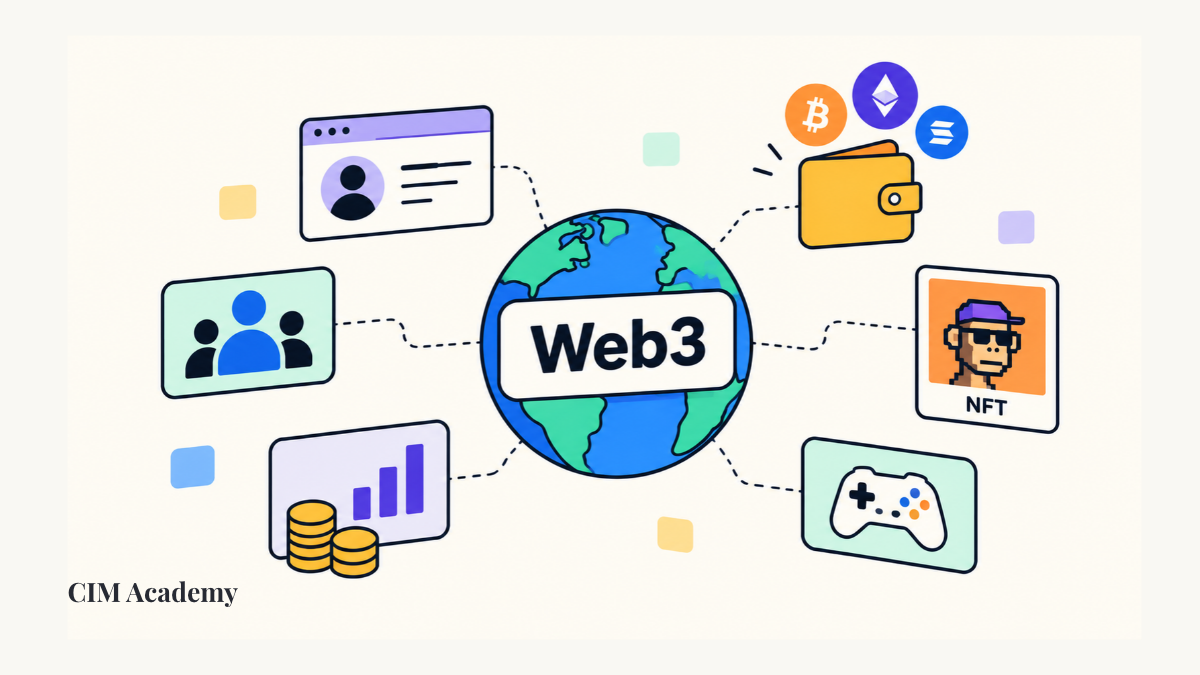
Web3 is a vision for a version of the internet built on blockchains, where users own their data, money, and digital belongings directly, instead of renting access to platforms that own everything for them. It runs on public blockchains, cryptocurrencies, and tokens, which let people hold assets and identities that no company can take away or shut off. Gavin Wood, a co-founder of Ethereum, coined the term in 2014.
Web3 is easiest to understand as the third stage of the web, so that is where this lesson starts. From there, it shows the actual machinery that makes “ownership” real, what you can do with it, and where it still falls short.
What Is the Difference Between Web1, Web2, and Web3?
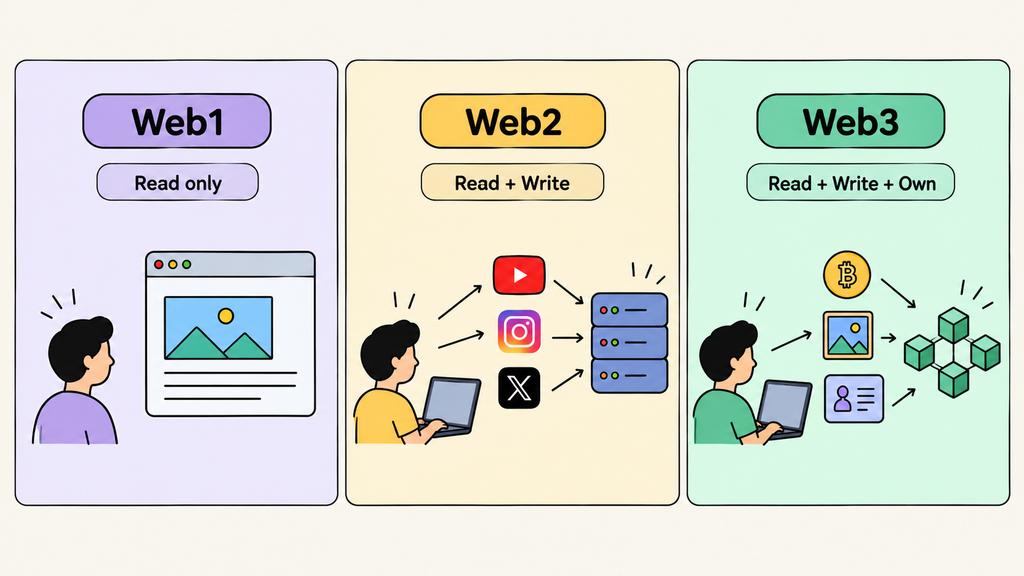
The clearest way to see what Web3 means is to put it next to the two webs that came before it. Each era is defined by what an ordinary person could do.
Web1, roughly the 1990s to early 2000s, was read-only. Websites were static pages you could visit and read, like a library of documents. Almost nobody could publish without technical skill, so for most people the web was something you consumed and nothing more.
Web2, the web of today, is read-write. Platforms like YouTube, Instagram, and X let anyone create and post, not just read. This is the web most people know. The catch is who owns what you make. You write the posts and film the videos, but the platform holds the account, the audience, and the data, and it sets the rules.
Web3 adds a third verb: own. Web1 was read-only, Web2 is read-write, and Web3 is “read-write-own”. The new piece is ownership. In Web3, the things you hold, your money, your digital items, even your login identity, belong to you directly and are recorded on a blockchain rather than inside one company’s database.
That word “own” is doing all the work, and on its own it is still a slogan. The rest of this lesson is about what actually makes ownership real, because that mechanism is the whole point of Web3.
What Does It Mean to Own Something in Web3?
In Web2, you never really hold anything. Your Instagram following, your game purchases, your account, all of it lives in a company’s database, and the company controls that database. In Web2, creators produce content on platforms but do not own it, and the platform can change the rules or remove accounts, which means a creator who leaves or is banned loses the audience and reputation they built.
Web3 changes this by moving the record of what you own out of any single company’s database and onto a public blockchain. A blockchain is a shared record of transactions copied across many computers, which no single party controls. Because the record of ownership sits on that shared ledger rather than inside a company, the company cannot quietly delete it or lock you out of it.
ALSO READ: What is blockchain?
Here is the mechanism followed through with one example. Say you buy a digital item in a Web3 game, recorded as an NFT, which is a unique token on a blockchain that marks you as the owner of one specific item. When you buy it, the blockchain records that this item now belongs to your account, and only you, holding your private key, can move it. Users can own in-game items as NFTs that no one can revoke, including the game’s creators. So if the game studio shuts the game down, bans you, or changes its rules, the record that you own that item still stands on the blockchain, independent of them. In a Web2 game, the same item is a line in the studio’s database that vanishes the moment they decide it should. That difference, a record they control versus a record they cannot touch, is what “own” means in practice.
What Is a Web3 Wallet and How Does It Work?
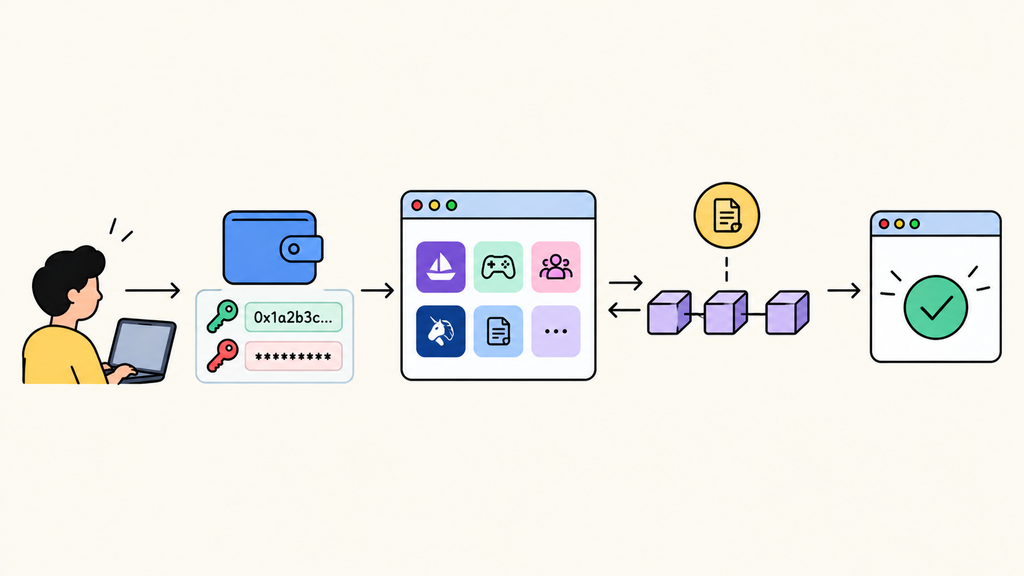
For ownership to work, you need something that proves the assets are yours and lets you use them. In Web3, that thing is a wallet, and it replaces the username and password you use across Web2.
A wallet holds two linked keys: a public key, which is an address others can send things to, and a private key, which is a secret that proves the account is yours and approves any action. These keys are what let the blockchain recognise you as the owner of whatever is recorded against your address.
ALSO READ: What Is Cryptocurrency?
The practical effect is a single identity you carry everywhere. In Web2, you need a separate account for each platform, and each platform can lock you out or demand personal information. In Web3, your blockchain address serves as one login across many apps, because any app can read the public blockchain and see what your address owns. You do not register with each site and hand over your email and password; you connect the same wallet, and the app reads your holdings from the chain.
Follow it through: you connect your wallet to a Web3 app, the app checks the blockchain to confirm your address holds whatever it requires, for example, a membership token, and it lets you in, all without creating an account or giving the app a password it could later leak. Your identity and your belongings travel with the wallet, not with any one platform.
How Do Web3 Apps Work without A Company? Smart Contracts Explained
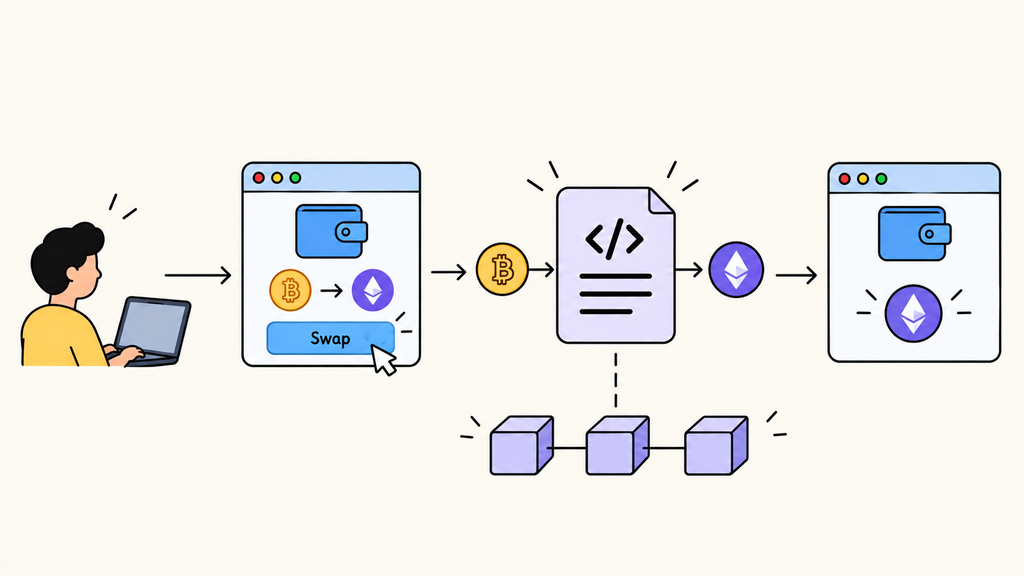
A wallet proves what you own, but something has to do the actual work of a Web3 app, taking in a transaction and acting on it, without a company’s servers in charge. That job is done by smart contracts.
A smart contract is a program stored on a blockchain that runs automatically when its conditions are met, with no company operating it. The lending or trading app you use in Web3 is built from these contracts. When you act, your wallet sends a transaction to the contract, the contract executes its fixed rules, and the blockchain records the result.
Take a Web3 exchange where you swap one token for another. In a Web2 exchange, a company holds your money, matches your trade, and settles it on its own books, and you trust the company to do this honestly. In the Web3 version, a smart contract holds the pooled funds and the swap rule in code that anyone can inspect. You send your token to the contract from your wallet, the contract runs its rule and sends back the other token, and the swap is recorded on the blockchain. No company took custody of your money or could refuse the trade, because the contract, not a firm, carried it out. This is what replacing trusted third parties with code and economic incentives means in practice.
What Is a DAO and How Do People Own an App Together?
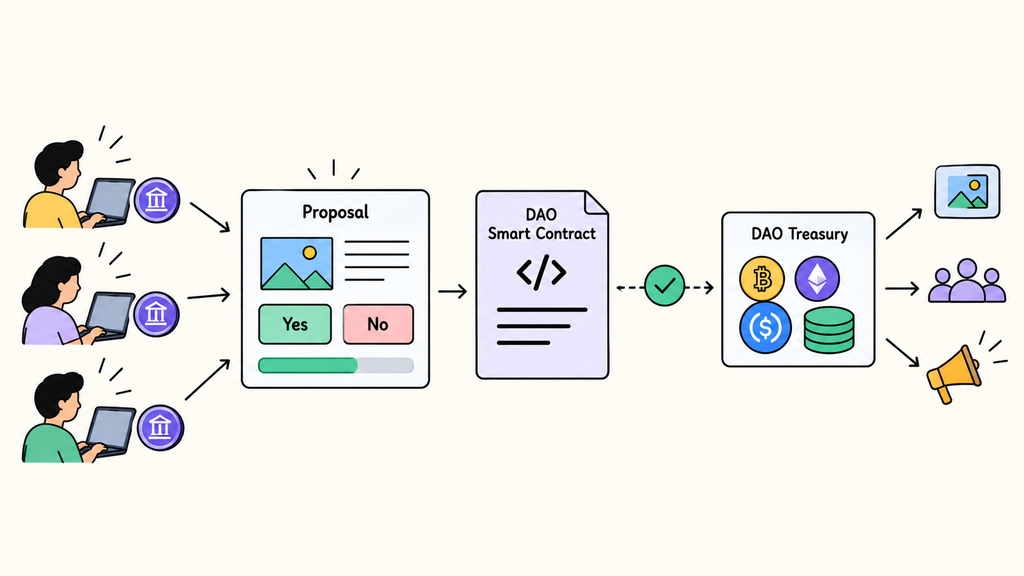
Individual ownership is one half of Web3. The other is collective ownership, the idea that the users of a platform can own and run it together rather than answering to a company. The tool for this is a DAO.
A DAO, meaning decentralized autonomous organization, is a group that is governed by its members through tokens, with its rules enforced by smart contracts instead of a management hierarchy. DAOs let token holders collectively own and govern a platform. Holding the platform’s token gives you a vote, and decisions pass through code rather than a boardroom.
Concretely, a DAO might hold its shared funds in a smart contract that will only release money if enough token holders vote yes. A member proposes spending the funds on something, every token holder votes with their wallet, and if the vote passes the threshold written into the contract, the contract releases the money on its own. No executive signs it off, because the rule is the code and the voters are the owners. Ethereum’s own documentation is careful here: how decentralized a DAO actually is varies, and the model is still being worked out, so this is an early and uneven part of Web3, not a settled one.
What Are Tokens in Web3, and What Are the Different Types?
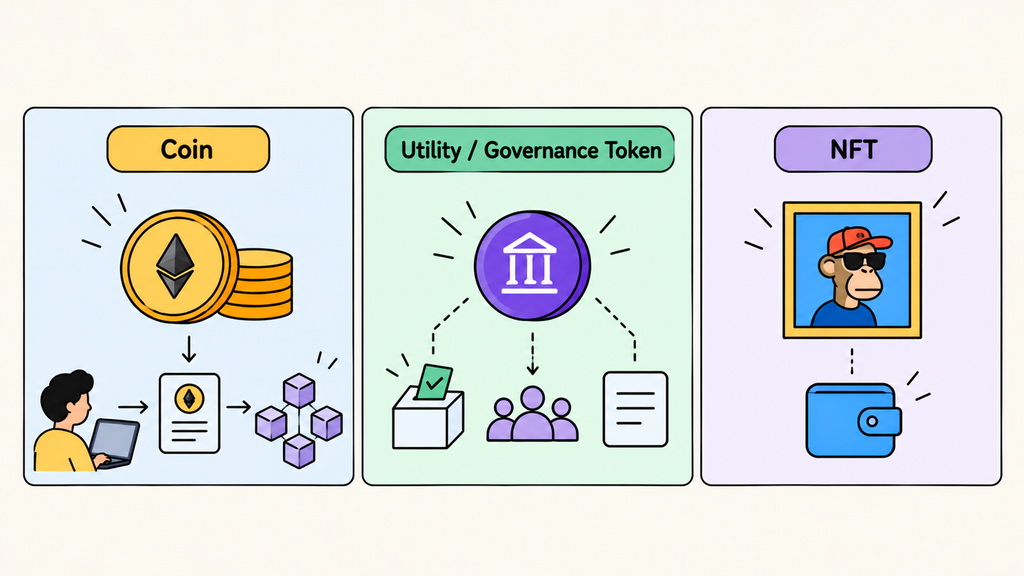
Every section so far has leaned on one word, the token, so it is worth stopping to define it properly, because tokens are what actually move through Web3 and carry the ownership the whole idea rests on.
A token is a unit of value or rights recorded on a blockchain and held in your wallet. What a token represents depends on how it was created, and there are three kinds a beginner meets.
- A coin is the native currency of a blockchain, used to pay for actions on it, such as Ether on Ethereum. When you make any move in Web3, the blockchain charges a small fee paid in the chain’s coin, because the network of computers recording your action has to be paid for the work. This is the token you spend simply to use the chain.
- A utility or governance token is issued by a specific app or platform and gives you a right within it, most often a vote. This is the token a DAO runs on. Holding the platform’s token is what lets your wallet cast a vote, and the smart contract counts the tokens behind each vote to decide the outcome. The token is your share of control, recorded on the chain, not granted by a company.
- An NFT, meaning non-fungible token, is a token that marks ownership of one unique item, such as the game item from earlier in this lesson. The word non-fungible means each one is distinct and not interchangeable. One coin of Ether is worth exactly the same as any other, the way one ten rupee note equals another. An NFT is the opposite: each represents a specific, one-of-a-kind thing, so the blockchain can record that this exact item belongs to you and no one else.
Follow a single token through to see why this matters. You earn a platform’s governance token, held in your wallet as a record on the blockchain. You use it to vote in the platform’s DAO, where a smart contract counts it. Later you send it to someone else, and the blockchain updates the record so it is now theirs, with no company approving the transfer. One unit, owned by you, usable across the platform’s apps, moved by you alone. That is the ownership the earlier sections described, made concrete in the thing that actually carries it.
Conclusion
Web3 is best understood through its one new idea: ownership that the user holds directly, rather than ownership a platform holds on their behalf. Everything that sounds abstract about it becomes concrete once you trace that idea through the machinery. The record of what you own moves onto a public blockchain no company controls, a wallet proves it is yours and carries it across apps, smart contracts do the work that a company’s servers used to do, DAOs let users own a platform together, and tokens are the units that carry all of it. Each piece exists to make “own” mean something real. Web3 is the attempt to rebuild the web around user ownership, with the mechanism already working and the model still taking shape, and it is worth understanding as exactly that.
Frequently Asked Questions
No. Cryptocurrency is one part of Web3, used for payments and ownership, but Web3 is the broader idea of an internet where users own their data, assets, and identity on a blockchain. Even the person who coined the term argues some Web3 services could run without users handling tokens at all.
In Web2, you can read and post, but the platform owns your account, audience, and data and sets the rules. In Web3, the record of what you own lives on a public blockchain instead of a company’s database, so you hold your assets and identity directly and carry them between apps.
Generally yes. A wallet holds the keys that prove what you own and acts as your login across Web3 apps, replacing the separate username and password you use on each Web2 site. Without one, there is no way for an app to confirm which blockchain assets are yours.
No single company does, by design. Records of ownership sit on public blockchains, apps run on smart contracts rather than company servers, and some platforms are governed collectively through DAOs. In practice, parts of the ecosystem still depend on centralized services, so it is not fully decentralized yet.
No, though they are often mentioned together. Web3 is about ownership and decentralization across the web, built on blockchains. The metaverse refers to immersive virtual worlds, which may or may not use Web3 ownership underneath them.