

Key takeaways
- Blockchain is a decentralized, distributed digital ledger that records transactions across a network of computers, with no single party holding the master copy.
- It exists to solve one problem: letting parties who do not trust each other share one agreed record without a central keeper.
- Every node holds a full copy, so there is no single point an attacker can corrupt.
- Transactions are sealed into blocks by a hash, a fingerprint that changes completely if the data is altered.
- Each block stores the previous block’s hash, so editing an old record breaks every block after it and exposes the change.
- Consensus (proof-of-work or proof-of-stake) decides which block is added next and makes cheating cost more than it pays.
- Public, private, permissioned, and consortium types trade openness and tamper-resistance against speed and privacy.
- Blockchain is the technology; cryptocurrency is one application. Every cryptocurrency uses a blockchain, but many blockchains carry no coin.
- It is worth using only when several distrusting parties need a shared record none can secretly change; otherwise a database is better.
Blockchain is a decentralized, distributed digital ledger that securely records transactions across a network of computers. No single party holds the master copy; every computer in the network keeps the same copy, and once a transaction is recorded, it is practically impossible to alter. That combination lets strangers who don’t trust each other share one agreed record without a bank, a government, or any middleman keeping it for them.
The rest of this lesson takes that definition apart and shows exactly how each piece works.
Why a Shared Ledger Needed Inventing
A ledger is a record of who owns what and who paid whom. For all of history, a ledger needed a trusted keeper: a bank holds your balance, a land registry holds who owns a plot. You trust the record because you trust the institution behind it. The weakness is that the keeper has total control. It can change an entry, freeze an account, make an error, or be hacked at a single point, and you have to trust it anyway because there is only one copy that counts.
The question blockchain answers is: can a group keep one shared ledger that everyone trusts, when no single member is in charge, and nobody trusts anyone else?
If every member keeps their own copy, you face a new problem. Whose copy is right when they disagree? And what stops someone from editing their copy in their own favour? Blockchain’s whole design exists to solve those two problems. Everything below is a piece of that solution.
The Ledger Lives on Every Computer at Once
In an ordinary system, the record sits in one place. In a blockchain, the full record is copied onto every computer in the network. Each of those computers is called a node, and each node holds a complete, identical copy of the ledger.
This is what “distributed” and “decentralized” mean in practice, and they are not the same thing. Distributed means many copies exist instead of one. Decentralized means no node is the boss, so no node’s copy is the official version that the others must accept. There is no head office. If one node vanishes, or lies, or is seized, the record survives untouched on every other node. To corrupt the ledger, you cannot attack one target, because there is no one target. You would have to overpower the whole network at once, which is the first half of why a blockchain is hard to tamper with.
That solves the “single keeper has total control” problem but sharpens the second one: if everyone has their own copy, how does the network stop someone forging entries, and how does it agree on one version? The next three sections answer that, in order.
How Transactions Get Sealed Into Blocks
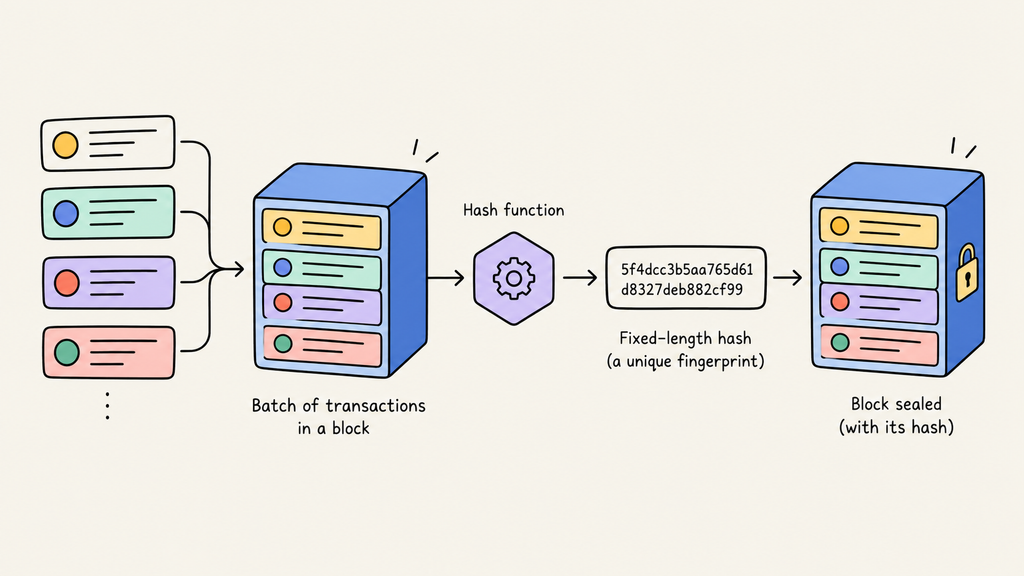
Transactions are not added to the ledger one at a time. The network gathers a batch of recent transactions and packages them together into a block.
Each block is then passed through a hash function. But what is a hash function? A hash function is a piece of maths that takes any amount of data and returns a short, fixed-length string of characters, the hash, which acts as a fingerprint of that exact data. Feed it the contents of a block, and it returns one specific hash. The property that makes this useful is total sensitivity to change: alter one comma in the block, and the hash that comes out is entirely different, with no resemblance to the original.
So the hash is a seal. If the block’s contents are genuine and untouched, re-running the hash produces the same fingerprint. If a single detail was changed, the fingerprint no longer matches, and anyone can detect it in an instant by recomputing it. At this point, a block is sealed but still standalone.
The next step ties it to history.
How Blocks Chain Together
This is the step the technology is named for, and it is what turns a pile of sealed blocks into a tamper-evident record.
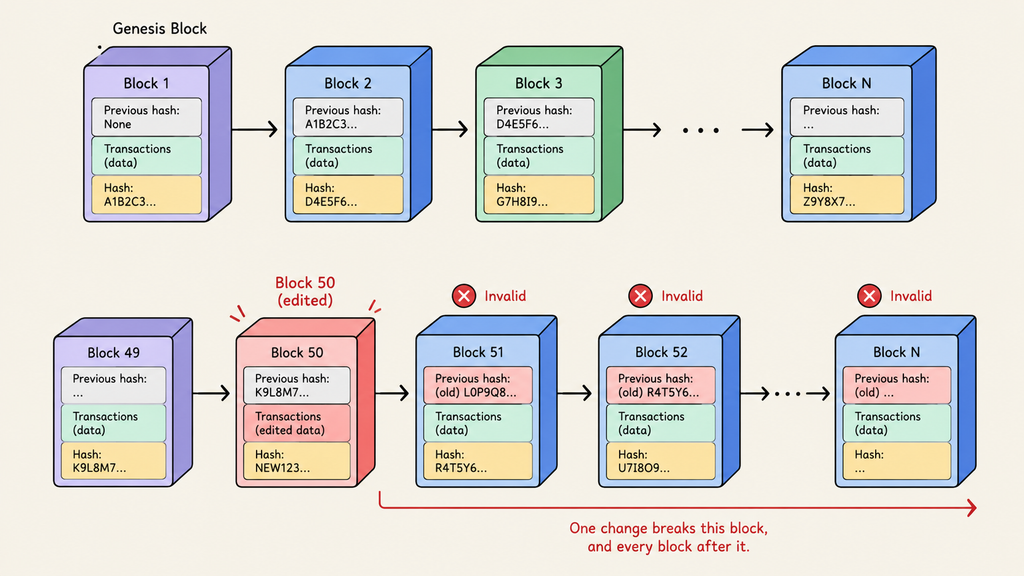
Every new block records, inside itself, the hash of the block immediately before it. Block 2 contains block 1’s fingerprint. Block 3 contains block 2’s fingerprint. This continues back to the very first block, the genesis block, which is written into the software at launch and is the only block with no predecessor to point to. The blocks are now threaded together in a fixed order, each one carrying proof of the one before.
Now, watch what this does to a tamperer.
Say someone wants to rewrite a payment buried in block 50. The moment they edit it, block 50’s contents change, so block 50’s hash changes. But block 51 still stores the old hash of block 50, so the two no longer match and the chain visibly breaks at that point. To hide the break, the tamperer must also rewrite block 51 so it carries the new hash, which changes block 51’s own hash, which breaks block 52, and so on all the way to the newest block. One change forces them to redo every block that came after it.
This is why records on a blockchain are called immutable, meaning unchangeable in practice once buried under later blocks. The hash chain is the second half of why tampering is so hard, and it works together with the first half, the many copies, which the final step now brings together.
How the network agrees: consensus
The links make tampering visible, and the copies mean there is no single point to attack. The last piece is how the network decides which new block everyone adds next, so that all those copies stay identical without anyone in charge. That decision process is called a consensus mechanism, and it is also what stops forged transactions getting in.
The two main approaches both work by making it expensive to add a block, so that honest participation pays better than cheating.
In proof-of-work, computers compete to solve a hard mathematical puzzle, and the first to solve it earns the right to add the next block. Solving the puzzle takes real electricity and hardware, so forcing a false block onto the chain, and then outrunning the entire honest network to rewrite every block after it, would cost more than it could ever return. Bitcoin uses this.
In proof-of-stake, participants called validators lock up a deposit of their own coins for the right to add blocks. Approve a fraudulent block and the network destroys your deposit, so cheating means burning your own money. This achieves the same deterrence without the electricity. Ethereum uses this.
Either way, once the network accepts a block through consensus, every node updates its copy to match, and the ledger stays identical everywhere. The two problems from the start, no trusted keeper and no agreed version, are now both solved: by copies on every node, by hash-linked blocks, and by consensus deciding what gets added.
ALSO READ: What is cryptocurrency?
Not every blockchain is open to the public
The description so far fits a public blockchain, the open kind anyone can join. But “who is allowed to take part” is a design choice, and it produces different types for different jobs.
A public blockchain lets anyone join, read every record, and submit transactions without permission, as Bitcoin and Ethereum do. Openness is the point, and security comes from the sheer number of independent participants. A private blockchain runs on a closed network controlled by one organization, with only approved members admitted. Fewer computers means it runs faster, which suits a company’s internal records, but it is more centralized, closer to a shared database with hash-linking than to Bitcoin. A permissioned blockchain sits between the two: open to a defined set of vetted members, used where several known parties need a shared record they can all trust but outsiders should not see. A consortium blockchain is a permissioned chain run jointly by a group of organizations rather than one, common where rival firms such as banks want one shared record with no single member controlling it.
The trade-off is consistent and worth remembering: the more open a blockchain, the harder it is to tamper with but the slower and less private it tends to be; the more closed, the faster and more private, but the more you are trusting its controllers, which is the very thing a public chain was built to avoid.
Blockchain Is the Technology; Cryptocurrency Is One Use of It
These two get treated as the same thing, and they are not. Blockchain is the method of record-keeping described above. Cryptocurrency is one application built on it, where the records happen to be coin balances and the consensus rewards are paid in those coins.
Every cryptocurrency runs on a blockchain, but a blockchain does not need a cryptocurrency. When the records are coin transfers, you have Bitcoin. When they are tracked shipments or verified documents, you have a supply-chain or records system with no coin anywhere in it. Same record-keeping method, different contents.
What Blockchain Is Actually Used For, and How
A claim like “blockchain improves supply chains” is useless without the mechanism, so here is how it actually works in each case, by tracing one example through.
Supply chains
Picture a crate of mangoes moving from an Indian farm to a supermarket in Dubai. Today each party keeps its own private records, so when a buyer asks “was this kept cold the whole way,” no one can prove it, and any party can quietly backdate or fake an entry later. On a shared blockchain, the farm writes the first record when it packs the crate, with a tag ID, time, and temperature. The trucker adds a record at pickup, the port at loading, the shipping line in transit, customs at arrival, each one a new entry sealed into the chain. The buyer, reading the same ledger, sees the whole journey as one unbroken, timestamped sequence that no single party could have edited after the fact, because editing one earlier record would break the hash links on every record added after it. The value is not “transparency” as a slogan; it is that every participant writes to one record none of them can secretly rewrite.
Cross-border payments
A bank transfer from India to Mexico passes through a chain of intermediary banks, each keeping its own ledger and reconciling with the next, which is why it takes days and loses money to fees. When the two sides instead move a blockchain-based token, the transfer is a single entry on one shared ledger that both parties already see and agree on. There is no chain of middlemen to reconcile, because there are not several ledgers to match up, only one, so settlement happens in minutes.
Healthcare records
A patient’s history is scattered across hospitals that cannot safely share files, so records arrive incomplete. A blockchain does not store the medical files themselves, which would be slow and expose private data. It stores a tamper-proof index: a record of which document exists, where, and who is permitted to open it. A hospital granted access reads the index, confirms the record is the genuine unaltered one by checking its hash against the entry, and retrieves it, while the patient controls who gets permission. The blockchain’s job here is proving a record is authentic and controlling access to it, not holding it.
Verifying documents and ownership
A degree certificate or a land title can be forged, and checking one means phoning the issuer. If the issuer records a fingerprint of the genuine document on a blockchain when it is issued, anyone can later verify a copy by hashing it and checking the result against that permanent entry. A match proves it is authentic and unaltered; a mismatch exposes a forgery, with no call to the issuer needed. Nothing secret is published, only the fingerprint that confirms the real thing.
The common thread across all four: a blockchain is worth using precisely when several parties who do not fully trust each other need one shared record that none of them can secretly change. When a single trusted party could just keep the record, it is the wrong tool.
What Blockchain Is Not Good At
Which is the honest limit, and it rules out most things. A blockchain pays a real price for removing the middleman, and for many jobs that price is not worth paying.
It is slow and limited in volume. Making many independent computers agree on every entry is far heavier than letting one server write to its own database, so public blockchains handle far fewer transactions per second than ordinary payment systems, and slow down when busy. Proof-of-work chains are also energy-hungry by design, since the puzzle is meant to be costly to solve; proof-of-stake exists partly to fix this. The technology is complex, which raises the cost of building on it and the stakes of a mistake, since a flawed, immutable record cannot simply be edited back. And most decisively, it is usually unnecessary. If one trusted organization can hold the record, a normal database is faster, cheaper, and simpler. A blockchain earns its cost only when the absence of a trusted keeper is the actual problem being solved.
Conclusion
Blockchain is best understood not as a magic ledger but as a specific answer to a specific problem: how a group with no shared trust and no central authority can still agree on one unchangeable record. It solves it by giving every participant a full copy so there is no single point to attack, sealing records into hash-linked blocks so any change exposes itself, and using consensus to decide what gets added so the copies never drift apart. Those three ideas are the whole of it, and every use, from a cryptocurrency to a mango crate’s journey, is the same three ideas pointed at a different kind of record. Its strength and its cost are the same fact: it removes the trusted middleman, which is powerful exactly when that middleman is the problem, and wasteful whenever a trusted keeper would have done the job.
Frequently Asked Questions
No. Blockchain is the record-keeping technology; Bitcoin is one cryptocurrency that runs on a blockchain. Bitcoin uses a blockchain, but blockchains also record things with no link to cryptocurrency at all, such as shipments or official documents.
A block is a batch of transactions bundled together. A hash is a short fingerprint of that block’s contents, and each block stores the previous block’s hash to chain them in order. Change any data and the hash changes, which breaks the chain and exposes the edit.
Almost never, once it is buried under later blocks. Editing a record changes its hash and breaks its link to every block after it, so a tamperer would have to redo all those blocks across most of the network at once. This is why blockchains are called immutable.
Only when several parties who do not trust each other need one shared record that none of them can secretly alter. If a single trusted organization can hold the record, a normal database is faster and cheaper, and blockchain adds cost for no benefit.
No. Public chains like Bitcoin and Ethereum have their own coins, but private and permissioned blockchains run by companies and institutions often have none, serving purely as a shared, tamper-proof record.