
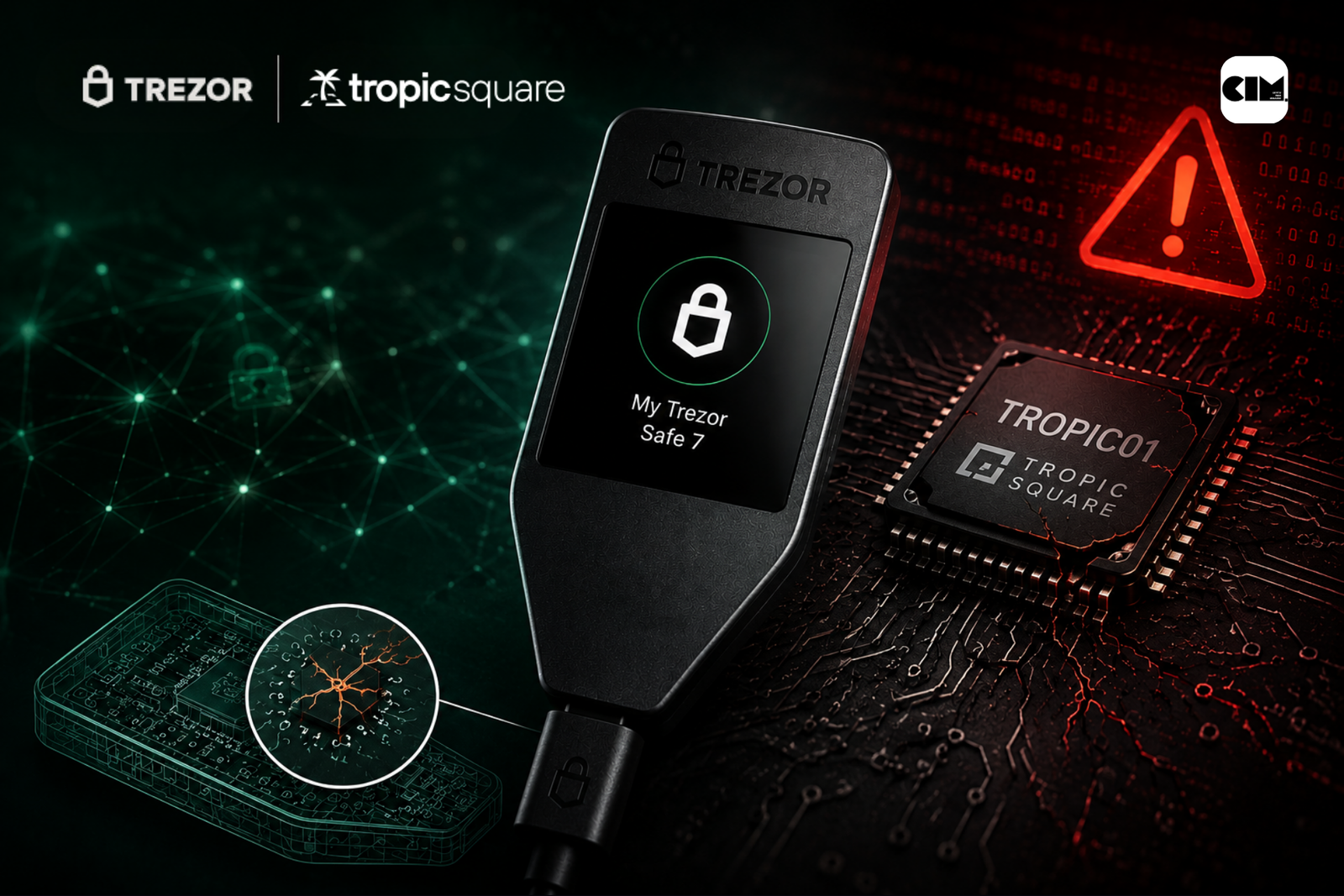
- Trezor and chip designer Tropic Square disclosed on June 3, 2026, a hardware vulnerability in the TROPIC01 secure element used in the Trezor Safe 7 wallet, found through an independent audit by rival Ledger’s Donjon research team.
- The flaw uses a laboratory laser fault injection attack to bypass the chip’s firmware signature verification, and affects only one of the device’s three independent security layers; private keys, wallet backups, and PINs are not stored on the chip.
- Trezor said user funds remain safe and no action is required, while Tropic Square confirmed the issue cannot be patched on existing devices and that a hardened chip revision is in production.
Trezor and its sister chip designer Tropic Square disclosed a TROPIC01 secure element vulnerability in the Trezor Safe 7 hardware wallet on June 3, 2026, after Ledger’s Donjon research team demonstrated a laboratory laser fault injection attack against the chip. According to the companies’ coordinated disclosure, the attack extracted a subset of the secrets the chip protects, but did not compromise user funds, wallet backups, or PINs.
The vulnerability surfaced through an audit that Tropic Square itself commissioned. Tropic Square supplied a TROPIC01 chip to Ledger Donjon, the white-hat security division of competing hardware wallet maker Ledger, to evaluate the part against secure element requirements. In late January 2026, Donjon reported that it had bypassed the chip’s firmware signature verification under highly specific laboratory conditions, according to the Tropic Square technical advisory.
“Because the Trezor Safe 7 was built with multiple independent security layers, a vulnerability in TROPIC01 does not put user funds at risk,” said Matej Žák, CEO of Trezor.
The keys to users’ coins, the wallet backup, and the PIN are never held on a single chip, which Žák described as a deliberate design choice to avoid a single point of failure.
The TROPIC01 advisory describes a laser fault injection attack that targets the chip’s Ed25519 signature verification during authenticated firmware updates and secure boot, opening a path to running attacker-controlled firmware. Tropic Square said all production versions of TROPIC01 currently in the field are affected. Building on Donjon’s report, Tropic Square’s own engineers identified a further method that exploited the same weakness to extract an additional secret tied to the chip’s PIN-related functions.
ALSO READ: Trezor’s Head of Hardware on the Safe 7, Open Security, and Self-Custody
Even with that additional finding, compromising TROPIC01 alone does not unlock the Safe 7 PIN, the company said. The chip is one of three physical, independent security layers, and it holds only one component that contributes to the PIN. Trezor added that the flaw cannot produce tampered devices carrying persistent malicious firmware, ruling out a supply chain attack vector.
The attack carries hard practical limits. Exploiting it requires full physical possession of the device, disassembly, backside decapsulation of the chip package, a connection to custom equipment, and an expensive laser fault injection rig operated by experts. Trezor said there is no evidence of real-world exploitation and that the Safe 7 has never been hacked.
Because the vulnerability sits in the silicon, it cannot be fixed through a remote firmware update on devices already in users’ hands. Tropic Square said it is producing a new chip batch that addresses the flaw, though existing owners do not need to take any action. Trezor framed the proactive disclosure as a defense of its open-source approach, arguing that closed, NDA-protected secure elements force users to trust black-box designs they cannot independently verify.
Editorial Note: Reported and edited by the Crypto India Magazine editorial team. We use AI tools to assist with research and drafting; every article is reviewed and fact-checked by our editors.
Interested in advertising with CIM? Talk to us!


Clarity Act Defeat Hands SEC and CFTC the Lead on U.S. Crypto Rules
The Senate's 49-50 vote on September 15 stalled the Clarity Act. Within 48 hours, the SEC issued an Innovation Exemption for tokenized stocks, and the CFTC sent a crypto markets rulemaking to the White House and broadened no-action relief for passive software providers.

ECB’s Lagarde Intervened to Block Binance’s EU MiCA License: WSJ
ECB President Christine Lagarde asked Greek PM Kyriakos Mitsotakis not to approve the Binance MiCA license, the WSJ reports. Greece had signaled approval to ESMA in early June before Binance withdrew on June 24. Greek officials deny interfering, and Binance declined to comment on speculation.

The $4.5 Billion Crypto VCs Raised in A Bear Market Came with A Different Pitch, and the New One Is Spelled “AI”
Crypto startup funding hit a 12-month low in April 2026, yet a16z crypto, Haun Ventures, Dragonfly, and Framework Ventures closed billions in new funds. Polina examines why LPs kept writing checks and how stablecoins, tokenization, and AI agents became the pitch that worked.

MENA Crypto Volume Hits $350 Billion as Gulf Adoption Accelerates
MENA crypto volume climbed to an estimated $350 billion by 2025-2026 from about $100 billion in 2022, according to the Bitcoin Policy Institute. Turkey leads by transaction value, the UAE by institutional flows, and Saudi Arabia by growth, as conflict and regulation reshape demand.