

Anyone who has researched a cryptocurrency seriously knows the peculiar fatigue of it. The price action lives on one website, the on-chain flows on another, the sentiment somewhere else, and by the time a trader assembles those fragments into a coherent picture, the opportunity has evaporated.
The platforms that promise to consolidate the scramble tend to carry price tags written for institutional desks abroad, leaving the ordinary Indian retail trader paying a steep premium for clarity that ought to be a baseline.
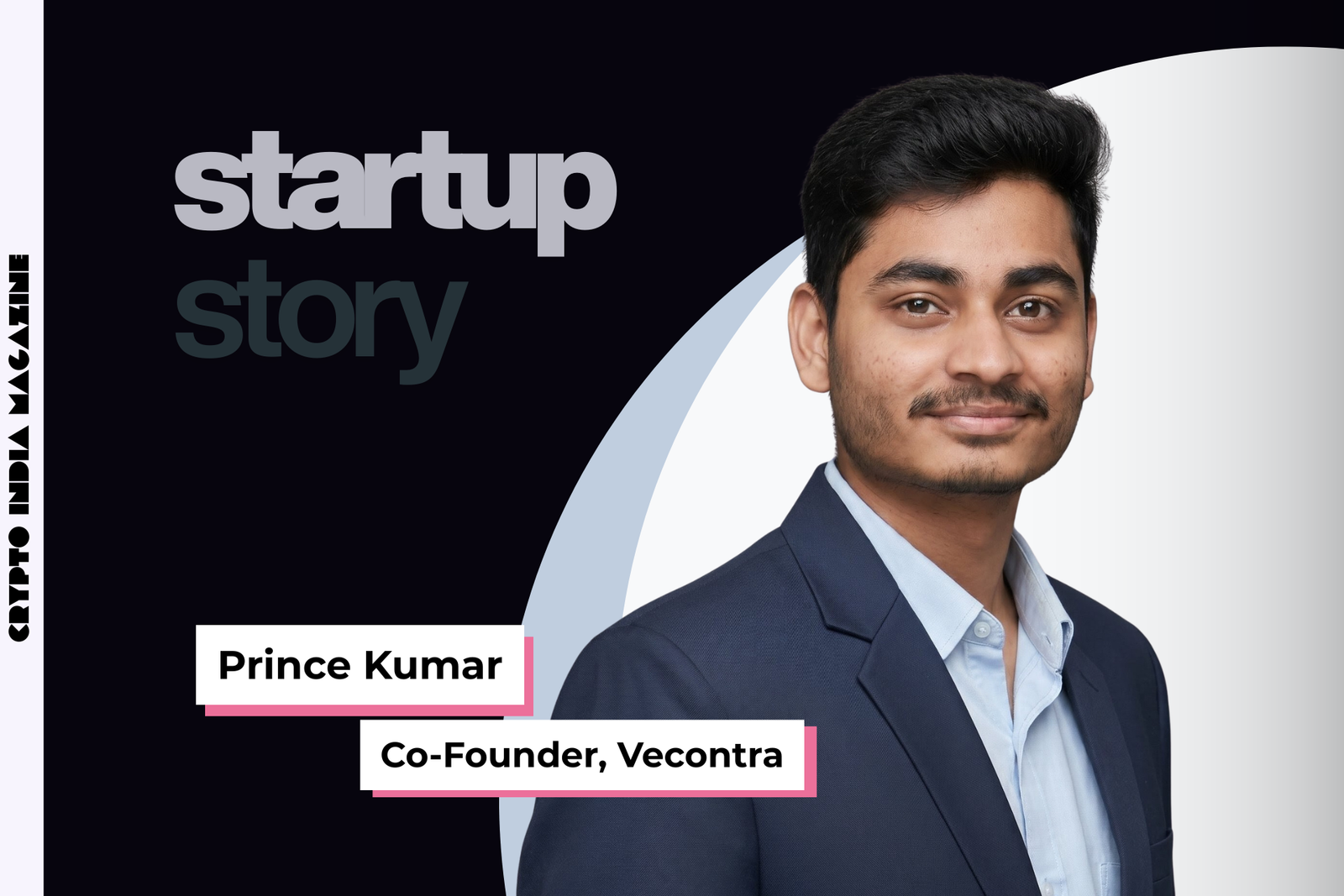
At Crypto India Magazine, we spend much of our time seeking out the people who survey a frustration of that kind and resolve to mend it. For this startup story, we sat down with Prince Kumar, co-founder of Vecontra, a final-year engineering student who grappled with that exact fragmentation for the better part of a year before engineering his own way out of it.
The Partnership Behind Vecontra
Prince had been turning the same idea over for close to a year, a single place to handle all of one’s crypto research, before he went looking for a partner. Scaling the backend, he realized, would require a technical mind he could trust, so he approached Rakesh Kumar, a computer science classmate with an appetite for complex systems architecture.
What’s interesting about this duo is that their partnership began on improbable terms. The duo had come to blows in a physical altercation during their opening semester, long before either imagined building anything together. Their temperaments diverge as sharply as that beginning suggests. Prince is the devoted crypto enthusiast, while Rakesh, by his own account, cares little for the asset class and gravitates instead toward the architecture of complex systems.
“Friendship doesn’t mean you can be co-founders, but intense collaboration and building something difficult together make the best co-founders,” he said.
For most of that year, Prince researched the market the hard way. “During that year I spent researching the market on my own, I was met with pure chaos,” he recalled. A single informed trade meant shuttling across five separate websites, one for price action, another for total value locked, others for sentiment and on-chain flows, while the services that tidied the clutter carried subscription tags written for institutions and overseas desks rather than the everyday Indian trader.
Vecontra is his answer to that fragmentation, a unified research platform that gathers the scattered workflow into one affordable dashboard. An integrated assistant named Vicco AI threads through it, surfacing quick quantitative signals so a user never has to abandon the page to find them.
From Price Tracker to Research Engine
Before Vecontra carried its name, it was CryptoInsight, a rudimentary price tracker the pair launched in March 2025 as a college project. The early architecture buckled under its own ambitions and refused to scale, and the design asked too much of the user, presenting raw numbers that proved overwhelming and visually cluttered. An attempt to automate alerts using basic moving averages grew too noisy to trust in volatile markets. What endured was the machinery underneath. “What survived and thrived was our robust backend engine,” Prince said, and that engine carried the project from a modest tracker into the unified research platform it has since become.
Sitting atop it is Vicco AI, a helper layer built to interpret the platform’s data. The assistant currently wraps OpenAI’s foundation models, GPT-4 and GPT-3.5-Turbo, for cost efficiency, with proprietary models planned later. Its latitude is kept deliberately narrow. Every technical indicator is computed through strict mathematics on Vecontra’s own servers, then injected into the model’s context through dependency injection and retrieval-augmented generation, with the temperature held low at 0.3 to discourage invention. The prompts forbid the model from conjuring price levels and oblige it to cite the server-side figures it receives; when context runs thin, it is hard-coded to answer, “Insufficient context for technical analysis.” Each insight closes with a reminder that it is not financial advice and to do one’s own research.
“The AI is simply there to help format and summarize the hard math into plain English for the user,” Prince said.
Feeding the whole arrangement is a parallel asynchronous pipeline built in Node, drawing from several top-tier providers at once, with broader token coverage now being added. To reconcile speed against accuracy, Vecontra leans on a MongoDB-first caching layer. A request first checks the database for a fresh snapshot, usually between five and fifteen minutes old, and serves it instantly when current; when stale, the system calls the external APIs, computes the indicators locally through a custom library, and caches the result for whoever asks next.
For all that engineering, Vecontra remains an MVP that has run no formal marketing, with a small cohort of users on board purely to test it. The early validation, Prince says, has been encouraging; questionnaires circulated across university campuses suggested that retail traders want a tool of this kind. A freemium model awaits the public launch, keeping core metrics free while a premium tier, priced to remain affordable for the Indian retail trader, unlocks unlimited AI queries and advanced quantitative signals.
What Comes Next for Vecontra
Vecontra has been built without outside capital. “We are 100% bootstrapped right now,” Prince said, crediting the discipline of student life.
“As final-year college students, we’ve learned how to be incredibly scrappy and lean, which has allowed us to keep our historical burn rate near zero,” he added.
The pair have funneled their own time and slender resources into the product itself, holding off on marketing until there is something proven to market. That restraint has a limit, however. To carry Vecontra through the coming year and out of its testing phase, the pair is now seeking to raise ₹20 lakh (roughly $24,000), capital earmarked strictly for scale. The sum, by Prince’s reckoning, buys a year of runway to finalize the MVP, win the first 1,000 paying customers, and plant a footprint in the retail market.
That year is mapped in quarters. The first is given over to stabilizing and finalizing the MVP. The second brings the heavier engineering, widening blockchain coverage to take in non-EVM assets and deploying an integrity engine for static sanity checks. The third quarter belongs to the users, a stretch reserved for iterative refinements drawn from the feedback of early adopters. The fourth turns commercial, with payment gateways wired in to open the premium tier and the same thousand-customer target waiting at the finish.
Hard Truths From the Startup Journey
Ask Prince about the hardest part, and he does not reach for the technology. The real strain, he says, has been social and psychological, the cost of choosing an uncertain road while classmates queue for campus placements and the comfort of a salaried career. “Building a startup in your early twenties is an incredibly lonely journey,” he said, describing a constant undertow of doubt about whether he is squandering his most important years.
His sharpest regret is a familiar founder’s sin, the impulse to perfect the product in private before letting anyone touch it. Months vanished, polishing features in isolation, time he now believes belonged to real users and their feedback.
“Ship fast, listen harder,” he said.
He is equally frank about the advice he was wrong to heed. Someone urged him early to lean everything on the AI, on the theory that intelligence alone would sell. That counsel did not hold. A clever model means little, he learned, if the data beneath it cannot be trusted, and so the foundation came first.
That conviction shapes the counsel he would pass to any founder reading this in 2026. The temptation in Web3 is to chase whatever narrative is ascendant in a given quarter, the AI agents, the DePIN, the restaking. Prince argues the companies that endure are the ones tending to an unglamorous, immediate ache, the sort he felt himself when a researcher in India had to canvass five websites and pay institutional prices to reach a single decision.
“Don’t chase trends, chase pain points,” he concludes.
Editorial Note: This article is based on an interview with Prince Kumar. It has been adapted into a narrative format for readability, but his perspectives and insights remain presented as originally expressed.


This Startup is Helping Indian Law Enforcement Track Crypto-Related Crimes
Hornet’s software is designed to make sense of the often opaque world of cryptocurrency transactions. By leveraging proprietary algorithms, the startup helps trace the flow of digital assets across wallets and exchanges. This has already led to breakthroughs in criminal probes.

This Reddit-Born Startup Wants to Make AI Development Affordable Through Decentralized GPU Sharing
Reddit-born rLoop is pioneering a different approach to technological resource sharing. The rLoop DAO, a community-governed organization, believes the solution lies in decentralization.
How Koboto Network is Bridging the Gap Between AI and Blockchain
Koboto serves as an intermediary that connects users with AI-powered services—whether they're automating capital management, forecasting actions, or eliminating inefficiencies.

How Catoff Reshapes Fitness with Blockchain Wagering
Catoff addresses a key issue that many current fitness and social gaming platforms face—a lack of real-world incentives and trust.